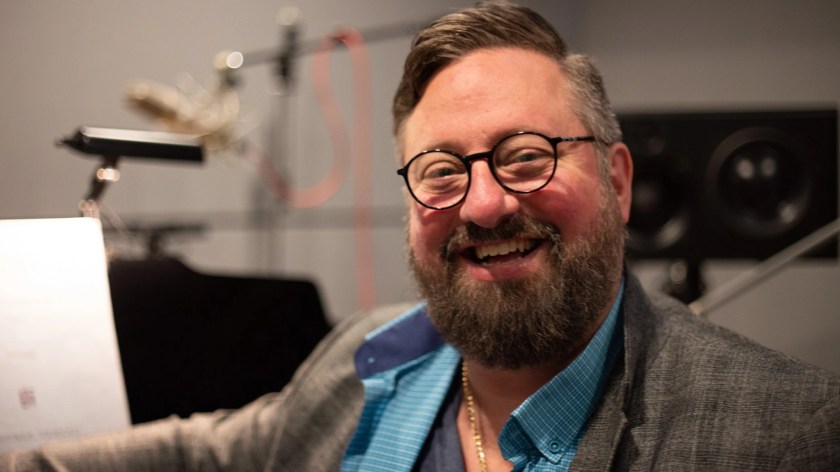
Who or what inspired you to take up composing, and pursue a career in music?
That’s a very easy question to answer, I went to see E.T. back in the 1980’s and was so enthralled, enchanted and moved by the music that I had to find out more. From that point on I was obsessed with the works of the great John Williams. I explored the music of Jerry Goldsmith, James Horner, Bernard Hermann, and the like – I was hooked for life. I managed to see John Williams and Jerry Goldsmith conduct the LSO in the 1990’s which fulfilled a lifelong ambition of mine and was beyond moving for me, cementing the future path of writing music for a living.
Who or what have been the most significant influences on your musical life and career as a composer?
Without a doubt all the aforementioned great composers of our time. After I started work scoring Endeavour for ITV, I had the chance to record classical music for the series. This was a real turning point for me. Imagine getting the chance to conduct and record Mendelsohn’s first violin concerto with some of the world’s finest musicians. I have always been awestruck by the talent in London, but to work, first hand, recording some of the great works of music was another level entirely. Wagner, Mozart, Beethoven, Purcell, Fauré – the list goes one, all for the show. That changed the way I worked – having such intimate experiences with these fine works of art fundamentally changed the way I looked at composing. Setting a new bar – slight panic as well, having to have my own music juxtapose these master pieces.
What have been the greatest challenges/frustrations of your career so far?
I’m sure I’d never work again if I told some of “those” stories! It can be a frustrating job. Conveying individual thoughts over someone’s score can often result in conflicting ideas and directions. When I started composing for TV and film these used to wind me up something chronic, and not being one to hold his tongue, would often vent my frustration upon the individual who had asked me for something to be “happy and sad, with a simple complexity…”. I soon learned that part of the job is interpretation, to perhaps understand more what’s not being said.
The time frame for composing music now has significantly reduced. You must be able to work quicker and harder than ever before, so that brings its own set of challenges to the table. I remember an old Hollywood quote that often springs to mind, “you don’t have to be good, just be quick”. Not entirely correct, as you must be good enough to get the next gig!
What are the special challenges and pleasures of working on film/tv scores?
The obvious one is when there’s the budget to record with a live orchestra in London. It’s an absolute apex of the work when you get that opportunity. You don’t have to slavishly mock up things in the computer, and just write music in score form for performance. It’s like being unshackled when one can compose music like that. Don’t get me wrong, technology is enormously helpful, but does also hold you back in terms of limitations of creativity.
When it comes to challenges, the Monty Python phrase “herding cats” springs to mind. When you’re constantly chasing picture changes. Almost as soon as I’ve composed a music cue to picture, the picture is already out of date. Sadly, most TV series don’t employ a music editor to help, so you’re sometimes chasing your tail!
Of which works are you most proud?
My recent Endeavour Variations album must be the one for me.
To be able to score the music for 26 feature length dramas, then have the freedom and opportunity to arrange them into orchestral suites was a dream. 88 musicians from the London Metropolitans finest in Air Lyndhurst Hall I think was my best musical experience so far. Quite an incredible day. What I loved most was taking the small themes and ideas I’d composed for the telly and fleshing them out into large scale works was both challenging and rewarding. We’re looking to take the album on tour as well, so that’s the cherry on the cake, being able to perform the album live.
How would you characterise your compositional language/musical style?
Harmonic and textured I guess would technically summarise my style. I like to nod to the great orchestral works rather than what’s going on within the industry now. I’ve been working more with extended orchestral techniques recently for my work on GRACE (ITV) and that’s informed my music for other projects I’m working on now.
How do you work? What methods do you use and how do ideas come to you?
That all depends on my schedule. If I have the time, I’ll start at the piano with pencil and paper. Try a few ideas until something takes hold, then develop before moving into the computer. That’s my favourite method of getting going. If time is short, then it’s straight into the box. I don’t think I have one method for composition. My process always stems from the emotional pull of a scene or film. How does it make me feel and how do I want the audience to feel. I often don’t like to get involved before I see a rough cut of something, just so I can feel the immediate emotional response that the audience member may have. Being too informed before composing can get in the way of a gut reaction.
As a musician, what is your definition of success?
That’s a tough one! It must vary from composer to composer, but my personal criteria are if the orchestra or ensemble is impressed after a session. They are the harshest critics out there and helps keep one’s feet on the ground! If you’re working enough to make a living out of music, then that must also define success. It’s a hard career to enter, even harder to maintain it – so, if people are still willing to hire you, success it is.
What advice would you give to young or aspiring composers?
It’s a very different world to when I started back in the 1990’s. So many more people want to do this job and have the technology to help them. I arrived in the industry as an assistant to a professional composer, which I still think is one of the best ways to experience what it’s like to work writing music. There can be no substitute for understanding core music theory, orchestration, and technical constraints of the instruments you’re writing for. All the greats studied these for many years before ever getting a job. Technology can only assist and should be used as such.
If you play, get as much experience sitting the other side of the podium as you can. Play in ensembles, bands, orchestras – doesn’t matter at what level, it’s the experience of what you may one day conduct or produce.
Be easy to work with. I know some great composers who aren’t that busy because of being known as being hard to work with. It’s a collaborators job and at every level it’s about having the ability to communicate with the team you’re working within and, ultimately, to the audience.
What’s the one thing we are we not talking about in the music industry which you really feel we should be?
A.I. [Artificial Intelligence] There seems to be some conversations happening, but I don’t think anything fundamental is being discussed. To quote Michael Crichton “we’re so preoccupied with whether we could, we never stop to consider whether we should.” I guess it’s maybe how fine artists may have felt when photography came into being. In the end, it wasn’t replaced, it formed a new art form. I don’t think the same applies to music though through A.I. Copyright right of how these engines have been fed is something I don’t think is clear yet. Humans interpret, A.I. factualises so I think there’s some concerns around how a machine learns to compose music.
I do hear a lot of worry around this subject, and it’s changing almost daily. Like the greatest works of art in the work, human involvement is mandatory. I can only hope that remains the same in the future.
What next? Where would you like to be in 10 years time?
I would love to be working in the theatre, more live concerts and to continue to be recording regularly with my friends in the LMO.
What is your idea of perfect happiness?
As a dreamer, a life of balance. Calm, peace and community.
What is your most treasured possession?
I have a very old teddy bear that has sat on the side of my cot / bed since I was born. For a 48 year old bear, he looks like he’s had a hard life!
What is your present state of mind?
Always as usual, change the things you can change in life and don’t worry about the things you can’t.
Matthew Slater is an experienced composer and conductor, spanning many styles across feature film, short film and TV dramas alike. Matthew’s diverse skills cross sound design, synths scores right up to the full orchestral and chamber classical approach to composing to picture. His latest work Endeavour Variations is released with the lead track, ‘Dots and Dashes’.
His experience in the industry of film and television spans two decades across a huge variety of styles and genres, with work on ITV’s huge global success ENDEAVOUR, which has garnered him a new platform composing for film and drama. More recently, Matthew has scored for ITV’s dramatization of Peter James’ global success and bestselling novels GRACE, and will continue writing for its fourth series next year.
Discover more from MEET THE ARTIST
Subscribe to get the latest posts sent to your email.
 MEET THE ARTIST