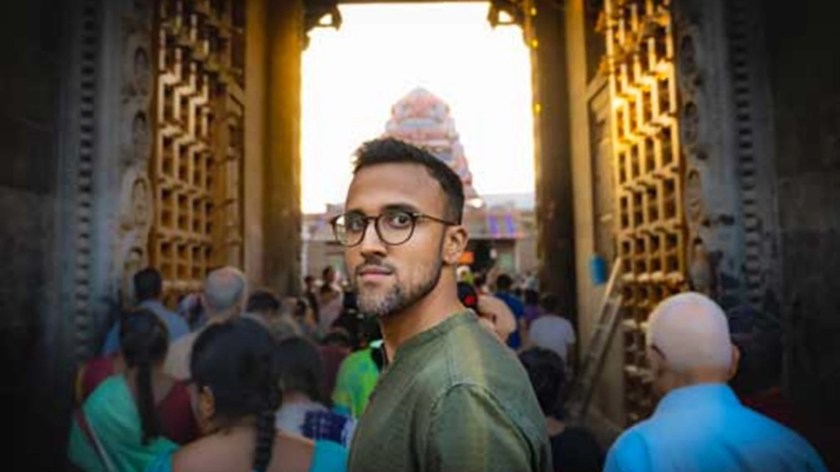
Who or what inspired you to pursue a career in music and who or what have been the most important influences on your musical life and career?
- My mother – She is a prolific Bharatanatyam dancer (South Indian dance form) and one of the first practitioners to start a dance school in California in the 1970’s. I grew up around music and dance and was especially drawn to my mother’s obsession with rhythms, grooves and cross-rhythmic patterns.
- My father – My father gave up his career to help my mom pursue her dream of running her dance school and touring her dance productions. My father took the reins of the day to day work at the school, which freed my mother to focus on her passion. My father also supported both my sister and me in our artistic endeavours and urged us to pursue arts full-time, something rare amongst the South Asian immigrant families at that time.
- My sister – My sister, a leading Bharatanatyam dancer today, is one of the most rigorous, obsessive and hardworking artists I have ever seen. I don’t have the same levels of obsession that she does; but being around her, it did rub off on me in certain ways. Especially her method of working and chiselling her artistic product down into fine detail is something that played a major role in the creation of my new album, ISOLASHUN.
- Pandit Ravi Shankar – I was fortunate to tour with the maestro from the age of 15-17 and his advice to me before I started college was to pursue music full time as a professional. He even recommended skipping college and going all in with my career at the age of 16. He believed in me greatly, maybe more than I did myself. I always assumed music would be a side-hobby. But it was not till I heard the reaffirming words of Ravi-ji that I had the confidence that this WOULD be my career.
To be honest, I never actually decided on music as my career; I think things just happened and fell into place all at the right time. In that sense, I really have not had a choice. Music is all I’ve known.
What have been the greatest challenges of your career so far?
- Consistency in maintaining the same intensity in whatever I do.
- Being able to switch gears from completely different artistic projects, whether it’s composing for a dance production to then producing my own solo project, to then touring with my band – they are all completely different mindsets with different approaches, and to be able to move dynamically and freely between all of them is very difficult.
- Being an artist in a capitalistic world; being a brand that sells. This is not something that draws me into my music – it actually pulls me away. But it is what is needed in today’s artistic landscape if one wants to be able to share their art with others. I enjoy and love making my music – but what is the point if it just stays on my laptop, in my room, in my home and in my mind? I want to share with others the joy, love and intensity that creating music gives me.
Which performances/recordings are you most proud of?
I am proud of every album I have out there. Are there things I would do differently now? Yes, absolutely! But given the place I was in musically and personally when I created and released those works, I am very happy with all of them. For me, recordings and performances of the past don’t stay glorified in my mind too much – I move on to what is happening now and that is what is most exciting and makes me most proud. Once that is finished, I am on to the next!
Which particular works/composers do you think you perform best?
I think improvisation is my biggest strength (only when I am in the state of flow). Flow improv allows me to be in the present and brings out the best in the abilities my voice has at that moment. Because the voice changes from day to day based on mood, rest and diet, one composition may sound great one day and not so great the next, but adaptive improvisation will fit the mould of what is needed in that moment.
What do you do off stage that provides inspiration on stage?
My morning chai or coffee routine provides me great calm and joy and sets my day right. Anything that keeps me in a state of calm and relaxation provides the best inspiration. I love and appreciate silence before I get on stage, although it is usually hard to get!
How do you make your repertoire choices from season to season?
My repertoire is really based on my mood and how I am feeling. That is the benefit of being an independent musician I guess. However, sometimes I am part of a touring production, where I don’t get to “choose” my repertoire.
Do you have a favourite concert venue to perform in and why?
Blue Whale jazz club in Los Angeles has been my favorite concert venue for over a decade. Unfortunately, it had to close down during the pandemic. Other venues I really enjoy are Chicago World Music Festival’s series in Chicago Cultural Center, and Samueli Theater at Segerstrom Center.
What do you feel needs to be done to grow classical music’s audiences?
I come from the Indian “classical” music world. And unfortunately those audiences are staying within the same community. Some ways to help grow it are by bringing it to spaces that are not commonly thought of as “classical” venues. The risk is it may not be invited there, which is a risk we have to take. Also, maybe a change in the way the education system of classical arts will do some good and broaden who will take an interest in learning and eventually performing it, which in turn will also grow the audience. There is no short term fix I can think of.
What is your most memorable concert experience?
Hard to say now… Off the top of my head – The first live concert with my crossover genre band, Aditya Prakash Ensemble at Blue Whale in 2012 and the first live concert with an audience during the period of the pandemic – which happened at Segerstrom Center in 2021.
As a musician, what is your definition of success?
Being honest and true to your Self and in the moment with your art.
What’s the one thing in the music industry we’re not talking about which you think we should be?
Acknowledging some of the social inequities in the “classical” world that end up homogenizing who is performing and who is consuming the art. This is perhaps why largely we see the same or similar community at concerts.
What advice would you give to young/aspiring musicians?
Practice, practice, practice. Listen to a lot of music. Go deep and be obsessive. Be kind but also be firm with yourself.
Aditya Prakash’s debut solo album, ‘ISOLASHUN’, is released on 13 October 2023 with New Amsterdam Records
Aditya Prakash is an award-winning Indian classical vocalist and composer, best known for his powerful and emotive voice. Although firmly rooted in South Indian classical (Carnatic) music, which he studied under venerated Gurus in Chennai, his style is heavily inspired by North Indian classical music, Suf music, jazz, and hip hop, which he brings out in his collaborative cross-over genre projects.
Discover more from MEET THE ARTIST
Subscribe to get the latest posts sent to your email.
 MEET THE ARTIST