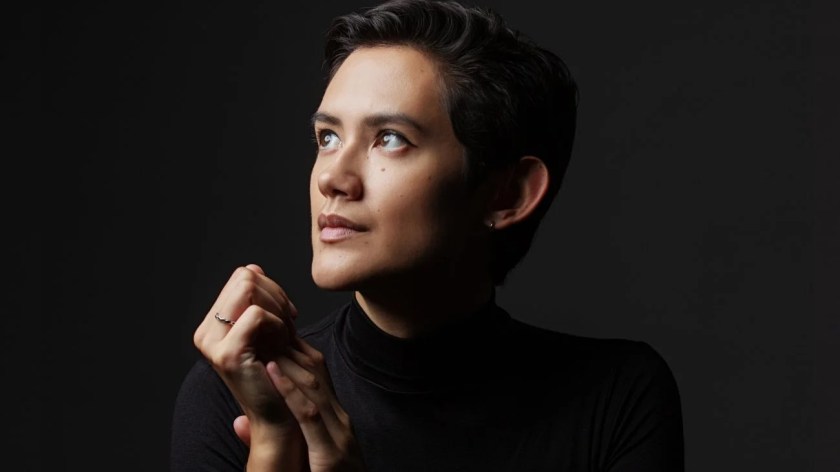
Who or what inspired you to take up conducting and pursue a career in music?
My love of opera was the main reason I not only became a conductor but also chose to pursue a career in music. A strongly held resistance to becoming a musician slowly dissipated when I was a teenager as I started skipping school to watch rehearsals of Billy Budd, Death in Venice and Der Rosenkavalier at the English National Opera. Parallel to this, I have to admit that my new-found passion developed at a time when I was also becoming a better violinist and therefore started playing in high-level youth ensembles such as the Barbican Young Orchestra and the National Youth Orchestra, two experiences that were a marked advancement from previous musical experiences, so I’d say the combination of the two definitely helped me consider music as a viable career path as opposed to just a serious hobby.
Who or what are the most significant influences on your musical life?
Growing up in a family that was not involved in classical music, my main influences (or idols even!) were artists like Tina Turner, Neil Diamond (I saw both live) and David Bowie. Nowadays, as a professional musician, I find myself seeking to be motivated or challenged rather than inspired. Artists that come to mind are the director Peter Sellars (after watching him work on the St John Passion and Oedipus Rex), conductors Stéphane Denève (my mentor during my time with the St Louis Symphony Orchestra) and Hannu Lintu, and certain orchestral musicians I have developed a close connection to over the years. People aside, I find that what drives and inspires me most is the idea that one can forever develop and deepen their connection to music; it truly is a lifelong pursuit.
What, for you, is the most challenging part of being a conductor? And the most fulfilling?
Ask any conductor and I think they will all mostly agree that our peripatetic, nomadic lifestyle can be quite challenging. I relish the stretches of time when I can stay in the same place for more than a week! However, this goes hand in hand with the opportunity to see and sometimes work with my friends, many of whom live around the world so that’s a very fulfilling aspect of the job.
As a conductor, how do you communicate your ideas about a work to the orchestra?
I truly believe that the act of communicating one’s ideas starts with building and strengthening your own interpretation of the work. If you are passionate and clear as to what you want, ease of communication will follow.
How exactly do you see your role? Inspiring the players/singers? Conveying the vision of the composer?
I recently re-visited Harold Schonberg’s book ‘The Great Conductors’ and it was interesting, even comical, to see how the role of the conductor has evolved over the last few hundred years; from just keeping time with a big, gilded staff as Lully would have done, through to the occasional wave of a bow or rolled up piece of manuscript paper, or even to the 1800s when it was normal for a conductor to stop beating for long stretches of time when one assumed things were going ‘well’. The emergence of the composerconductor as seen with Beethoven, Weber, Berlioz, Wagner and then of course Mahler did much to change the role of the conductor, as well as those who decided to forgo composition altogether and become mere ‘interpreters’. All of this to say that the role of the conductor has developed into something so varied it’s hard to know what is most important, whether that be simply beating time or inspiring those around us. However, there is no doubt that conducting has developed around three main poles: the musicians, the score and the audience. I try to always have these in mind when conducting and to draw something out of each.
Is there one work which you would love to conduct?
Only one? There are so many! The two operas I would most like to conduct would have to be Parsifal due to my love of Wagner and Britten’s Death in Venice because it is too seldomly performed. I recently dove into the score for the Rite of Spring and have a strong desire to conduct it one day. It seems like such a milestone work for all involved and I love how all orchestral musicians remember their first Rite of Spring.
Do you have a favourite concert venue to perform in?
There are a couple, and for various reasons. My favourite London concert hall has always been the Barbican (the building itself can be like Marmite but I absolutely love it), although I have only ever performed there as a violinist! I love how intimate it feels both onstage and as an audience member and look forward to conducting there one day. I recently conducted at the Palais Garnier in Paris and, it being such an iconic venue, I have to include it here as my choice for opera. Finally, a venue that will always hold a special place in my heart is the Chapel at St John’s College Cambridge; I have so many happy memories of playing, singing and conducting there as an undergraduate.
What do you do off stage that provides inspiration on stage?
The one thing that is just as important as inspiration is presence of mind and I hope I achieve that by staying active and running long distances which also helps with jet lag. However, in terms of inspiration, coming from a family that encouraged me to pursue many different activities, it’s not uncommon for me to find inspiration outside of classical music like in the visual arts, literature or even other types of music such as jazz (bebop specifically!). For me, classical music is engrained in daily life and our surroundings, so why sever it completely from other artistic media?
What do you feel needs to be done to grow classical music audiences?
More attention to arts education in general; the earlier people are exposed to it the better! It’s not about raising a generation of artists, but about helping people enjoy and actively seek out spaces where art can be shared, whether it be a gallery, cinema or concert hall.
As a musician, what is your definition of success?
Success is helping to solidify the legacy of your art form (which is very different from one’s own legacy!) and bring classical music and the arts to as many people as possible.
What advice would you give to young or aspiring conductors/musicians?
It takes a lot of time and effort to do things outside of music but it’s a must.
What’s the one thing we’re not talking about in the music industry which you feel we should be?
Two things: firstly, the way arts organisations are managed and secondly, the emotional and physical toll that locking yourself up to practise 4+ hours a day has on young musicians.
Where would you like to be in 10 years’ time?
Making music with talented colleagues and playing a very active role in changing the way we approach arts education.
What is your idea of perfect happiness?
A long hike with friends or cooking with a Nina Simone live album in the background.
What is your most treasured possession?
My health. Cheesy, yes, but I’m told it’s important.
What is your present state of mind?
Grateful.
Franco-British conductor Stephanie Childress returns to Glyndebourne to conduct Don Giovanni, from 12 November to 2 December. Find out more
(Artist image: Harrison Parrott)
Discover more from MEET THE ARTIST
Subscribe to get the latest posts sent to your email.
 MEET THE ARTIST