What have been the greatest challenges of your career so far?
I think, as for many emerging musicians and music makers, there are some practical challenges at first; it’s all about finding the time and resources to do the projects that you want to do, the ones which will help you grow artistically, and the ones that will help you pay rent! Another, more pleasant, challenge is finding your own artistic voice and your community within the community, the kind of people you want to work with.
What are the special challenges/pleasures of working on a commissioned piece?
If a piece is commissioned, it depends on how I get on with the brief. There have been times when the brief was too specific, and I felt like I didn’t have enough freedom. Other times, the brief was such that it made some decisions for me, but also gave me enough space to do what I want to do. Having a strict deadline is also quite helpful for me, so I consider it a perk compared to working on a project you have set up yourself.
What are the special challenges/pleasures of working with particular musicians, singers, ensembles or orchestras?
I love writing for soloists and smaller ensembles, because it’s easier to collaborate with them in a substantial way. The most exciting part of the creative process for me is when you work through sketches with instrumentalists. I ideally prefer giving them creative agency and getting them involved from the early stages of the writing process when the concept for the piece is being born. Unfortunately, this is not always practically possible. This is also the downside of working with orchestras; the rehearsal time is so limited that you just about have time to put the piece together. There is no space for experimentation or true communication with the players individually. On the other hand, nothing beats the excitement of listening to a whole symphonic orchestra bring your sounds into life.
Of which works are you most proud?
I am quite proud of Antigone, which was nominated for an Ivors Classical Award this year. It means a lot to me as a piece because it was the first one when I finished my studies at the RNCM, so I wrote it almost completely without any guidance. I also really enjoyed the “research” process for this piece; I was quite methodical with planning it. I did a lot of reading of and around the Antigone play and listened to a lot of great music for voice and orchestra. My parents were also quite helpful; they both teach ancient Greek in schools, so I had a lot of questions for them regarding the text. Working with a text as powerful as Sophocles’ was very special; reading some of the lines sends chills down my spine every time! It is incredible how a 2,500-year-old text can resonate with you emotionally.
Another piece I’m proud of is a piece called “unedited”, which I wrote last year for Trio Estatico, an amazing viola trio consisting of extraordinary players (Megumi Kasakawa from Ensemble Modern, Jack Stulz from Ensemble Intercontemporain, and Paul Beckett from Klangforum Wien). The end of this piece features a track of my own voice monologuing. I really wanted to try using my voice in a piece but felt quite scared and vulnerable. So, I am mainly proud that I went for it despite of that feeling. I hadn’t done anything like that before, and now I’d like to experiment more with adding extra-musical elements in my work in the future. The recording of the piece will be released on YouTube, in the next two months.
How do you work?
I always start with a lot of thinking, and I write down notes and ideas in my notebook. I will then probably listen/watch/read things that might give me some kind of input or impetus for the specific work. I used to get quite frustrated at myself because this phase always lasts long, sometimes longer than the actual writing. I’ve come to realise that this is not procrastination, it’s just my process! So now that I’ve embraced it I really enjoy this.
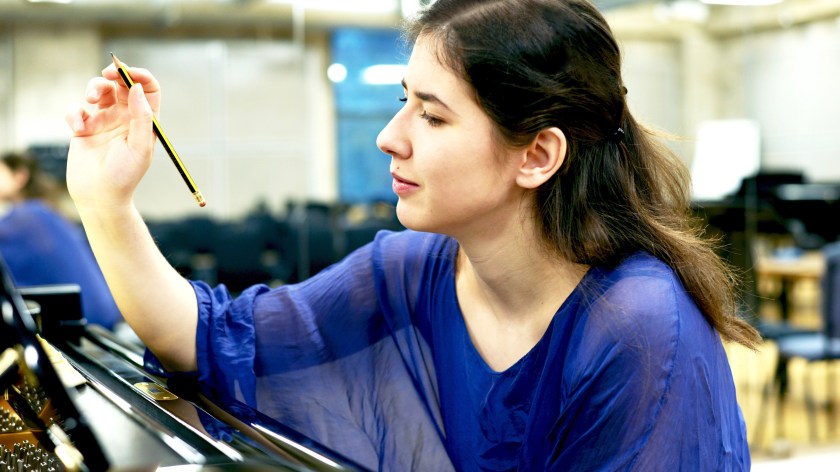
Then I start sketching, always on paper and at the piano. I can be quite specific about the pitches I use so I can sound quite annoying trying different chords on the piano. I sometimes improvise to get ideas. When the piece has a somewhat finished form, I typeset it and keep working on it until I’m happy or until it’s deadline time.
As a musician, what is your definition of success?
Success is such a loaded, anxiety-inducing word for everyone, I feel. I went through some loss and personal hardship recently, and it has really given me perspective and made me reconsider what this word means. So right now, I think of a successful life as one with health, safety, and people around you who love and support you. If that’s a cliché, it is for a good reason. In terms of professional life, making music as a job is enough of a privilege, and as long as one can have a decent quality of life, they are successful in my eyes.
What next – where would you like to be in 10 years?
Next: more music! I don’t mind where I am in 10 years, I’d probably like to stay in Europe, though.
What is your most treasured possession?
My reusable water bottle, I carry it everywhere I go. Also, my wireless headphones.
What do you enjoy doing most?
These days, I quite enjoy sleeping. Cooking and sketching music aren’t bad either.
What is your present state of mind?
I am not going to lie; my mind is anxious right now. It’s hardly a surprise given how crazy the world is. Thank goodness for yoga, meditation, therapy, music, friends, and family!
Athanasia Kontou is nominated for an Ivors Classical Award in the Best Large Ensemble Composition category for ‘Antigone: pure in her crime’. The Awards ceremony takes place on 14th November at BFI Southbank.
Discover more from MEET THE ARTIST
Subscribe to get the latest posts sent to your email.
 MEET THE ARTIST