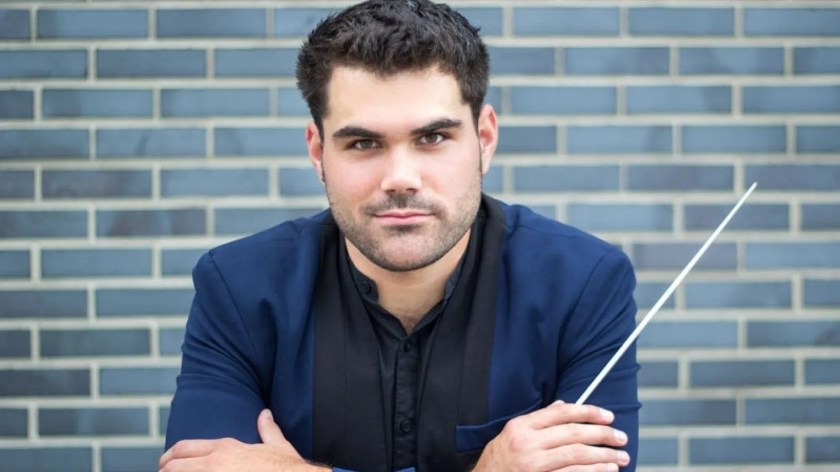
Who or what inspired you to take up conducting and pursue a career in music?
In high school I studied trumpet with Ramon Parcells, who was principal trumpet of the Detroit Symphony Orchestra. At one point in my lessons, he was asking me several questions about the piece at hand, and then stated I had the mind of a conductor. He encouraged me to continue mastering trumpet as well as studying conducting, piano, theory, etc. I was lucky to have such amazing teachers all through my studies.
Who or what are the most significant influences on your musical life?
The first conductor I came to revere was Herbert von Karajan. I had all of his Deutsche Grammophon recordings of the Beethoven Symphonies by the time I was seventeen. His ability to conduct everything from memory and with such conviction gave me a glimpse into the world of conducting. He exemplified mastery, and this inspired me. As I grew into my musicianship and discovered my love for contemporary music, Pierre Boulez would come to be one of the strongest influences in my musical life. His utmost integrity with the score and his ability to communicate so much with so little motion gave me a higher goal to reach for. His ability to balance and tune all of the sounds in the orchestra to make the ideal timbre remains to this day a miracle to me. I have since conducted several of his compositions. I love all types of music, and some other major influences from other genres would be Céline Dion, Miles Davis, Bob Dylan, and Elton John.
What, for you, is the most challenging part of being a conductor? And the most fulfilling?
The most challenging part of being a conductor for me is the process of learning a piece deeply, and finding an interpretation in which I can believe wholeheartedly. I’m searching for a deep, deep inner conviction about what the composer was trying to express, and in order to reach that conclusion, I must wrestle the piece to the ground and interrogate it. Like all artists, I have a strong instinct within me, but I am not satisfied unless I am able to prove that my personal taste and instinct is truly what is best for the music.
The most fulfilling part is working directly with the orchestra. I love people just as much as I love music, and so feeling the connection to the orchestra is really the most joyful experience. I am constantly learning from my colleagues playing in the orchestra and the collaborative process of bringing a performance to the public is what is most fulfilling.
As a conductor, how do you communicate your ideas about a work to the orchestra?
I aim to communicate as non-verbally as possible, with my body, my gestures. I think it was Maestro Kurt Masur who said, “If you tell them to play forte, they will do it with their minds. If you show them your forte, they will do it with their hearts,” and I believe this to be quite true. Sometimes you must speak and explain a detail in the score or answer a technical question, but my favourite ways to communicate are through my gestures, my eyes, and also through singing. I sing every note of my scores before I arrive at the podium so I am able to sing musical ideas to the orchestra if needed. I am always reminded that people came to rehearsal to make music, not to listen to the conductor talk.
How exactly do you see your role? Inspiring the players/singers? Conveying the vision of the composer?
I abide by an adage by the late great Maestro Bernard Haitink, “Your most important role is to give the musicians confidence.” This idea has been on my mind for years now, and recently it has really proven to be true. It doesn’t imply that the musicians are not confident in their abilities or they “need you” to play well. No – but in order for the orchestra to be completely unified in their exact approach to the spirit of the music at any given point, added conviction can clarify any doubts. The rehearsal process allows us to find answers to the many questions that any given piece poses. Once we have found our answers, in the performance, the added level of intensity and detail comes from the confidence that the conductor can hopefully provide the orchestra. Spontaneous music making can only exist when the trust between the orchestra and the conductor is very high.
Is there one work which you would love to conduct?
John Adam’s opera Doctor Atomic, Ravel’s complete Daphnis et Chloé, and Thomas Adés Dante
Do you have a favourite concert venue to perform in?
Seiji Ozawa Hall at Tanglewood Music Center
What do you do off stage that provides inspiration on stage?
I am very active and enjoy exercising, particularly weight lifting. I think that all forms of exercise help one be more aware of their bodies – but more importantly, channelling energy through one’s body on demand. Conducting is very much the same kind of energy channelling.
What do you feel needs to be done to grow classical music audiences?
Better access to high quality music education at younger ages. Growing up, I always had access to music classes through my public school. In grades K-5 I had music class multiple times per week, and then every day 6-12. I was really fortunate, because many music programs are being cut or defunded throughout the country. If the schools treated music as a core subject, with twenty to thirty minutes in school each day, students could read music fluently by the time they were leaving elementary school. Hands-on connection to the art form builds the strongest life-long patronage, but I also think that the classical music industry needs to find a way to deal with the preciousness that is often associated with it, and to lean into how music of any genre can help people cope with their day to day lives.
As a musician, what is your definition of success?My personal definition has a few layers. In simple terms, I want to consistently make music I believe in with orchestras and musicians at a very high level, and to spread joy and deep artistic experiences to the public. As an American, I am very interested in building my rather young country’s cultural heritage by working closely with American composers and other constituents to highlight all of the great work that is being done here, while funding more and more! I would also love to be an advocate for anyone who comes from a lower socio-economic background, like myself, who wants to pursue a career in classical music. I hope to start a foundation which would do just that. Success on stage means nothing to me unless I can give back.
What advice would you give to young or aspiring conductors/musicians?
Work hard. Be curious. Be brave. Talk to people in the industry who are where you want to be. Reach out to them. Ask them questions. Plan your own projects. Find a way. Ask for help.
What’s the one thing we’re not talking about in the music industry which you feel we should be?
There are so many but one that comes to mind is organisations publicly acknowledging that the path of any musician is a demanding one, which often comes at a great sacrifice to the artist. I can’t think of any conductor, soloist, orchestra member or professor who didn’t have to give up quite a lot to “make it”. Rather than simply glorifying the prestige of being in this industry, we should acknowledge that everyone is a human being first, and that we have limits. The deep humanity that we wish to express in music ironically doesn’t often get discussed when it comes to the physical and mental health of the artists actually performing. It’s a beautiful life, this one, but it doesn’t come for free.
What is your idea of perfect happiness?
Coming home right after conducting a terrific concert with my husband Kurt Tseng, to our two dogs, Bennie and Chipper. Glass of wine and perhaps a fireplace.
Kevin Fitzgerald is winner of the Special Prize for Best Performance of the Contemporary Piece, 2023 Mahler Competition
Discover more from MEET THE ARTIST
Subscribe to get the latest posts sent to your email.
 MEET THE ARTIST