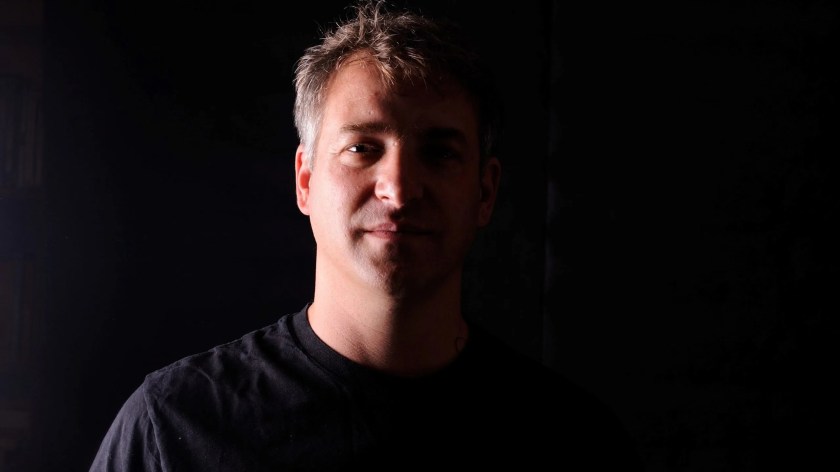
Who or what are the most significant influences on your musical life and career as a composer?
Some of the most signifiant – and certainly the most interesting – influences I find often come, surprisingly, from non-musical sources. For example, when I attended an exhibition of paintings by Caravaggio a few years ago I had no idea that this would inspire me to write a big dramatic piece for chorus, soloists and orchestra. There was so much in all the paintings to suggest dramatic musical works and seeing his painting of The Denial of St Peter immediately made me realise that Passion Fragment was a piece that simply had to be written. Moreover, this also put me on a path towards writing other pieces of this kind such as its sister piece Exodus Fragment (The Parting of the Waves) eventually culminating with Creation which we performed for the first time earlier this year. I discussed this very subject – at some length! – with with Verity Simmons and Seb Phillpott in the “3 in a Bar” : https://podcasts.apple.com/gb/podcast/94-jacques-cohen/id1506487316?i=1000598576914
What have been the greatest challenges of your career so far?
I find that each piece I write has it own new exciting challenges.
In day-to-day practical terms, however, the greatest challenge for me has always been balancing the composing with my other job as a conductor. It was very hard at first to earn a living as a composer and also find the time to do it whilst preparing difficult scores and all the complications that conducting involves. It is only in the last few years that I feel I have begun to get the hang of this. This is helped by getting more proficient at learning scores as a conductor on the one hand, and developing a more proficient compositional technique on the other. ( I tend to feel I am a relatively late developer.) But it is still very difficult – especially since I have only limited control of the number of concerts I have to conduct and what commissions I get. It is also not always easy to get the right balance between responding to commissions and working on pieces that I write just for me.
What are the special challenges/pleasures of working on a commissioned piece?
There is the obvious challenge of meeting a deadline – I have not missed one yet and do not ever intend to. In a way it is easier because some of the difficult decisions are made for you with regard to the parameters of the piece. It also gives your confidence a boost when you know someone is genuinely excited about getting a piece from you.
What are the special challenges/pleasures of working with particular musicians, singers, ensembles or orchestras?
I love working with other musicians both as a performer and as a composer. It is one of the great joys of life. We learn from each other and by working together we improve each other as well as the quality of the music we are able to make together. As all my students know, knowing your instruments and working with your colleague musicians is as fundamental as knowing your scales so you always make sure your music is practical. At the same time the best musicians love to be challenged.
I have been very lucky to work with some fabulous musicians. I have worked a lot for example with the soprano Marie Vassiliou, whose recording of my chamber opera The Lady of Satis House is released by Meridian in February 2024. I wrote this piece for her voice which I have got to know especially well over the years.
Another singer in a similar position is the alto Mae Heydorn who is sang the solo part in “Creation”. She played Akachi in my “Exodus Fragment – the Parting of the Waves” and she sang that part, also written for her voice, so beautifully.
And of course I love working with my friends the musicians in the Cohen Ensemble led by Susanne Stanzeleit with whom I have collaborated so many times. She is such a great musician. “Yigdal” is an example of this and of course “For Angel” which I wrote to commemorate our friend the wonderful David Angel.
Of which works are you most proud?
The next one! I believe I have developed relatively late as a composer and always feel that the latest work is the best. The 2 big orchestral pieces I completed during the lock down in 2020 “Ein Sternenzelt” and “Proteus” are certainly among the best things I have written so far as well my “Creation” oratorio which I am conducting for the first time later this month. You can see an interview on this here: https://www.youtube.com/watch?v=-LMNP0O4YKw
I would also like to make a special mention of my song cycle for soprano and strings “Love Journeys”.
How would you characterise your compositional language?
My goodness, that’s a difficult question to answer! This is partly because the language we have to describe anything aural especially music is so limited and partly because how I characterise it is bound to be different from other people’s. But I can see that answering this might be helpful to someone interested in getting to know my music – so I will give it a go:
I tend to divide composers into perfectionists and communicators. These are not mutually exclusive terms of course. Indeed it is hard to think of anyone who is just one or the other. But most composers I believe tend to lean more towards one or the other. Webern on the one hand obviously wanted to communicate something but he was primarily concerned with perfection. I am sure that Britten or Schubert on the other hand, wanted their works to be as perfect as possible but I believe they were primarily concerned with communicating something, a feeling, a thought, as anyone who writes songs, opera or programme music is bound to be.
Because my music tends to be (and when I use this word I include both vocal and instrumental music) programmatic (or sounds like it ought to be even when officially it isn’t) I would probably put myself more in the latter category. It therefore follows that in order to communicate a wide spectrum of (for want of a better word) feeling, I want to take advantage of the full harmonic spectrum. There are some composers who avoid any major triads on the one hand, or any clusters on the other, whereas I embrace both. My harmonies can be very complex and chromatic but I also love simple major and minor chords. \i also love melody. I remember a conversation with a very good composer friend who said he was always looking for new harmonies. I pointed out that the Vaughan Williams Tallis Fantasia only uses major and minor chords (mostly in root position) yet no other piece sounds like it written before or since. I also am a big fan of polytonality (surprisingly underused it seems to me) and using a very wide variety of modes.
How do you work?
Hard!
As a musician, what is your definition of success?
I talked earlier about perfection and communication. When I have got a piece as good as I feel I can get it and somebody, whether a stranger or someone I know, says something that shows that they understood, appreciated and, most importantly, felt what I was saying – then I feel that the piece has succeeded.
What advice would you give to young/aspiring composers?
I do a day each week working with young composers at the Purcell school so it is hard to summarise what I have said to them over the last few years in a sentence! But one of the most important things I tell them is that there as many ways to be a composer as there are composers. So our job is to find out what kind of composer we are meant be, and be that!
What do you feel needs to be done to grow classical music’s audiences?
More in schools. More emphasis on listening. Every young person needs to know these great pieces. A great piece is not just for musicians just as a great novel is not just for writers.
What’s the one thing in the music industry we’re not talking about but you think we should be?
The quality of the actual music rather than the superficial nonsense surrounding it.
What do you enjoy doing most?
Making music and having fun with Michelle (not necessarily in that order!)
What is your present state of mind?
Fluid.
The Lady of Satis House is released by Meridian on 23 February 2023. An operatic monodrama written for the Tête à Tête Opera Festival in 2012, it features Marie Vassiliou as Miss Havisham and the Tippett Quartet. The album also includes some smaller works which share a similar atmosphere – a set of three slightly eerie lullabies and a short tone poem about Stradivarius instruments trapped in glass cabinets.
Discover more from MEET THE ARTIST
Subscribe to get the latest posts sent to your email.
 MEET THE ARTIST