Who or what inspired you to pursue a career in music?
I didn’t really grow up thinking that making a career out of music was possible for someone like me. I assumed you had to be a classical musician or a pop star!
I started playing at local benefit concerts when I was about 12 years old – to raise money for the church roof or whatever – and then started getting booked to play at folk clubs. Then someone suggested that I try doing music full-time, so after I’d finished my A levels I gave it a try… it was a struggle to start off with, but I persevered!
Who or what have been the most significant influences on your musical life and career?
I grew up surrounded by traditional folk music: my father sang local songs, Mum played the concertina, my granddad played the fiddle, the accordion and the organ in church. A musician has real importance in those isolated rural communities: people who can turn an evening into a dance with just one accordion or fiddle, who can make an event special. One significant figure was a piccolo player called Billy Ballantine. My grandad took me to see him when I was about ten years old and I sat and listened to his every note and tried to play exactly like him. He had a really bubbly, bouncing style; he was such a character, he used to warm up his whistle with various forms of alchohol! For my first public performance (at the Wark Old People’s Christmas Dinner) I played one of Billy’s tunes ‘Bonny North Tyne’.
There were other traditional shepherd musicians like Willie Taylor, Dick Moscrop and Will Atkinson that I learnt such a lot from too. They all were a big part of the soundtrack to my childhood.
Later I was influenced by the work of Simon Jeffes and The Penguin Café Orchestra. In the years since Simon died I have often found myself thinking of what he might do, and my memories of him continue to give me confidence to try new things.
I listen to a wide range of music and have found inspiration in Percy Grainger’s folk song arrangements, as well as various roots traditions from around the world.
What have been the greatest challenges of your career so far?
I play an instrument with no dynamic range and a specific range of notes. The Northumbrian pipes also use a constant drone, which roots the player in one particular scale or mode. Many people might see those things as limitations, but actually I find that the challenge is what pushes me onwards. When you have no way of playing louder or quieter you really have to think deeply about phrasing, ornamentation, vibrato etc which can all help to create the illusion, and the emotional effect of dynamics.
When I have worked with classical composers they have certainly found the constant drone to be a challenge, but again I relish the tension and release of how the notes work against the drone – the push and the pull of it all.
Of which performances/recordings are you most proud?
I always like whichever music/album I am in the middle of composing/ recording/playing right now! But at a deeper level I just want my music to connect with people. I want them to feel something…for the music to reach straight into their hearts.
So I guess that means that I don’t always know whether or not that’s happening unless people tell me (although sometimes there’s something that happens in a performance and you just know that you’ve tapped into that….I don’t know how to explain it…that other dimension) And I also play lots of very up-tempo pieces, so if I can make people want to dance and send them home happy then I’m proud to feel that my music has done its job!
What do you do offstage that provides inspiration on stage?
Being in Northumberland, up on the hills, by the coast, along Hadrian’s Wall…all those places give me so much inspiration.
As a musician, what is your definition of success?
Being able to do the music you want to do, the way you want to do it (and still being able to make a living)
What advice would you give to young or aspiring musicians?
Practice a LOT while you’re young…that technical mastery will stand you in good stead!
Also – listen to lots of different types and genres of music. You might find a glimmer of something that might go on to inform or inspire your interpretation of your own music.
What’s the one thing we’re not talking about in the music industry which you really feel we should be?
Well this IS talked about…but not much seems to be happening… The way that (unless you’re in a salaried orchestra or similar) all your earning streams as a musician are being reduced or removed. Online streaming/Spotify etc etc mean that your music is available for free, so why would people buy a cd? (If they even have a cd player) Touring is also bringing in less money – all the costs have shot up over the last decade or so, but fees have absolutely not done the same. I could rant on and on about how difficult it is for self-employed musicians these days, but I’d only make myself angry…and it would be a very depressing read…
What next? Where would you like to be in 10 years time?
To be honest, I am very happy playing the music I love with my band – we get on really well and that makes the worst parts of touring (the long distances in the van, or waiting in airports in the early hours) much more fun. Ideally I’d continue to play with, and develop, the band. I’d also want to do a few ‘side’ projects – I always have lots of (too many!) ideas of interesting things I’d like to do.
What is your idea of perfect happiness?
Earlier this year I was in Canada with my band and it was an absolute blast! The sun shone, the gigs and festivals were great, the music was very well-received and we couldn’t have had a better time.
What is your most treasured possession?
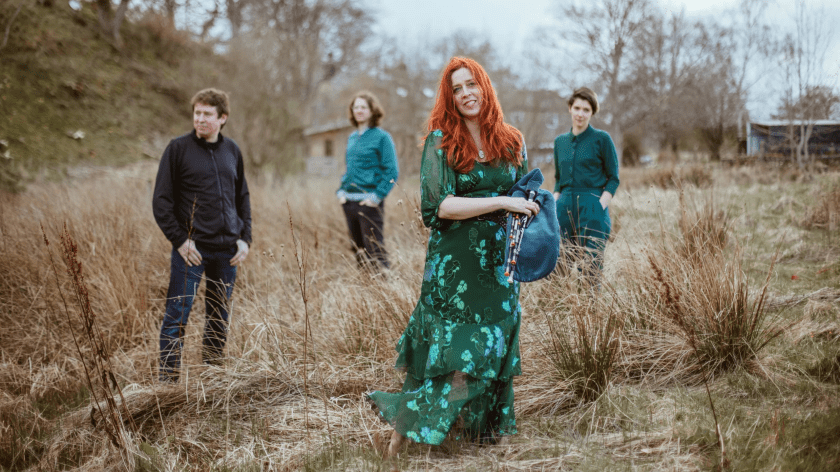
My pipes! Northumbrian smallpipes made by Mike Nelson and gifted to me on my 21st birthday
Northumbrian musician Kathryn Tickell has composed a poignant piece of music to mark the one-year anniversary of the felling of the iconic Sycamore Gap tree. The tree, a symbol of the Northumbrian landscape, was cut down in a shocking act of vandalism last year, leaving a deep void in the hearts of many in the region and beyond.
Kathryn Tickell, a celebrated figure in the Northumbrian music scene, was deeply moved by the event. “It all started nearly a year ago when I woke up to an avalanche of messages. The news of the Sycamore Gap tree being cut down had spread like wildfire, and everyone was in shock,” she said. “People started asking me if I was going to write a tune for the tree, and I realised that this was something I could do to honour its memory.”
Discover more from MEET THE ARTIST
Subscribe to get the latest posts sent to your email.
 MEET THE ARTIST