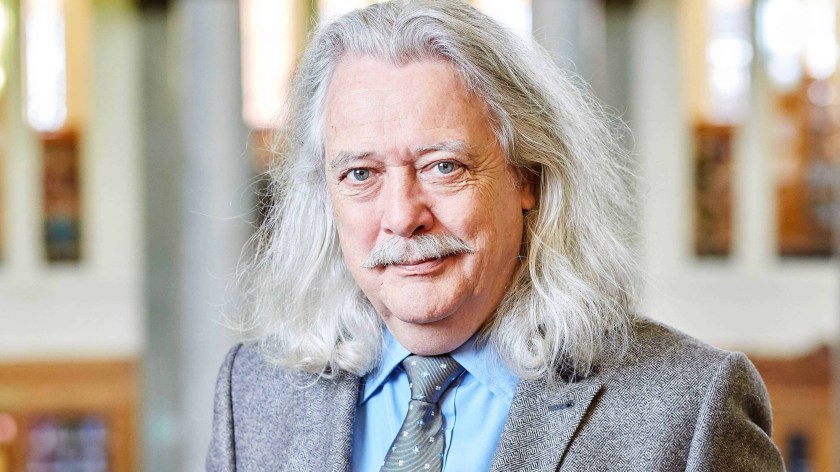
Who or what are the most significant influences on your musical life and career as a composer?
I was born in Edgbaston, Birmingham, in 1950 and came to music largely through the encouragement of my maternal grandmother, who was a pianist. Her grand-uncle, George Hope Johnstone, a friend of Edward Elgar, had been influential in the musical life of Birmingham as Chairman of the Midlands Institute and the Triennial Music Festival (one of his first commissions was Elgar’s Dream of Gerontius). I studied for a higher degree in composition at the University of Hull (1972–74) with Anthony Hedges, one of the UK’s leading composers of light music.
My first urge to compose music arose after I joined a rock group in my teenage years. Although I was later classically trained, I continued to be involved with popular music. For example, in the early 1980s, I presented two series of radio shows on Victorian ballads as a singer and pianist. Given my love of performing popular music, it’s no surprise to learn that, in my compositions, I wanted to mix techniques from both classical and popular genres.
What have been the greatest challenges of your career so far?
During my early career in Hull, there were no ensembles promoting contemporary music, so I and a friend co-founded chamber orchestra, Kanon, and I conducted performances in Hull and nearby cities such as Lincoln and Scunthorpe. In the 1970s, I was awarded three national prizes for my compositions, but began to feel pressured by a dominant expectation that ‘good’ music needed to have a modernist character. As the 1980s began, I chose to sail against the wind, and composed Wilberforce, an operetta in a popular style that explored a political subject. It was staged in 1983 as part of Hull’s sesquicentenary commemoration of the passing of William Wilberforce’s Act for the Abolition of the Slave Trade (1807). I sold my Norton Dominator motorcycle to help fund the production, but I was rewarded by an enthusiastic audience reaction during its week of performances. Yet, despite this and some other successes, I began to experience further doubts about the direction and purpose of my composing. I continued to be involved in performance, playing keyboards and singing with two dance bands and, then, in 1985 performing in London as a principal character in a jazz opera, Prez, based on the life of saxophonist Lester Young. During this period, my continued questioning of the social and cultural role that composers should play led to my absorption in the cultural history of music and, in 1992, I was awarded a PhD in the sociology and aesthetics of music.
I continued to write orchestral music, but it was usually driven solely by a personal compulsion, and, in 1990, having been appointed to an academic post, the demands of my musical historical research rarely allowed much time for composition. My first appointment as a Professor of Music was at the University of Salford in 1996 and, in 2006, I became Professor of Critical Musicology at the University of Leeds. There, I found myself under considerable pressure to produce musicological publications for submission to the research-assessment exercises, which have a big effect on the funding universities receive from the government. I was only at liberty to spend long hours on composition after my official retirement in September 2020.
What are the special challenges/pleasures of working on a commissioned piece?
The biggest challenges a composer faces often relate to requirements specified by a commissioner. For instance, I was asked to write a companion piece for Saint-Saëns’s Carnival of the Animals. It was to be performed in the same concert and was to be for exactly the same instruments. This meant writing for a mouth organ, which I had never done before. Moreover, my new piece, Motorcycle Michael, was to be narrated by a well-known TV personality who did not read music, so that presented another hurdle. I was asked to ensure that it would appeal to children and, if possible, involve their participation. That, of course, brought further challenges, because they needed to learn their parts during a short rehearsal at the concert itself. One unexpected pleasure of this composition was that its dramatic plot concerned a motorcycle speedway race and, to the amazement of the children, the hero of the local speedway track rode into the concert hall as the music concluded.
Some surprises can create a more ambivalent feelings, as happened after I was commissioned to provide music for Erik Knudsen’s film Brannigan’s March (One Day Films) in 2003 (my short tone poem for orchestra, Branningan’s Journey, track 3, TOCC 0589, is based on this film score). The story was about the physical and spiritual journey of a man who leaves home after being made redundant. For the final scene of his return, I joined together a hymn-like theme (on horns) and a lyrical theme (trumpets) to evoke a mood of triumphant arrival. However, I learned from this commission (as other composers have done) that it is the director decides what music to use, and he chose to conclude with some of my earlier, dour music, rather than my sounds of optimism.
What are the special challenges/pleasures of working with particular musicians, singers, ensembles or orchestras?
My second volume of orchestral music contains two symphonies originally composed for the popular medium of the British brass band (and recorded as such by Black Dyke Band). They were composed when I was head of the music department of the University of Salford, the first institution in the UK to specialize in the academic education of band musicians. That meant that I had the great pleasure of working with my own students. The possibility of making orchestral versions did not become possible until I retired and the Covid 19 pandemic forced everyone into lockdowns. I was able to complete my orchestrations in time for a recording under Paul Mann’s baton in Latvia in March 2022. Paul has been a great supporter of my music, and he shows such exceptional musicality and insight that I sometimes I think he understands my music better than I do! I also loved working with the Liepāja Symphony Orchestra, which is the oldest symphony orchestra in the Baltic States. The players always give of their best and I’m truly appreciative of that. I must also mention my delight at working with Martin Anderson, the boss of Toccata Records, who has given me unflagging support and encouragement.
Of which works are you most proud?
I am too insecure to say I’m proud of my music and prefer to say I have particular fondness for some of my compositions. Among them, is my operetta, Wilberforce, the book and lyrics of which were by historian Steve Davis. My tone poem, Wilberforce, Op. 43 (track 1, TOCC 0700), draws on music from this operetta. Five other compositions are special favourites: my two symphonies (TOCC 0646), my Five Yeats Songs from The Rose (tracks 9–13, TOCC 0619), my short Highland Bagpipe Concerto, Airs & Dances (track 2, TOCC 0589), and, most recently, my tone poem The Silver Sword (track 9, TOCC 0646). This last piece incorporated some of the incidental music I composed for a dramatic adaptation of Ian Serraillier’s novel of the same title, which tells of the search of three Polish children for their mother and father after the Second World War. The father gave a little silver sword to an orphan, in the hope that this boy might meet his son and two daughters and inform them that he was journeying with their mother to Switzerland. The silver sword inspires them all to persevere and, perhaps, I can dare to say I’m proud of the theme I devised to represent it.
How would you characterise your compositional language?
I have always mixed popular and classical idioms and techniques. My early Pagan Overture (track 1, TOCC 0589) has what is commonly termed a ‘blue note’ as the sixth note of the seven-note motif with which it opens. Blue notes sound insistently on trumpets in the central climactic section (06:40–07:05). Sometimes I use blue notes in connecting passages, for example, between some of the voice phrases in ‘The Cap and Bells’ from my second set of Yeats songs (01:17–01:30, track 19, TOCC 0619), and they are heard just before the return of the main scherzo theme in my Second Symphony (02:07–02:12, track 7, TOCC 0646). The last of my Thomas Hardy settings, ‘To Life’ (track 26, TOCC 0619), exhibits blues influences throughout, but the piece that leans heaviest on the blues, by adopting the 12-bar format, is my orchestral Boogie-Woogie (track13, TOCC 0589).
Although I make much use of blue notes, syncopation, and devices such as ‘call and response’ – you can hear an example of the latter in the opening of the finale of my Second Symphony (track 8, TOCC 0646) – it is not always the African American dimension of the popular that characterizes my shaping of musical material. Kirkliston Waltz (track 12, TOCC 0589) is a mixture of Viennese waltz and Scottish characteristics (especially the ‘Scotch snap’ rhythm). There is nothing new in that: some Scottish dance music was already taking on features of the Viennese waltz in the nineteenth century.
Traditional and folk music has also had its effect on my music. My early fantasy for horn and orchestra, Salisbury Plain,uses melodic material adapted from a song sung to Ralph Vaughan Williams by Mr and Mrs Verrall in Sussex in 1904. My bagpipe concerto, Airs and Dances (track 2, TOCC 0589) contains a mixture of original tunes and arrangements of songs from the Isle of Skye that were collected by Francis Tolmie in the nineteenth century. It has been arranged in the familiar order of a Scottish ‘set’: slow air, retreat, Strathspey, reel, and jig. The Victorian hymn lies not far behind the music of Brannigan’s Journey. It is heard first in minor form, but at the end, in Lisztian fashion, it blazes out in a triumphant major key. My fantasia Dafydd y Gareg Wen (‘David of the White Rock’) (track 4, TOCC 0589) is based on a harp tune first published Musical and Poetical Relicks of the Welsh Bards, 1784. After being given words in the nineteenth century, it became one of the best-known of Welsh songs, despite its grim contemplation of death striking down an old harpist. The Scherzo of my Suite Grotesque (track 9, TOCC 0589) incorporates allusions to the gruesome ballad ‘Long Lankin’ (Child Ballad 93). The variations movement of this suite takes its departure from an extremely well-known air that is never stated in its original form. These are my ‘enigma variations’, although the enigma in this case is pretty easy to solve.
Prominent among twentieth-century composers who influenced me were Ralph Vaughan Williams, Kurt Weill, Dmitri Shostakovich, and Jean Sibelius. Often the music of Vaughan Williams and Weill resonates in my choice of harmonies. I’ve always admired the unexpected minor twists in Weill, notably his use of the minor chord with added sixth. You can hear this harmony at the end of the first phrase of the second subject of the first movement of my First Symphony (01:05–01:10, track 1, TOCC 0646).
The popular music that influenced me most as a teenager was that of the Kinks and the Beatles, and the fondness for that music stayed with me. I enjoyed the satirical quirkiness of the Kinks, as well as the nostalgic tone Ray Davies gave to certain songs. I was aiming to evoke a sense of nostalgia in my setting of Yeats’s ‘The Ballad of Father Gilligan’ (track 13, TOCC 0619). Satirical quirkiness features in my setting of Swift’s ‘Elegy on the Death of a Late Famous General’ (track 2, TOCC 0619) and my music to Hardy’s ‘The Ruined Maid’ (track 25, TOCC 0619). In the case of the Beatles, I was very taken by unexpected harmonies (for instance, the move from F to E minor at the start of the first verse of ‘Yesterday’), and irregular phrases and changes of metre (there are striking examples in ‘Strawberry Fields Forever’ and ‘All You Need Is Love’).
How do you work?
In the past, I often found that improvising on an instrument would trigger compositional ideas. The most common instruments I employed in this regard were the guitar and piano. That’s partly because they are harmony instruments, meaning that if I were searching for lyrical ideas, I could vocalise at the same time. However, I do remember one musical idea emerging from the trombone, an instrument I used to play very badly. These days, instruments are mainly in my head, or exist as software versions on my computer. I have no idea where my musical ideas come from; they have always appeared spontaneously and I have never been able to force them into existence. However, once a composition takes shape, I am more than happy polishing and enhancing what is there.
My Fibrillation Fantasy had an odd gestation. During March and April 2022, I was enduring persistent arrhythmia of the heart, which I attempted to represent in this composition. A couple of months later, I had a catheter ablation and, since then, my heart has been behaving itself. Listening to Fibrillation Fantasy, however, brings back memories and makes me feel slightly queasy.
Political concerns have often driven me to compose. Besides Wilberforce, I might mention my wish, in The Warning Song, to highlight the suffering of neglected veterans of the UK’s nuclear tests carried out in 1957–58. My orchestral Pavane, dedicated it to the victims of war in Ukraine, was begun in April 2022. An email message had been circulated, suggesting that some composers might each write a pavane in sympathy with the plight of Ukraine, following its invasion by Russian armed forces in February, in breach of international law and in violation of Article 2(4) of the UN Charter. The contribution of Ukrainians to Todmorden, the town in which I live, has been significant since the late 1940s, and its Ukrainian Club had been an important venue for Northern Soul in the 1970s.
When it comes to the actual work of composition, obvious examples of how I make use of classical techniques can be found in the fugal devices of my Fugal Overture. The title may seem like a tribute to Gustav Holst, but I was actually more indebted to Shostakovich. For example, after a short introduction, a flute theme is heard that combines an unusual collection of notes together with a simple chordal accompaniment (00:41–01:00, track 11, TOCC 0589). There are many examples of this technique in Shostakovich’s output, from the main theme of his First Symphony onwards. Sibelius had an impact on my design of musical cells or motifs for development. The development section of my Pagan Overture has some Sibelian touches, as you can hear from 05:20–06:10 (track 1, TOCC 0589). That’s not to say that Sibelius always develops an idea; sometimes he can repeat it insistently, as in the second theme of the finale of his Second Symphony An example of something similar from my own output is found in the accompaniment to the closing section of my setting of Robert Burns’s poem ‘Highland Mary’ (03:57–04:38, track 3, TOCC 0619). In my Concerto Grosso in G Minor, my intention was to mix Handelian elements with quirky harmonic patterns that would substitute for the circle-of-fifths progressions that are so characteristic of baroque music. In the slow movement of this concerto, I mix baroque passacaglia technique with shifting tonalities that were influenced by the constantly modulating chord progression of the French chanson ‘L’Aigle noir’ by Barbara (Monique Serf).
To give an example of a technique I took from the Beatles, I might point to the unusual configuration of notes in the opening melody of ‘In My Life’; I can’t think of another song that begins with the first four notes that John Lennon sings to the words, ‘There are places’. I’ve often aimed to do such simple-but-unusual things: an example is the opening of my setting of Yeats’s poem ‘The Lake Isle of Innisfree’ (track 9, TOCC 0619). An example of the kind of clipped phrase heard when Lennon sings ‘love is all you need’ (at the end of the chorus in ‘All You Need Is Love’), can be found at the words ‘I chose to drift’ in the first of my Three Love Songs (00:24–00:30, track 14, TOCC 0619).
As a musician, what is your definition of success?
I believe success needs to come from a combination of feeling that people have genuinely loved or enjoyed something you’ve done, at the same time as being satisfied that your own skill was exercised as well as it could be.
What advice would you give to young/aspiring composers?
My first advice would be to compose music which you genuinely like. If what you have composed touches you, then it is sure to appeal to another person (unless you are a strangely unique human being). I have known many students who composed music that they would never wish to hear if it had been written by anyone else. My second bit of advice would be not to overrate the notion of originality and, in doing so, ignore what has been done before. For example, it’s easy to create highly original orchestration if you’ve not learned to orchestrate, but that doesn’t make it any good. My next bit of advice comes, I think, from Ravel: if you’re worried about finding your own compositional voice, scrutinize a piece you’ve written that resembles the style of a composer who has influenced you, and find places where you have done something that differs from the characteristics of that composer. In those places, your own compositional persona lurks.
Finally, I would advise against being seduced by any feelings that you are a great artist with great things to say. Other people will decide whether that is the case. Some ambitious composers view the symphony is a real test, as evidenced by the number of post-Beethoven symphonies that struggle to make grand statements and that stretch themselves to lengths barely warranted by their material. The symphony never solved how it was to move on from late Mahler in the way that opera managed to move on from late Wagner, and it continued to be tormented by a nineteenth-century ideology of progress. When composing my two symphonies. I felt the need to justify my choice of the label ‘symphony’, and I declared in a polemical programme note that I was attempting to return to the Enlightenment ideal of ‘seemingly artless art’ during a time in which there was so much ‘seemingly arty art’.
What do you feel needs to be done to grow classical music’s audiences?
Many young people are put off by misguided ideas about classical music, and these are driven by perceptions of its lack of relevance to their lives. If they go along to a classical concert, they see a mostly grey-haired audience, so they think the music is for the elderly. They discover that audience behaviour is much more regulated than at a pop concert. They must keep quiet; they mustn’t eat or drink; and they must only express overt enthusiasm at certain times. Most of the conventional rules for classical music audiences are there because lovers of this music want to listen without distraction. In contrast, a lot of young people are used to listening to music while doing other things. So, I think there needs to be an intermediary stage available, which allows them to experience classical music in a context that permits the kind of behaviour they might exhibit at a pop festival (or jazz club, for that matter). I was struck by the impact that the performance of Act 3 of Wagner’s Die Walküre made at the Glastonbury Festival in 2004. This seems to me the right way to go about building an audience. All too often, there are attempts to bring pop and rock features into the concert hall, rather than taking classical music to pop festivals. Festival goers are not frightened of new experiences, but they will naturally react in their accustomed way. Once hooked, I would hope that they then take their chances with more sedate concert environments.
What’s the one thing in the music industry we’re not talking about but you think we should be?
The music industry desperately needs comprehensible and equitable copyright and performing right law. The legal position based on ideas of ‘fair use’ and ‘fair dealing’ is currently a mess, and that is evident in the number of people being sued for musical plagiarism. On what grounds are such cases decided? Someone is likely to be sued for melodic similarities but is highly unlikely to be sued for harmonic similarities. Think of the many jazz pieces that use the chords of Gershwin’s ‘I Got Rhythm’, none of which have been deemed to infringe copyright. I’ve long been calling for more clarification of intellectual rights, although this certainly does not mean I’m in favour of making restrictions harsher. During my academic career, I acted as general editor for more than a hundred books in the Ashgate (now Routledge) Popular Music Series, and I became well acquainted with the fear that grips authors who wish to quote even a few bars of copyrighted music. This is because the definition of what is acceptable in the context of criticism and review is so feeble and unclear. That is bad for our deeper understanding of music and the spread of knowledge in general.
What next – where would you like to be in 10 years?
At my age, I should say that the first thing I would want to be is alive. As long as that is the case, and I still have friends and family, I will be quite content. Any knowledge that my music has given pleasure to others would be a bonus.
What is your idea of perfect happiness?
I think Aristotle had the best idea of perfect happiness when he used the term ‘eudaimonia’. It means striving for excellence, making the most of yourself and living well. However, my own idea of perfect happiness is less exalted; it is drawn from love and friendship and enjoyment of the creative arts.
What is your most treasured possession?
In an old chest in my house basement, I still have a teddy bear my grandmother gave me as a very young child. So, I guess that must be my longest treasured possession. In my adult life, my Triumph Bonneville T140 motorbike was much loved, but, after forty years I had become such a menace on the roads that I donated it to the National Motorcycle Museum. In a general sense my most treasured possessions are books and records.
What do you enjoy doing most?
For many years, I enjoyed performing most of all, especially when giving recitals of Victorian song as a singer and pianist. However, my singing voice gradually dropped from baritone to bass, and is now so deep that sometimes only its vibrations can be detected by the human ear. Therefore, these days I find pleasure in going to cultural events and academic conferences, although I know some will find my predilection for the latter to be weird.
What is your present state of mind?
After some health scares in 2019 and 2022, I had the novel experience of learning what the condition of anxiety feels like (and the Covid pandemic didn’t help). 2023 was a much better year for me health wise, so things have much improved. If you asked others about my state of mind – past and present – I know that a lot of them would say I’m fun-loving and, as one put it, ‘the most unstressed person ever’. I guess it goes to show my acting skills have not vanished.
The compositions I refer to in the interview can be found on Spotify, and on YouTube using the following links:
Derek B. Scott Orchestral Music (Vol. 1), Liepāja Symphony Orchestra, cond. Paul Mann, Highland bagpipe: John Dew, Toccata Classics, TOCC 0589.
Derek B. Scott Five Song Cycles for Baritone and Chamber Ensemble [CD], James Atkinson, Tippett Quartet, Lynn Arnold (pf), Toccata Classics, TOCC 0619. https://www.youtube.com/watch?v=CyZY4RiirE8&list=OLAK5uy_k6H27yGYwIYNK5JY05g4eTiOkJIjaAspk
Derek B. Scott Orchestral Music, Vol. 2: Symphonies 1 & 2, The Silver Sword (Tone Poem) [CD], Liepāja Symphony Orchestra, cond. Paul Mann, Toccata Classics, TOCC 0646. https://www.youtube.com/watch?v=bnlTB9ElZlU&list=OLAK5uy_lDeKDY-3MSouljFmXgsBSxU36EEXR45aY
Derek B. Scott Orchestral Music, Vol. 3 [CD],Liepāja Symphony Orchestra, cond. Paul Mann, Highland horn: Ingus Novicāns, violins: Līga Baltābola & Janis Baltābols, cello: Klāvs Jankevics, harpsichord: Getruda Jerjomenko, Toccata Classics, TOCC 0700 0589.
Discover more from MEET THE ARTIST
Subscribe to get the latest posts sent to your email.
 MEET THE ARTIST