
Who or what inspired you to pursue a career in music?
As a young child, my parents knew I was musical because when they played Spanish music I would twirl around and around the living room. We lived opposite a happy constellation of neighbours: an opera singer, Jacqueline Fugelle, and a music teacher, Gwen Clutterbuck. Gwen’s retirement project was teaching music to as many children as possible at bargain rates. She used to charge only 50p a lesson. Every day after school we would head over the road and queue up with the other families in her small back room, which contained an upright piano, a table covered in music books and several chairs. Sometimes the throng extended down the stairs. Each child would get a short lesson during which Gwen would chat with the waiting mums and occasionally correct a stray finger with the words ‘Doggie D, darling!’. I started with piano, recorder and singing, but recorder was my favourite. Every six months we would get the next Trinity College of Music grade book and I worked my way through them all the way up to Grade 8. Meanwhile we could hear Jackie’s amazing operatic voice soaring over the road. I used to hang out with her daughter Abigail, who had a rock-polishing machine which transformed the dullest pebbles into magical gemstones. So I knew it was possible to have a career in music from a very young age.
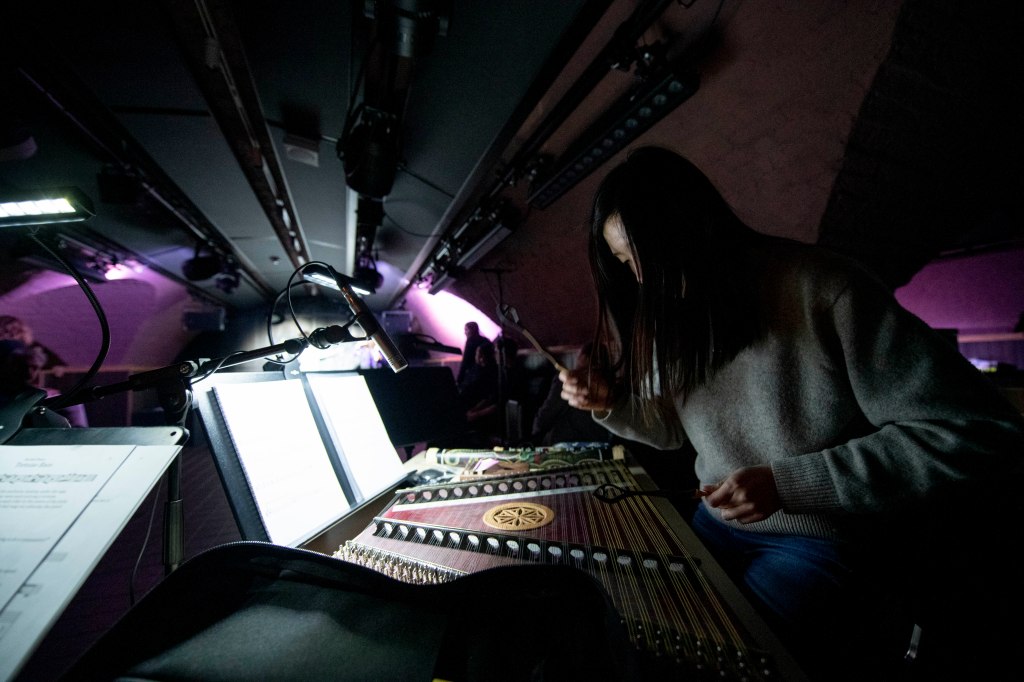
My parents felt that we didn’t have enough money for me to become a musician. I’ve been lucky to study at some amazing places but I’ve always been a scholarship kid and many of my instruments were given to me by teachers. That’s why it’s incredibly important to me to show that you can make music at a professional level using simple, inexpensive instruments. I made my roborecorder, which has MIDI output capability, from a simple plastic recorder, and on my new album, The End Times, I have transformed a simple blackboard into a synthesiser, the modular synth of chalk.
Who or what have been the most significant influences on your musical life and career as a composer?
I would never have defined myself as a composer until a few short years ago, despite the fact that I had been writing music for many years. When I joined Paraorchestra, Lloyd Coleman listed me as a composer on the announcement. I’m not sure that he put much thought into his use of the word at the time- it was, to him, the obvious way to describe what I was doing. But to me, when I saw the word next to my name in black and white, it was transformative. Having trained as a classical performer, I had associated being a composer with dead white men and large scrolls of paper. It had not occurred to me that what I was doing was ‘composing’ in the traditional sense of the word. While I would notate materials as part of my creative process, I was using a lot of electronics, text based scores and working with musicians who for the most part learnt by listening to rather than reading the music.
As soon as the label ‘composing’ was applied to it, the value ascribed to my musical output increased exponentially. For me the creative process is quite instinctive, whereas the process of strategic career planning is less so. This single word has had a huge impact on how I value and present my own creativity, and hence on its perception within the world at large. As soon as you start to define yourself as a composer, a myriad of opportunities open up, from networking organisations to funding to residencies and more. The words we use to self-define are so powerful and in my opinion are responsible for a large number of the barriers we see in the arts world today.
What have been the greatest challenges/frustrations of your career so far?
A few years into my career as a classical clarinettist, I started to lose control of my hands. Practising an audition piece, my fingers would start to twitch uncontrollably. Hours of repetition just made it worse. Unsurprisingly, playing wrong notes doesn’t land you many jobs in the classical world, where instrumentalists are all too often treated like note reproduction machines. These days, there are many more opportunities for disabled musicians. In those days, there was literally nothing. If you couldn’t play perfectly, you were out.
I was diagnosed with music-triggered epilepsy, a 1-in-a-10 million dose of bad luck. No-one is quite sure why I got it, although neurological glitches are relatively more common in musicians. Check out Oliver Sachs’ book ‘Musicophilia’ for a fascinating overview of this. Fascinating or not, this was an extremely dark time for me. I didn’t play at all for several years and changed career completely, studying medicine at Kings College in London.
I don’t believe that everything happens for a reason, but I do believe that we are given the power to make something positive out of anything that happens to us. Throughout this period, I started to write songs, and eventually started to play again in folk, rock and electronic bands, freeing myself through improvisation. I found I was able to work around the glitches and twitches in my brain, diving from note to note as if walking a tightrope.
At music college my clarinet teacher once told me that I thought too much to be a musician. I think she may have been right. It turns out that thinking too much is literally a composer’s job. I am now able to create my own work and collaborate with many amazing artists across so many disciplines. Whenever I’m facing a challenge I always try to remind myself that something unexpected and wonderful is guaranteed to come from it.
How do you work> What methods do you use and how do ideas come to you?
For me, music always starts with a story. Maybe a passing comment will spark an idea, or something I’ve seen on a bike ride or read in a book. Then I’ll go down the rabbit hole of ‘What would happen if…?’ For my new album, The End Times, I wanted to know if I could make electronic music with a blackboard. Often I’ll bring several ideas together in a conceptual collage and write a story before I start work on the sounds. The short stories accompanying my EPs INNERVATE and Beyond the Blonde were both written before any of the music was created. I always envision the listener reading the story while listening to the music.
I had the idea for making music with blackboards while working in Wales with Ty Cerdd. When I was young we would sometimes go on caravan holidays on the Welsh island of Anglesey. My favourite part of the holiday was clambering and drawing on the slabs of slate scattered around the site. We would create all sorts of marvellous writings, all of which would be completely erased by the frequent and torrential rain. I found the sound and texture of the rock fascinating. From there, I was just waiting for the right story to find me. I knew I wanted to write a full length novel and album. The work of Ursula Le Guin has always been a huge inspiration for me, including the incredible album Music and Poetry of the Kesh, created with Todd Barton. I really wanted to create a soundworld for my book in the same fashion.
An impromptu visit to Corpus Christi College, Oxford, where I had studied as an undergraduate, gave me the kernel of the story which would become The End Times. I was able to go and stay there to research and write the book, using my own experience and mixing it with the history of the college. The resulting apocalyptic coming-of-age tale ended up being a cross between Dan Brown and Brideshead Revisited.
I was then given the ideal opportunity to create my electroacoustic blackboard: a year-long residency at Paraorchestra. We were lucky enough to record The End Times album live in the Wood Room at Real World Studios. When I’m in the studio, it’s important to me that the performers feel that they can really embody the story within the space, and using an incredible space like the Wood Room makes that process so much easier. We were able to record the whole performance in 3D using a cube mic array to reproduce the live sound perfectly in Dolby Atmos, so when you’re listening to the album, it’s as if you are sitting right next to us as it was played.
How would your characterise your compositional language/musical style?
The people I make music with are a key part of the language I use for each piece. I see it a bit like casting a play- the physicality, style and personality of the performers are crucial to the piece itself. So after creating the narrative, I like to decide on the players first, and then design an physical and digital adventure playground for those people to make magic in. You create a unique story and space with a range of sonic possibilities, add the humans and a little time and see what happens!
Scientific concepts form a key part of the underlying structure of my work, as does imagery from the Bible and of course, the performance space itself. I created CRYSTALQUEER with CHAINES for the Glasshouse inspired by parallels between crystal structures and metamorphosis with non-binary identity and the polyhedral architecture of the venue itself. For the recording of The End Times, we used the room itself as an instrument, recording three dimensional soundscapes as overlays to each live track while perching on the raised walkways and ladders within the space.
Of which works are you most proud?
‘The End Times’ is my largest scale work to date, comprising a full length novel, an album recorded in Dolby Atmos and a theatrical performance which we will be touring from June 2025. It’s taken years to bring this to fruition: the work of many amazing collaborators, a few trips into the depths of my subconscious and the support of incredible organisations including Paraorchestra and My World.


As a musician, what is your definition of success?
Success is having the time and the freedom to make the work you want to make. There is constant pressure to sculpt your work to fit other people’s priorities, whether that be funders, the political environment or fashion. The artists I admire the most are completely uncompromising in their pursuit of their vision. Creative freedom is always my highest priority.
What advice would you give to young or aspiring composers?
Firstly, if you are writing music in any format, you are a composer, and don’t let anyone tell you otherwise!
Secondly, keep putting yourself out there. Rejection is an unavoidable part of success. Be like Stephen King and pile your rejections up with pride. He used to pierce his with a nail, I prefer a spreadsheet. For me receiving a rejection is also an achievement, because it shows that you’ve put yourself on the line. The more rejections you receive, the closer you get to success.
What’s the one thing we’re not talking about in the music industry which you really feel we should be?
Class. Too often residencies are unpaid. Many artists earn little on paper, but are in fact supported by well-off relatives, perhaps living bill-free in other people’s accommodation, or having been given money to purchase their own place. This frees your time to take advantage of residencies and other opportunities which in the UK are often unpaid, or if they are paid, do not cover realistic living costs.
I’m not in that category. I’ve always had to pay for myself and I still do. I never used to get angry about this, despite growing up surrounded by others with a much more privileged financial position, but now I do, because I can see in retrospect the impact it has had, not only on my career, but on my health. We need to talk about how creativity is valued not only by the music industry but by society as large. This is key as we move into the age of so-called ‘AI’, algorithms which can imitate and extrapolate but are not truly creative. In France, for instance, creative artists are supported by a scheme called the ‘intermittent artist scheme. They are paid salary between projects based on the amount of time they spend creating new work. I’d like to see a system like that here in the UK.
What next? Where would you like to be in 10 years time?
The very next thing is the release of ‘The End Times’ on 25th April. We will be touring the live show – the London launch is on the 22nd June at the National Opera Studio. I’m also currently looking for a publisher for the novel.
Alongside these performances, I’m already thinking about my next big project. Primarily I’m thinking about what we can do as artists to protest the rise of fascism around the world. I’m writing this from Real World Studios where we have made the very first explorations of these ideas. There are as always a few bucket list items: I’d love to make a game soundtrack, for instance, or have one of my stories adapted for the screen. Above all I’m open to the lovely unexpected.
What is your idea of perfect happiness?
A sandy beach, brilliant sunshine, a good book, a sun lounger, a wide parasol and a purring cat.
What is your most treasured possession?
My health and sanity.
What is your present state of mind?
Curious.
The End Times, recorded in Dolby Atmos at Real World Studios, is set for release on 25 April 2025 with Liza’s own label BMV Records
Artist photo: Ben Hughes
Discover more from MEET THE ARTIST
Subscribe to get the latest posts sent to your email.
 MEET THE ARTIST