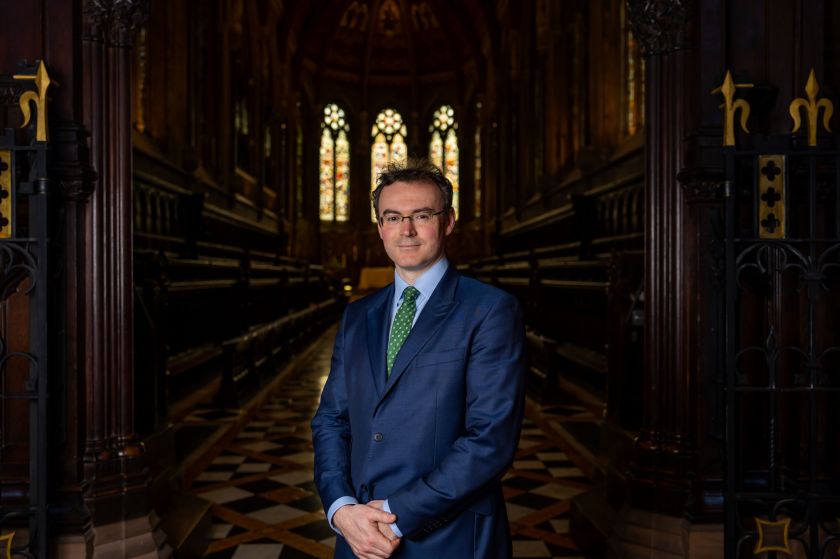
Who or what inspired you to take up conducting and pursue a career in choral music?
I had my secondary education at Bangor Grammar School in Northern Ireland where we were fortunate to have a Director of Music, Ian Hunter, who was a brilliant choir trainer, passionate about the Anglican Choral Tradition and, especially, the singing of St John’s under George Guest and King’s under David Willcocks. I played the piano and this apparently qualified me to join his choir, the Gryphon Consort, where I was introduced to the world of choral music, with life-long memories formed singing services as a visiting choir in St Paul’s Cathedral, Westminster Abbey, St George’s Windsor and many more of the iconic places where the history and tradition are in the stones. I feel very lucky to have had this magical kingdom opened up to me and I know not all schools are able to offer opportunities like this to pupils. I started having organ lessons and playing at St George’s Church in Belfast where there is a flourishing choral tradition, in the Anglican cathedral style, and at the age of 18 took up the organ scholarship at Pembroke College, Cambridge where I read Music. The choir at Pembroke sang to a high standard and the music-making was rooted in an exceptionally friendly atmosphere fostered by my distinguished predecessors, William Carslake and Sarah Baldock. All of these early experiences helped deepen my passion for choral music and for the close communities that build around it.
Who or what are the most significant influences on your musical life?
My earliest performing and listening experiences now form part of my musical hard-wiring. I’ve always enjoyed accompanying on the organ, and some of the earliest CD recordings I bought in the 1990s were of St Paul’s Cathedral Choir under John Scott and Barry Rose, with Christopher Dearnley and Andrew Lucas playing. I marvelled at the variety they achieved on that wonderful instrument, and their attention to balance, bringing important melodic material out above the choir, underpinning full-blooded moments, or lightly colouring magical quiet passages. In the right hands, the organ can provide a canvas for the choir to paint on, stepping forward to lead when required. Listening to recordings from St John’s, I was aware of that profound engagement with the text that you can almost touch. And then there was the purity of groups like the Tallis Scholars, with their ringing, beautifully-tuned chords and crystalline polyphony.
I enjoyed experimenting with what I heard the organists and choirs doing on those recordings that were available in the 1990s, and then, at Cambridge, regularly getting the real thing – most often attending Evensong at St John’s under Christopher Robinson. When I became Assistant Organist at Truro Cathedral, I was fortunate to work under Andrew Nethsingha and then Robert Sharpe, observing how two masters of their craft turned musical vision into practical reality. In my time as Director of Music at Truro, I invited Barry Rose to come to work with the choir on several occasions – these were always inspiring and very helpful as he got the most remarkable results through some sort of alchemy it’s impossible to put into words.
What, for you, is the most challenging part of being a conductor? And the most fulfilling?
The hardest thing here at St John’s is protecting energy levels and remaining free to be ‘in the music’ when term time is at its most intense and draining. Getting into the zone of performance for our seven services each week needs to be planned and fought for.
The most fulfilling thing is working with young people who are at the early stages of their engagement with the music we sing – they are still fresh to it, and it’s wonderful to see it through their eyes. I may have conducted ‘I was glad’ forty times, but they will only have sung it a small number of times, if at all. There is a particular open-hearted passion that seems embedded in the culture here and it’s quite compelling.
As a conductor, how do you communicate your ideas about a work to the choir?
Two years into my time directing this remarkable choir, I’m still honing the language and techniques that bring out the very best in this particular group. They like to know precisely what they’re singing about, line by line. This stems from the psalms we sing daily to Anglican chant. I’ve taken to doing psalms almost entirely unconducted so that the singers have to take responsibility for the character of every verse, not switching off and looking to the conductor for this information. This emotional autonomy then feeds into other repertoire to create performances that make full use of all of the singers’ musicianship, not just the conductor’s. Depending on the repertoire, we focus on meaning, imagery, and a look at what is specific to a particular style or piece – this could be the harmonic language, talking through dissonances to ensure they are balanced and come off the page in the right way, ensuring extremes of register are well managed, and various other technical, musical and textual things. On the days when I get this right, it unlocks untold musical riches in the performance.
What does the role of ‘Director of Music’ entail?
The first thing is to have an artistic vision that fits with what the College wants from its choir. This includes shaping interesting collaborations (so far, with The Gesualdo Six and the Academy of Ancient Music), choosing the right new repertoire to challenge and enrich the singers and those listening, and ensuring we tour to interesting places (we had fifteen days in the USA last month, and a shorter trip to Hungary and Germany last December, including to Hamburg’s extraordinary Elbphilharmonie). Underlying all of that are the daily rehearsals: I’m at school with the boy and girl Choristers from 7.30 to 9.00am each day, and the full choir rehearses for an hour before each of its seven services per week during term time, All of these need to be planned and carefully thought through. Then there is recruitment: with a University-based back row that changes entirely every three to four years, we are constantly looking for the most talented sixth-form singers who might like to be part of this amazing experience. It’s a similar story with the boy and girl Choristers – parents sign up to a huge commitment, including boarding, but the rewards are immense, not least in the education provided at St John’s College School. And then there is College business: St John’s College is a very well-run but busy place, and everything the Choir does needs to be communicated and approved through the right channels. Only if the Choir serves its own College community well on a daily basis will it continue to flourish. We particularly enjoy adding a special magic to the student experience at St John’s on occasions like Matriculation and Graduation.
The Choir of St John’s College, Cambridge has a long-standing choral tradition and is famous for its distinctive ‘St John’s Sound’. How does this feed into your performances with the Choir? Does the venue (the St John’s chapel) itself help to shape that sound?
In our daily rehearsals, a good deal of time is spent discussing the sound, but it’s not an end in itself. It comes out of the meaning of the words, and what we aim for is a rich palette of colour to be available at the service of the text. There is something wonderfully unfashionable about the sound: in a world where many of the finest choirs have a beautiful, pristine straight tone, it’s great that there is still space for a choir that focuses on fulness of tone, vibrato when natural, and occasionally sacrificing balance or blend when the text demands it – for instance, in the desperate, horrifying poems of James MacMillan’s Cantos Sagrados, when we are singing the words of a ‘Mother of the Disappeared’ in the most extreme distress. It’s not a coincidence that so many celebrated professional singers have been through our choir stalls. Last term, we welcomed back Sir Simon Keenlyside to sing with us at Evensong; and other stars have included Allan Clayton, Iestyn Davies and many, many more.
Our Gilbert Scott Chapel undoubtedly contributes a great deal to the way the Choir sings. It responds well to a generous bass sound, and to trebles that sit colourfully on the top of the texture without needing to force their sound; and it invites a huge dynamic range, with pianissimos and fortissimos equally clear from all parts of the building. The organ, too, has a part to play. We are currently having some work done to install an 1889 ‘Father’ Willis organ, which is being expanded in a sympathetic style by the organ builders Harrison and Harrison of Durham. I’m excited about the effect this will have on the Choir’s sound when the project is completed next year.
Several works featured on your first recording with the Choir of St John’s College, Cambridge, Lament & Liberation, are new works commissioned by you for the choir. What was the commissioning process like? What drew you to each of those composers? Did you have a specific theme/text in mind for each piece, or were those selected by the composers themselves?
Over the decades, the choir at St John’s has recorded music from a wide range of styles and periods and has been a prolific commissioner of new music. For my first album, I wanted to build on this ‘new music’ tradition, and I couldn’t be more pleased with the works written specially to this end by Martin Baker, Joanna Marsh and Helena Paish.
The Marsh was a big project, resulting in a triptych, Echoes in Time, setting poems by Malcolm Guite (one of which we commissioned) for Advent, Epiphany and Ash Wednesday. These are very special pieces and there is a YouTube video available of our recording session capturing the first movement, The Hidden Light: https://www.youtube.com/watch?v=CYxMDzrND80
A key objective of the Marsh collaboration was to create pieces that were rooted in the appropriate Biblical stories and that also spoke to ‘now’. Guite’s poems provided the ideal channel for this ambition, focusing on the vulnerability of the pregnant Mary at a time of social-political turmoil, then the Holy Family as they fled the cruel dictatorship of Herod, and finally the burnt palm crosses of Ash Wednesday reminding us that the forests are being destroyed and daring us to hope that things could be better.
The Marsh is intended to complement the other triptych on the album, James MacMillan’s Cantos Sagrados. This gripping work confronts the horrors of South American military dictatorship in the 1970s and 80s, clothed with liturgical texts that place God alongside and among the victims of unfathomable suffering. MacMillan asks a great deal of the singers in the challenging writing he employs to mirror the immediacy of the poems by Ariel Dorfman and Ana Maria Mendoza.
I wanted to design an album that would reward those who chose to listen to it all the way through, as well as those who wanted to dip into odd tracks. I say more about this in the inlay booklet, but it is perhaps important to note that there is comfort, not least in the final item: through soaring treble lines and rich harmonies in the lower voices, Dobrinka Tabakova’s short work, Turn our captivity, O Lord, hopes that ‘they that sow in tears shall reap in joy’.
I hope that this first album at St John’s will affirm my commitment to continue the work of my predecessors in championing contemporary music, both by commissioning new works and by offering fresh performances of existing works by contemporary composers. This direction of travel feels appropriate for the choir at St John’s, where we have talented young singers with an appetite for new things, rooted in a profound respect for the centuries-old tradition they uphold.
What was the recording process like for this album?
We had producer Adrain Peacock and engineer David Hinitt, so we were in the most expert hands in making the recording. We record for about five hours each day, and this album was recorded during sessions outside term time in April and July 2024. I’m very much on a learning curve with my first album at St John’s, but it felt like there was lots of committed, passionate singing – this choir never gives less than 100%. I hope that comes over in the end result.
What do you feel needs to be done to grow classical music audiences?
Every artist or group will have their own route to growing classical music audiences. For us here at St John’s, I believe we need to be true to our roots and the traditions we have inherited – I feel that makes us more interesting to audiences than trying to anticipate what they might want and fulfilling that, as a business might do with a new product. Authenticity and seeking out high-quality music that sits comfortably within our tradition is the starting point. Beyond that, we undertake various outreach and engagement activities with the aim of sharing our passion for the amazing music we have the privilege of singing. And we have some interesting collaborations in the pipeline that will cross-pollinate with new audiences. But it’s hard to escape the need for the Government to resource music provision in schools – no classical artist is big enough to fulfil that high-level responsibility to ensure that young people have the chance to have musical seeds watered and, just maybe, their life transformed.
Lament & Liberation, Christopher Gray’s first album with the Choir of St John’s College, Cambridge,, is available now on Signum Classics
Discover more from MEET THE ARTIST
Subscribe to get the latest posts sent to your email.
 MEET THE ARTIST