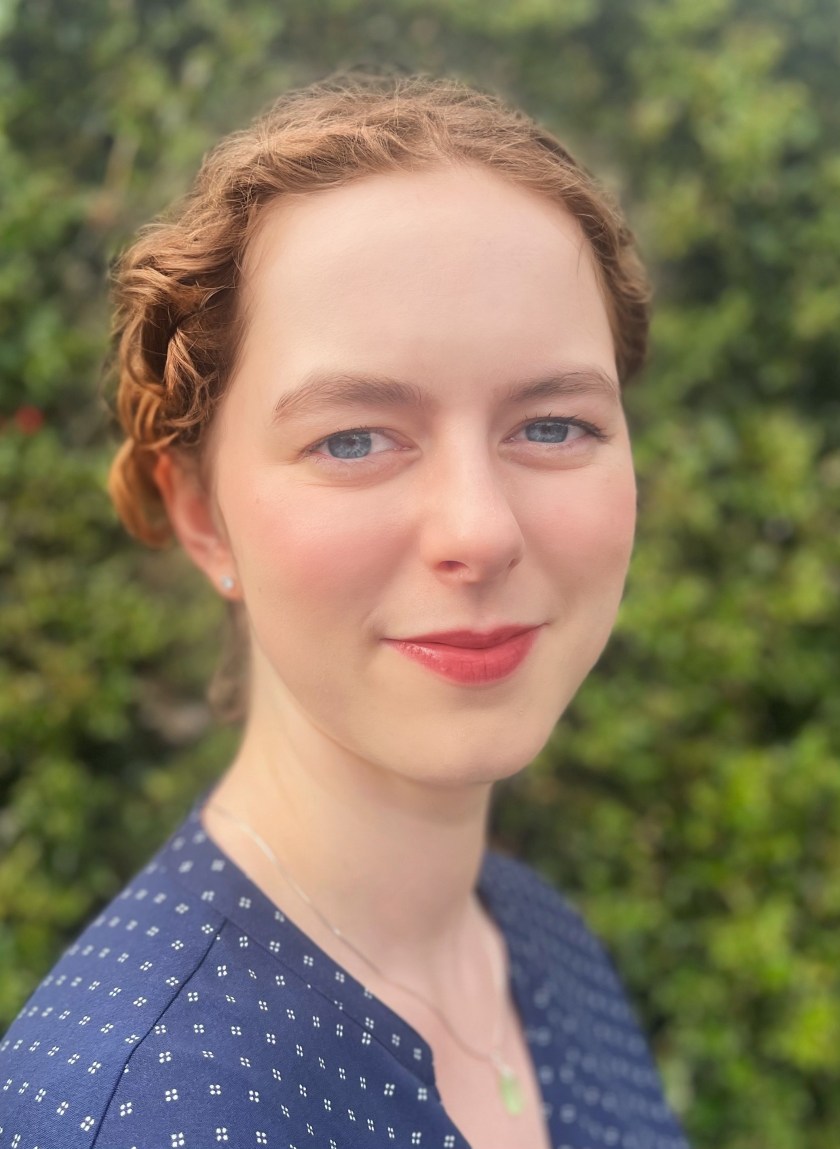
Who or what are the most significant influences on your musical life and career as a composer?
I have been lucky to have had several musical mentors in my life, but the first is probably the most influential and important. I was extremely fortunate to have Barry Rose as my first singing teacher. He instilled in me a love for text and painting words that have been the foundation of my musical life. My time in Trinity College Choir under Stephen Layton inspired my musical language quite a lot. He taught me to find the musical journey of a piece, rather than making a moment out of everything.
What have been the greatest challenges of your career so far?
Juggling my time! It was challenging taking on commissions while pursuing singing and studying for a music degree. I’m now at the Royal Academy of Music for singing, so composition is slightly on the backburner. I have a portfolio career, and nourishing both parts of it is really important to me, but sometimes tricky.
What are the special challenges/pleasures of working on a commissioned piece?
Commissions can vary in terms of how much free rein you get. Some directors are quite specific about what they want from you – which can either be tricky or freeing. As long as I can connect with the text, I am happy, but I don’t always! Then there’s the choir themselves. As a singer, I have been lucky to have known quite a few of the choirs I have written for. I sang with St John’s College Choir on their tour to the Netherlands, so when it came to writing a piece, I knew the sound I would be working with. I love the colours that a choir like St John’s can access, and the level of musicianship among the back and front rows is extremely high, so I was excited about having a broad palette to use in this piece.
What are the special challenges/pleasures of working with particular musicians, singers, ensembles or orchestras?
A challenge is often time! I rarely get much time, if any, with choirs I’m writing for, especially if I don’t have a personal connection to them. Funnily enough, one of the most exciting parts of writing for me is seeing what different choirs do with what I’ve written. I know quite a few composers who are very precious about the interpretation of their work. They know exactly what their vision is for a piece and are meticulous about achieving that. I’m not like that at all! I love hearing a choir’s take on my music – often they bring it off the page in a way that I may never have considered, which is exciting!
Of which works are you most proud?
I have to say “While Mary Slept”, as being published for the first time at 18 years old was a big moment for me! It’s also been a joy hearing it performed across the UK, especially at Westminster Abbey. I wrote an “O Lux Beata Trinitas” a couple of years ago dedicated to Stephen Layton and the choir of Trinity College Cambridge, although Stephen sadly left before I could show it to him. It’s quite an ambitious piece, seven minutes long, with five-part choir, solo vocal trio, and string trio. I think it’s one of my best works, and I would love to hear it performed at some point! A passion project which I’ve been working on for the last few years is a setting of T.S. Eliot’s “Ash Wednesday”, for chamber orchestra, solo treble trio, and baritone and tenor soloist. The poetry doesn’t go out of copyright for another 10 years, so it won’t see the light of day for a while, but there’s a freedom about having something to work on without a deadline, just for my own enjoyment!
How would you characterise your compositional language?
I would like to think that it is complex (hopefully enjoyably challenging), yet accessible. It’s difficult to pinpoint a specific inspiration for my style. I think I’ve been inspired by everything I’ve ever read or listened to. I enjoy using thick and overlapping textures to create a specific atmosphere. I would say that a lot of my music has a bitter-sweet quality. I’m interested in finding those places where two emotions overlap: sorrow and joy, excitement and anxiety, and wonder more than anything else. A lot of the texts I choose to work with inhabit those primal, human emotions.
How do you work?
As a singer, I have always been text-led. I try and create an overall atmosphere that fits the text. The structure of the work comes out of the text – If there are clear sections then that makes my job easy, if not then the piece may end up being more through-composed. I start by improvising at the piano (although I’m not much of a pianist). When I have some initial ideas down, I use a voice-layering app to improvise individual vocal lines; at this stage I sometimes add or subtract harmonies. Only after I feel happy with how these musical sections suit the words do I start notating. There are usually a few sections which I need to link to one another, which can be the trickiest part, ensuring that the structure, and therefore the musical journey, makes sense.
As a musician, what is your definition of success?
Regularly being a part of something musical that is able to emotionally affect people, whether that be as a performer, composer, or educator.
What advice would you give to young/aspiring composers?
Give it a go. If I hadn’t seen one of my friends apply for the BBC Young Inspire Competition, I would never have had the confidence to try it. Don’t let your insecurities hold you back!
What do you feel needs to be done to grow classical music’s audiences?
I think it’s easy to forget how much we owe to our teachers and mentors. The musician that I am today comes from being inspired and encouraged by my teachers. I feel that I have a responsibility to do the same for younger generations in order to keep classical music in good hands. It’s so important to expose children to classical music at a young age, dispel the misconceptions that classical music is “posh”, “too expensive”, and “inaccessible”. As a 22-year-old living in London, there are so many opportunities to experience some of the best music-making in the world: the young Royal Opera House scheme where you can get some of the best seats in the house for only £30; £5 tickets to concerts at the Wigmore Hall; Young Barbican, to name just a few. And in terms of choral music, you can walk into nearly any church, cathedral, or chapel in the country and hear extraordinarily beautiful music for free at a church service. Hearing classical music is about as easy as it ever has been – the work that needs to be done is in educating the next generations so that they can appreciate it.
Tell us about The Annunciation, the work commissioned by the Choir of St John’s College, Cambridge and included on their upcoming album, Lament & Liberation. Where did you first encounter Edwin Muir’s poem, which you used as a basis for the work? Did you use any particular techniques to illustrate the text?
Christopher Gray suggested the text and I instantly connected with it – that doesn’t always happen but it’s nice when it does! St John’s College kindly arranged for the rights for me to set the text. I tried to create an otherworldly atmosphere in the piece to mirror the unique way that Muir approaches the annunciation story. There is such a wonder to the poetry. Muir conveys the realness of an angel coming down to meet a girl in a way that is both cosmic and personal. At the end I wanted to capture a sense of time stopping inspired by the final stanza of the poem:
“But through the endless afternoon
These neither speak nor movement make,
But stare into their deepening trance
As if their gaze would never break.”
This final section uses a vocal trio in canon, repeating the final words over and over. These are joined by celestial goings-on in the upper voices and two five-part tenor and bass choirs echoing the first words of the poem in an antiphonal loop.
I also specifically chose to use two soloists – a countertenor and a girl chorister (a combination I haven’t seen much) to represent the Angel and the Girl. I wanted the richness of the countertenor tone to contrast with the purity and innocence of a young treble voice.
What next – where would you like to be in 10 years?
Doing more of what I’m doing! I would love to have a full portfolio career as a professional oratorio soloist, choral musician, and teacher, alongside the composing.
Helena Paish’s work ‘The Annunciation’ features on the latest album from the Choir of St John’s College, Cambridge, Lament & Liberation, available now on Signum Classics
Discover more from MEET THE ARTIST
Subscribe to get the latest posts sent to your email.
 MEET THE ARTIST
2 comments
Comments are closed.