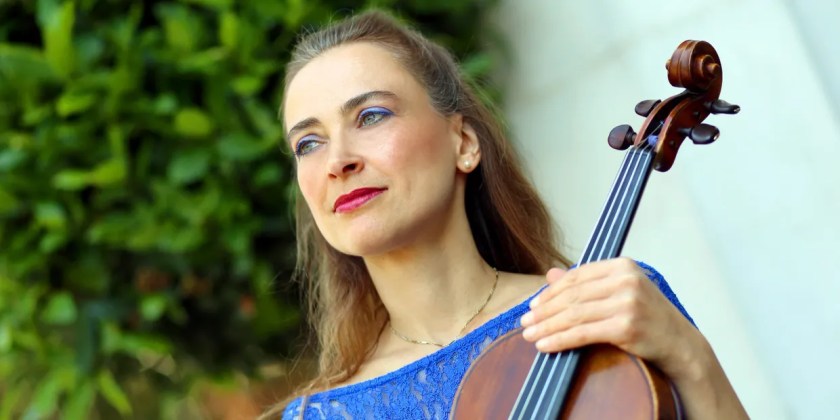
Who or what inspired you to pursue a career in music and who or what have been the most important influences on your musical life and career?
I always knew from a very young age that I wanted to be a musician, and I begged my parents for piano lessons, starting at the age of 7; I wanted to be a pianist for as long as I can remember. I also started violin lessons aged 8, but was never really interested in the squeaky sounding violin, spending all my practise time on the piano. When I was 12, my violin teacher at school asked if I might like to learn the viola because the school orchestra needed a viola. I was attracted to the mellow sound, and also to the rarity value- because no-one else was doing it that appealed and I liked the idea of being a bit different! At that time the county music centre ran a viola course, run by Harry Danks, former principal viola of the BBCSO and John White who was later to become my viola teacher at RAM (although I did not know it at the time). I remember liking the sound of the viola, and also being very inspired by Harry showing us and playing his viola d’amore which seemed quite exotic with its 12 strings. When I was 13 I started piano lessons with Geoffrey Pratley who was famously accompanist to Dame Janet Baker, Paul Tortelier, Ralph Holmes Takayoshi Wanami and others. He was an incredible musician and a very warm personality and became a personal friend and mentor. He always used to impress on me the importance of phrasing and ‘singing’ the music, and looking for different tone colours, and imitating other orchestral instruments- which of course applies to the viola just as much as the piano.
All of my teachers have been an inspiration to me. During my time at RAM I took a joint first study with piano/viola- for the first 3 years I spent most of my time on the piano, but gradually the viola took over with various incentives, exam grades and prizes leading me in the direction of the viola. My viola teacher John White helped me to perfect my technique, and to seek for refinement and physical freedom. He also introduced me to violinist Marianne Thorsen, with whom I formed a duo which was to form the basis of the Leopold String Trio. My piano teachers Ruth Harte and Hamish Milne were also important influences musically and technically- I still retain my love of the piano and especially enjoy working with pianists, both in recital and in piano quartet repertoire with my Rossetti Ensemble and John Lenehan in recital.
My studies in Salzburg as a postgraduate with Thomas Riebl pushed me to a new level, working on Paganini Caprices, concertos and other challenges which prepared me for the Lionel Tertis International Viola Competition, at which I was a semi-finalist and prize-winner in 1994.
What have been the greatest challenges of your career so far?
The biggest challenge for me was when my Leopold String Trio fell apart. We formed a trio as students at the RAM, and were taken on by YCAT in 1995. We were playing all over the world, and our recording of the complete Beethoven string trios for Hyperion was runner up for Gramophone Award in 1999. I was passionate about this medium and it was a devastating separation. Fortunately 6 months later I was head-hunted by the Sorrel String Quartet, quickly becoming a member and carried on my chamber music career in a different direction with a Shostakovich string quartet recording cycle for Chandos as well as many other recordings such as Elgar and John Pickard. The string quartet repertoire is endless and it was a wonderful experience working with this group.
Which performances/recordings are you most proud of?
This is a difficult question to answer but I think in terms of performances it would be my 2 viola recitals at the Wigmore Hall, and live broadcasts on Radio 3 of David Matthews viola concerto “Winter Remembered” with City of London Sinfonia and Matthew Taylor’s Viola Concerto with the BBCSO. In terms of recordings, I think it would be my recordings for Dutton of British Viola Music with Orchestra Nova (David Matthews “Winter Remembered”, John McCabe Concerto Funebre, Elizabeth Maconchy Romanza, Holst Lyric Movement and William Alwyn Pastoral Fantasia), a futher CD of British viola music with the Hallé (Benjamin Dale Romance, Rebecca Clarke Viola Sonata/Concerto, Richard Walthew 10 Mosaiques and Henry Waldo Warner Suite) and a recital of previously unrecorded British repertoire with pianist John Lenehan. I’m also especially honoured to have recorded James Francis Brown’s string trio with Jack Liebeck and Gemma Rosefield, as well as his piano quartet with Tamas Andras, Gemma and Katya Apekisheva.
Which particular works/composers do you think you perform best?
I seem to have formed quite a reputation for performing/recording British music and have been approached on multiple occasions with specific requests to perform/record British repertoire! This includes the Edgar Bainton and Granville Bantock Sonatas, Vaughan Williams Romance, Concertos by Arthur Butterworth, Paul Patterson, Delius Double Concerto (originally for violin and cello but transcribed by Tertis) as well as aforementioned works. I do love the sound world of this repertoire, and imagined landscapes that these works inhabit. Possibly the sound of my Chanot viola of Manchester, 1896, especially suits this repertoire.
How do you make your repertoire choices from season to season?
The fashion is to look for centeneries – also in terms of contemporary composer’s birthdays! But I also like to build programmes around special themes such as night-time music, poetic/literary/artistic connections, songs and dance, romance etc.
Do you have a favourite concert venue to perform in and why?
I especially enjoy performing in churches because the resonant acoustic is particularly favourable to string players. St John’s Smith Square is a venue I have a lot of affection for because I gave my London recital debut there (and also my concerto debut with the Philharmonia). I also love the grandeur and acoustic of the Pittville Pump Room in Cheltenham, with many happy memories of performances at the Festival.
What do you do off stage that provides inspiration on stage?
All life experience adds to the diversity of emotional experience which then feeds musical expression! With family commitments I don’t have reams of time to devote to hobbies but when I can I do enjoy art galleries, the theatre, literature, gardening and mediterranean/middle eastern cuisine!
What is your most memorable concert experience?
That’s a difficult one as there have been so many! I have enjoyed working with many distinguished colleagues and it would be very difficult to choose!
However, one of my most memorable concert experiences was playing the Faure C minor piano quartet with Marc-Andre Hamelin and the Leopold String trio at the Cork Chamber Music Festival in Bantry Bay in 1998
In addition to the Faure C minor Piano Quartet in Bantry Bay, West Cork, the other most memorable performance for me was of the Faure G minor Piano Quartet. Funny how both performances were of Faure Piano Quartets. It was at the Marlboro Festival in the summer of 1992, in Vermont, with pianist Richard Goode, violinist Robert Chen playing on a Stradivarius (he now leads the Chicago Symphony Orchestra) and cellist Peter Seidenberg. This was an amazing experience for me, fresh out of my studies at the RAM, I auditioned for Marlboro not really knowing what a prestigious festival it was- I was lucky to be awarded a full scholarship for the 8 week summer there, and spent up to 12/13 hours per day playing in various groups with a mixture of established musicians and young professionals starting out in their careers. The group with RIchard Goode was a dream with such wonderful colleagues- we spent several weeks working on it- being a late work it takes some getting to know. Richard is such an incredible, and humble musician- very respectful of us all, and we were made to feel like equals. The performance was in the Marlboro college campus, in the middle of the green countryside, surrounded by sheep- a rural idyll! I still consider it to be one of the pinnacles of my musical career!
As a musician, what is your definition of success?
How does one define success? Hitting the big time, lots of concerts everywhere (with congruent financial recompense), accolades from critics, international recognition and demand, multiple recordings, working with colleagues at the same level of recognition?
Or could it be about the legacy that one leaves behind through recordings, the pieces which composers write through being inspired by a certain player, and also by passing on skills down the generations via pupils?
Bach didn’t achieve recognition during his lifetime, being a hardworking employee. Mozart achieved early fame as a prodigy but struggled financially and to get enough work to survive before his untimely death. However, we hold them up as musical icons today and their legacy pervades.
The fashion today seems to be about blowing one’s own trumpet but ideally it’s better to have others blow it for you!
What do you feel needs to be done to grow classical music’s audiences?
Definitely to appeal to the younger generations through teaching and school concerts, and also making programmes as attractive and varied as possible. Including music in the school curriculum is also essential.
What’s the one thing in the music industry we’re not talking about which you think we should be?
Valuing music as an essential part of our cultural identity and heritage for future generations and giving it a higher status in society.
What advice would you give to young or aspiring musicians?
Follow your passions, set your bar high, work hard, persevere, communicate, look for something unique which hasn’t been done before.
Sarah-Jane Bradley performs music by Robert Schumann, Johannes Brahms, James Francis Brown and Lloyd Moore (premiere) at this year’s Hertfordshire Festival of Music in a lunchtime concert on Wednesday 11 June. Find out more here
Discover more from MEET THE ARTIST
Subscribe to get the latest posts sent to your email.
 MEET THE ARTIST