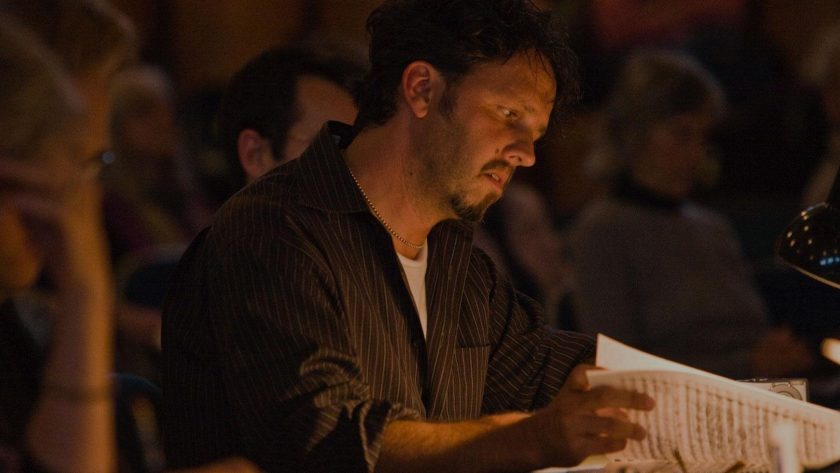
Who or what are the most significant influences on your musical life and career as a composer?
I could list the musical influences that may or may not be obvious, such as Ravel and Stravinsky, the latter of whom is, in my mind, the greatest musician of the 20th century. Frank Zappa is in there. Ginastera, 1920s-30s French music. William Schuman. My work is shaped by my love of rock and punk, where my musical life started, playing in bands, writing songs and performing. I’m told that my rhythms are sharp-edged and in the spirit of music that might be lacking in traditional concert settings. I often utilize quotation in my work, though much of it is so deeply sublimated or buried as to be unrecognizable. Sometimes I forget they are there.
I’ve often found great inspiration in travel, nature and a specific sense of place. This is evidenced in works like Arroyo Seco, Barri Gotic, Tiergarten, my Viola Sonata “Jefferson Chalmers”, and others. In the past few years, I’m animated by the fact that my work should serve a purpose beyond its base declaration of existence; and stories of struggle and hope, as well as the urgency of our decaying democracy have provided fodder. Works like Sapiens, Mutually Assured Destruction, Fluid, Let Every Dawn, and One Song, America, Before I Go are all examples. Each is imagined in an unstable world, and are my humble and insufficient contributions to its order.
What have been the greatest challenges of your career so far?
I have been incredibly fortunate to not have to worry about fully making a living as a composer, as attractive as the desire remains. If I’m honest, I’m frustrated by the new music cottage industry of commission/premiere/obscurity. I fondly recall a conversation with Ned Rorem sometime around 2000 or so, where he lamented the fact that much of his work – including three very interesting symphonies – had been performed no more than once or twice. I have been fortunate to mostly work on commission for the past twenty or more years. Many have been played once and a couple of works have seen their premieres fall through, as in my Mandolin Concerto. It remains unperformed.
I could point out that at times my music feels a bit overlooked in that many people know me from the other work that I do: shaping recording legacies, helping others find their voice and in cultivating musician entrepreneurship. But the greatest challenge is finding the time and space to execute even a portion of my ideas. I still carry clear memories and detailed sketches of works I conceived decades ago but haven’t really started. One day I hope to, and perhaps it’s a result of an over-active imagination and my particular conviction of the infallibility of my own fantasy, to paraphrase Schoenberg.
What are the special challenges/pleasures of working on a commissioned piece?
The longer I work the more I appreciate the relationships that I have cultivated and how so many have enriched my life. Composing for a particular personality is a joy because it’s far easier to imagine someone you know and respect struggling and overcoming the challenges inherent in learning any new work. Once that is acknowledged, composition need not be a solitary endeavour.
A commission from a known relationship can be a pleasure, whether soloist, conductor or ensemble. For me, I find the invite to “write me/us a piece” to be quite intimidating. I prefer to discuss in some detail what might be desired and the circumstances of its performance, not that I write to strict specification. Some amount of limiting factors allow my imagination to flow a bit more freely, and knowing the setting of the premiere also helps immensely.
What are the special challenges/pleasures of working with particular musicians, singers, ensembles or orchestras?
There must be about twelve or so pianists that perform my work with some degree of regularity. Not one of them is like another, and few pieces are performed by more than one or two of them. My most performed piece, The Birds of Barclay Street, composed in 2001, is one exception.
As above, keeping an artist, ensemble, choir or orchestra in mind makes the work easier to conceive and its composition more enjoyable. Fluid, commissioned, premiered and recorded by Lara Downes, was very certainly made with her particularly inspiring type of musicality in mind. Its composition came relatively easy as a result.
Of which works are you most proud?
My recently-recorded piano opus, Sapiens: A Brief History of Humankind, is at the top of the list. I will never approach the piano in that way again, nor tackle something so expansive and intimidating. I happen to love my piano quintet, Terroir, commissioned by Xiayin Wang and the Fine Arts Quartet, which they premiered at Lincoln Center in 2014. And among my concertos is my latest, Congregate Settings, for guitar – both classical and electric – and wind symphony. I believe it is bold and risky, as I know the guitar well but haven’t written extensively for it, other than three solo works. The work will be premiered by guitarist Matthew Cochran at the Frost School of Music in April 2026. I’m also proud of my concerto for recorder and wind symphony, commissioned by the brilliant Michala Petri, A Pacifying Weapon, which was also brilliantly recorded.
How would you characterise your compositional language?
I’m not really sure, other than to call it eclectic, the sum of my listening and my experience.
How do you work?
In very small and concentrated bits of time, largely at the piano but often on paper while traveling. I have composed countless hours of music on airplanes, a wifi-free oasis where I largely can’t be bothered.
Much of my work begins with a gesture or shape by which resulting musical material might be produced. But even before that, I labor extensively over a title and a broad concept that can dictate compositional decision making. These limiting factors help give shape to my ideas.
As a musician, what is your definition of success?
Just as originality is often emphasized over quality, and happiness over peace, success over contentment can also be confining. I have composed over 80 pieces of music, as well as a few dozen songs in my adolescence. Some even I have never heard. Though I would certainly like each work to be performed and recorded, I feel no burning itch to share everything. I know what I do has merit and was and is very much a product of its time and circumstance. Furthermore, I can’t imagine a world where I’m in it and not writing music. It’s inconceivable. Success, if pressed, to me means the ability to produce work and to reflect on it positively over time. Sharing, via performance, recording or emulation, is a form of achievement and recognition. I think it’s important for every young musician to strive to identify their own personal definition of success. I speak to many each day and several focus on one or two small desires: attracting management or touring, for instance. Composers must seek their own sources of peace. The work itself can and should be the reward.
What advice would you give to young/aspiring composers?
For years it was more or less distilled into a single word: listen. Nowadays, with the world’s music at our fingertips, composers possess nearly limitless versatility and curiosity, and that is reflected in the broad spectrum of music composed today, with so much of it free of academic dogma that was taught in America up until the time I began my studies.
Over two decades, I have spoken at dozens of schools, conservatories, festivals, competitions and professional gatherings on the subject of the artist’s role in understanding new media and in cultivating musician entrepreneurship. While composers today have more musical fluency than ever, there is much to learn on what Big Tech essentially demands of all of us, and what we can do to maintain both privacy and agency while harnessing the immense power that our interconnected world provides us. With few exceptions, young composers are not taught artistic citizenship in programs; therefore, we have a citizenry that does not know its rights, does not understand the broad musical ecosystems of publishing, PROs, labels, distribution, mechanical administration, marketing, PR and more, and thus struggle with some questions often deep into their careers. The internet offers us all a window into the world. We may see different things through that window and there is certainly a dangerous global assault on truth. But composers must recognize that having a worldwide, instantaneous potential public is an opportunity not given to any composer in any prior generation.
What do you feel needs to be done to grow classical music’s audiences?
I think it’s a valid question, though improperly asked. The music that most agree would be called ‘classical’ stretches back a thousand years. At almost no point was it understood – nor even heard – by the masses. Mostly a wealthy, literate European elite could experience it, and only in private performance in small settings. In fact, with the advent of the internet and streaming models, infinitely more people are listening to classical music than at any point in history and more people discover its rich legacy every day. Younger listeners live in a post-genre world, different from mine when radio and record stores segregated music by genre. I often share this anecdote from my work, told to me from a prominent executive at one of the global streaming services: of all of the identified genres, classical is the third most popular in the sense that, if one listens mostly to rock and hip-hop – or country and jazz – classical is the genre most likely to be one’s third choice. Classical music has benefitted enormously from the access-model that streaming provides, in that more people are at least likely to sample it. Heaps of dirt have been shovelled on the grave of classical music for far longer than I’ve been around, but technology has allowed for a far larger and more curious public.
The more salient question is: how might we convert some of those people to regular listeners, concertgoers, commissioners or anything that supports the artform more meaningfully? Though I can offer no easy answer, the question is the animating one of my work life. Facilitating conversations with some of these people has led to some very meaningful relationships for me, but scaling up such interactions is quite difficult. I do encourage deep and immersive listening, something I struggle with myself. If one truly disconnects from activity, worry, distraction and the soul-destroying internet – at least for a time – and submits oneself to a communal experience within the concert-hall audience, I believe one can indeed become a convert. This is especially true in the presence of some of the greatest artists of our time and with a work that happens to inspire. It happened to me when I was 15, and I’ve stayed with it ever since. Classical music demands only one thing of its listener, and that is time.
What’s the one thing in the music industry we’re not talking about but you think we should be?
If we limit this question to concert music, the one thing not discussed in any depth is AI, something I have written about before. Right now, dozens of AI models are training themselves on our work, just as is done across all genres of music and facets of work and information. To use but one example, this has huge implications for the licensing of music including sync. All musicians must know “fair use”, a term behind which tech companies can hide when it comes to the theft of our work. Most alarmingly, if AI models can produce a reasonable facsimile of a Mahler symphony as a Beatles song or a Shakespeare sonnet, then the timeless art of its composers and authors is diminished at best and stolen at worst. AI may be another step, but a gargantuan one, in the further diminishment of the value of music. What I do is art; what others wish to call it is content. I reject it fully.
AI is like irony, something we like to think we know the definition of but haven’t a clue. Generative intelligence tools are poised to rewrite most of the aspects of life, and we’d be foolish to think they won’t influence creativity, even becoming – as it is now – as valid a compositional tool as an instrument or pencil. It may also offer us – like the nascent days of the internet and on-demand streaming – a way for original music to find an even broader audience.
What is your idea of perfect happiness?
I’m not sure that I believe in perfect anything, and I think happiness – which requires the presence of time – is not necessarily something to aspire to. Peace, on the other hand, requires no outside influence: time, setting, circumstance, etc. As a result, it is harder to find or achieve than happiness, but its rewards should be lasting. As many composers know or should learn to know, the work itself can and should be sufficient reward.
Discover more from MEET THE ARTIST
Subscribe to get the latest posts sent to your email.
 MEET THE ARTIST