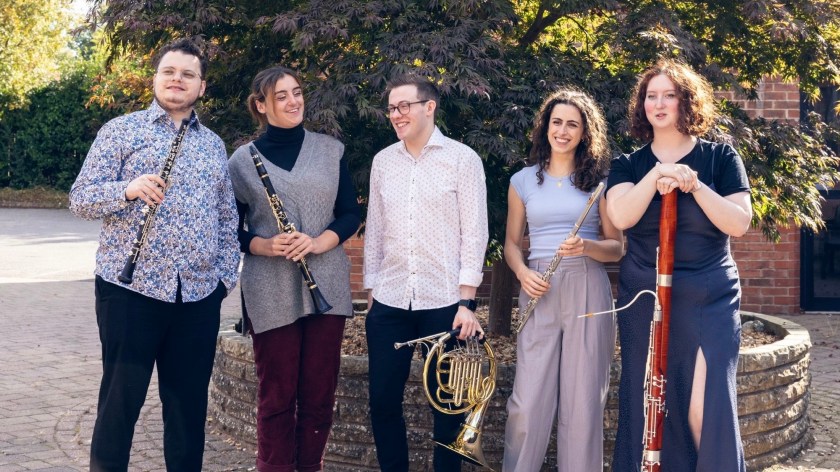
Bute Wind Quintet are Gabriella Alberti (flute), Sam Willsmore (oboe), Hannah Harding (bassoon), Nathan Barker (French horn) and Meg Davies (clarinet)
Who or what inspired you to pursue a career in music and who or what have been the most important influences on your musical life and career?
Our teachers and tutors been a huge influence throughout our musical education. From our very first teachers, through to our music college tutors, having supportive mentors who believe in you is so important for someone wishing to pursue a musical career. As a quintet, we are inspired by musicians who have a respect for their craft and a love of performing, such as the Orsino Ensemble. We were even lucky enough to receive coaching from Adam Walker (flute) within our first month together as a quintet back in 2022 and getting to witness the Orsino Ensemble in concert, was the definition of inspiration.
What have been the greatest challenges of your career so far?
We like to challenge ourselves through our repertoire choices. It’s not a Bute Wind Quintet concert without a technically and musically challenging piece programmed (maybe even two!). We challenged ourselves very early on with David Maslanka’s fourth quintet, which was a piece of many characters. Every player had to work especially hard to nail that one. As if that wasn’t enough, we have just begun work on Maslanka’s third quintet for our performance at the Cowbridge Music Festival.
Which performances/recordings are you most proud of?
Our London debut at Conway Hall. We felt it was our most energised and ‘in-sync’ performances ever, and captured the essence of why we love chamber playing!
Which particular works/composers do you think you perform best?
Our favourite piece is our big showstopper, Tzigane by Valerie Coleman, which lets us all demonstrate our virtuosity in a passionate frenzy inspired by Roma music.
How do you make your repertoire choices from season to season?
Sam, our oboist, has a library of quintet music (in his head, on his Spotify and in real life too!) We have found connecting pieces together through themes, such as “A Parisian Affair” and”A British Celebration”, or through special anniversaries and significant events to be a great way to deliver a cohesive programme that invites an audience into the magnificent repertoire of the wind quintet genre.
Do you have a favourite concert venue to perform in and why?
In May we got to perform in St George’s Bristol and that was a beautiful stage to play on, with such friendly FOH staff and organisers who made it such a fun and welcoming space. It was also our biggest audience to date, with 200 in attendance!
What do you do off stage that provides inspiration on stage?
We find for us, it is important to be human beings first and musicians second. We are not only colleagues, but really close friends off stage. Having that camaraderie in rehearsals, before and after concerts inspires us to work closely together and uplift each other as players. Some other activities we enjoy doing outside of playing music together include travelling, reading, eating… you name it, we probably enjoy it!
What is your most memorable concert experience?
Whilst we have had very successful concerts, the beauty of live performance is that not all concerts go swimmingly! Our clarinetist, Meg, experienced some page turns gone wrong in our concert themed around the music of of Welsh composer, Mervyn Burtch. The beauty of live music is that every other member kept going and Meg learnt to sellotape her pages together for future concerts.
As a musician, what is your definition of success?
Creating experiences through incredible music that create a sense of connection between us and our audience. Feeling really connected to the audience can be much more rare when doing orchestral concerts, and so chamber playing really allows us to play around and be more creative, choosing our own repertoire, introducing them to the audience, and building the whole thing ourselves.
What do you feel needs to be done to grow classical music’s audiences?
Creative and interesting programming that feels fresh without being intimidating is one way of integrating classical music into everyday society, encouraging wider audiences to listen and participate. The funding of music education so children and young people are able to experience it without financial limit
What’s the one thing in the music industry we’re not talking about which you think we should be?
How great it is to hear music you’ve never heard before! You never know what you might enjoy until you’ve listened to it. Don’t be afraid to go to concerts with programmes that don’t involve Mozart or Beethoven. You never know what amazing composer or musician might be on that stage, especially as the classical music industry opens its doors to more women, POC and minorities. It’s okay to not like certain pieces or composers that are purported to be ‘genius’, and that it’s okay to like (or love) music and composers that are deemed lesser, or less ‘serious’ . The joy of music is that everything speaks differently to different people.
What advice would you give to young or aspiring musicians?
Forge your own individual path that’s based on what you love and makes you want to get out of bed in the morning. That might include composing, teaching, arranging, non-classical music, and other art forms. Also don’t worry if you don’t know what you love yet!
What’s next? Where would you like to be in 10 years?
Celebrating the Bute Wind Quintet’s long life with some exciting gigs, maybe even a tour. Maybe something themed around silk and linen, as that seems to be the 12th anniversary’s speciality!
What is your idea of perfect happiness?
Cooking with friends while drinking wine (preferably after a gig with the Bute Wind Quintet).
What is your most treasured possession?
Our instruments…
What is your present state of mind?
Being professional musicians can be taxing at times. Some months can be busy, with lots of gigs and calls and others can be quiet and have you doubting yourself as a creative. Through all the fluctuations, keeping a positive attitude and allowing yourself to bounce back from setbacks or rejections is important. The highs make you realise why choosing a career in music is a life worth living.
https://www.butewindquintet.com/
Discover more from MEET THE ARTIST
Subscribe to get the latest posts sent to your email.
 MEET THE ARTIST