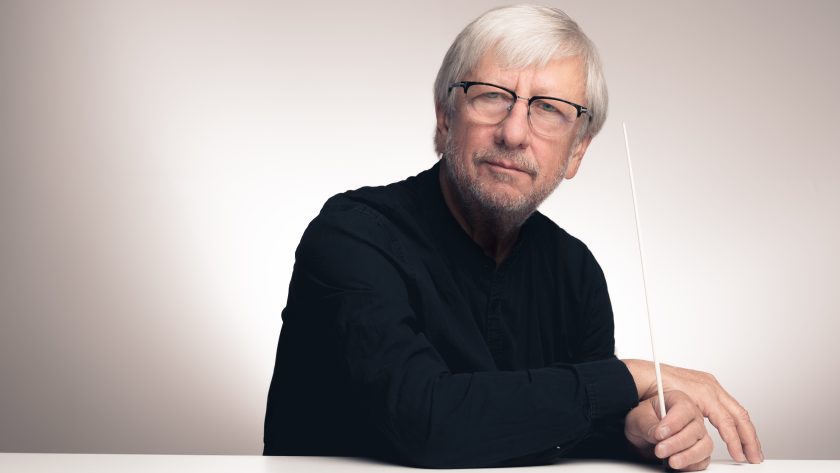
Who or what inspired you to take up conducting and pursue a career in music?
It all started with my mother, who wanted my siblings and I to learn piano. A teacher would come to our house and give lessons to my older brother. I remember that as a four- or five-year-old, I would often sit on the carpet and listen to them. One time, the woman asked me to play something. Without even practicing, I performed exactly the same thing as my older brother. The conclusion was clear: I absolutely had to be sent to music school.
My education spanned about a dozen years. My friends naturally saw me as a leader. Whenever something needed doing, they asked me to collaborate. This is how my first vocal-instrumental ensemble was formed, operating at the church. I created arrangements and instrumentations for it and wrote my first compositions. As I said, taking on the role of leader was no problem for me. Soon, as a self-taught musician, I began conducting. Later, I studied at the Academy of Music in Wrocław, at the Department of Composition, Conducting, and Music Theory. That was my beginning.
Who or what are the most significant influences on your musical life?
I consider myself open to inspiration. There have been and are many people who have inspired me and continue to inspire me. In the musical field, these are the musicians who collaborate with me. From my student days, I owe much to my composition professors in Wrocław. I wrote a lot of music back then and taught this art at school. Today, my compositional experience allows me to better understand other composers when I pick up their scores.
It must also be said that a very significant factor, pushing me to action, was the fact that the International Festival Wratislavia Cantans has been running in Wrocław for several decades. I am currently its artistic director, but as a student and later a university student, I attended Wratislavia. When Poland was behind the Iron Curtain, in the 1970s and 1980s, opportunities for exposure to music were limited. This was particularly true for vocal and instrumental works from earlier eras. This festival was practically the only opportunity, at that time and in that place, to meet great masters and become acquainted with their productions. The concerts became a discovery, an inspiration, an opening for us, especially when it came to historical performance.
What, for you, is the most challenging part of being a conductor? And the most fulfilling?
This issue is paradoxical. Being an artist is a profession that provides immense satisfaction, but it’s also true that a musician never feels completely happy. Even after a wonderful concert, the question arises: could it have been done differently, better? I believe that for a conscious musician, achieving success rarely goes hand in hand with a sense of unconditional happiness. In sports, if someone wins an Olympic medal, they reach the pinnacle. For us, however, that’s not the case; the aforementioned question always lingers in the back of our minds. This is connected to another life observation: a person unaware of certain things, such as the craft of music, will more easily achieve satisfaction, in this case, through the reception of what they hear. Someone more deeply immersed in a given subject will feel a correspondingly great dissatisfaction.
As a conductor, how do you communicate your ideas about a work to the orchestra?
Although I most enjoy vocal-instrumental music, with an emphasis on historically informed performance, I also explore other genres. The nature of the work, however, depends on the ensemble. In chamber music, communication is different than when I’m standing in front of a symphony orchestra. In the latter, persuasive gestures, conducting technique, and body language are key. The goal is for the performers to follow my lead without unnecessary explanation. If commentary is needed, it should be as precise as possible, simply to the point.
In chamber music, with artists I’ve known for years, we don’t need to convince each other about many things; we’ve had many discussions and performances together. When you have a coherent musical vision with the ensemble and are well acquainted, the work flows differently than with an orchestra you met a week ago. If I were to point out a common denominator in both fields, it would be to find a channel of communication that allows for the shortest and most reliable way to reach an understanding.
How exactly do you see your role? Inspiring the players/singers? Conveying the vision of the composer?
When I begin working on a program, I turn to the score, whether I’m performing a piece for the first time or the twentieth, and try to reread the text and the composer’s intentions. It could be said that the more brilliant the work is, the more I can decipher from its notation each time. I have the greatest respect for such works.
It’s important to note, however, that in the 17th century, musical notation was completely different from that of the 19th or 20th centuries; it was sparse. Knowledge of performance customs not captured in the score is crucial for a musician. Today, this knowledge is readily available; all we have to do is consult old treatises or studies on performance practice in the styles of specific periods.
When composers’ individuality began to manifest itself in scores, around the turn of the 18th and 19th centuries, they took care to provide musical notation with symbols and added commentary. The notation is much more precise. They believed this would ensure it was close to their original version. Today, of course, we know that this isn’t entirely possible. Even if we follow all the instructions precisely, individual performances will differ—thankfully.
In the second stage of work, the conductor’s role is based on mutual inspiration between him and the musicians. When I stand before an ensemble I meet sporadically or for the first time, I never come with a ready-made concept. I believe that’s a dead end. Instead, I start by listening to what the musicians are playing. They can do it wonderfully, far better than I could have imagined! I respect the performers and often learn from them myself. Then, there’s a collaborative effort to coordinate, integrate, and during the concert, unleash what was prepared and share it with the audience.
Is there one work which you would love to conduct?
(Laughter), no, there’s no “one” piece. There are a few, maybe a dozen. Every time I lead such a composition, I feel both happiness and anxiety. I’m facing a great challenge. I’m talking primarily about Bach’s masterpieces: the two Passions, the Mass in B minor, and The Art of Fugue. I want to keep returning to these works.
Do you have a favourite concert venue to perform in?
Of course, it’s the National Forum of Music in Wrocław – you could say it’s my baby. It’s an extraordinary hall, an extraordinary place that has consistently inspired artists since its inception in 2015. I’m delighted that virtually 100% of the musicians, conductors, soloists, and orchestras who have had the pleasure of performing at the NFM want to return. I love our hall for the beauty of the sound – it’s pure, selective, but also spacious. This is the place where I feel most at home.
What do you do off stage that provides inspiration on stage?
Everything that sparks curiosity in a person, an open attitude toward others, toward the world. If someone steps onto the stage closed off, cut off from others, they won’t be able to convey what they should and fulfill their role. And that is to share beauty and emotion with the audience. And we need to be open to that. Everything we do in life—when we interact with other arts, nature, people, or pursue our hobbies—is meaningful if it allows us to share emotions. Then we will fulfill our role.
What do you feel needs to be done to grow classical music audiences?
Besides being a musician, I was a manager for many years, managing large cultural institutions for twenty years: the Wrocław Philharmonic and the International Festival Wratislavia Cantans, which later became the National Forum of Music. These are not my only experiences of this kind. I was also a professor at the Academy of Music in Wrocław for many years.
In all areas of my work, education has always been and remains incredibly important. Being active in this field is, in fact, our duty as artists. The easiest way to ensure audiences come to concerts is to nurture this aspect from the very beginning. Because where do listeners come from? I believe the issue is simple: either someone has a need for contact with art, or they don’t. This develops throughout our lives. Family is the first natural influence. Every child learns through imitation. Later, school and other environments become such spaces.
In my opinion, these needs can be nurtured at any age, but the earlier the better. The Hungarian composer Zoltán Kodály was once asked by a young man, “Master, when is the best time to start learning to sing?” He replied, “nine months before birth,” and then corrected himself: “nine months before the mother’s birth.” In summary, I believe that any activity in the field of education is desirable and bears fruit. We can do much. I myself have been involved in musical education throughout my life and am the author of numerous projects in this area. The largest of these is Śpiewająca Polska, a choral education program coordinated by the National Forum of Music. Several hundred choirs participate in it; several thousand, perhaps even hundreds of thousands, of children and young people from all over Poland have participated in this program over the past twenty years.
What advice would you give to young or aspiring conductors/musicians?
People have dreams at different stages of their lives. Regardless of age, one can dream of being a musician. It’s a starting point, but not a sufficient condition for becoming one. Courage is also essential, not content with mere desire. Consistency is essential for consistent action, and this is essential in music, as is patience. At a certain stage, an honest assessment of one’s own capabilities is essential. Investing one’s dreams and passion in an endeavor that won’t lead to success can be painful. In other words, self-reflection and an honest questioning of whether this is truly the path for me are essential. The idea of becoming an artist may be fantastic, but there’s no limit to the number of good life ideas. If we realize that this path won’t lead us anywhere, let’s remember that it’s not the only successful career idea.
What’s the one thing we’re not talking about in the music industry which you feel we should be?
I have the impression that too many things are being talked about, but too few things are being done.
Where would you like to be in 10 years’ time?
In ten years, if my health permits, I’ll be exactly eighty. I’d like to maintain what I consider the wisest approach in life: to enjoy each day. Carpe diem—and that’s enough for us.
Andrzej Kosendiak conducts the Wrocław Baroque Ensemble in performances of choral music by Mikołaj Zielenski and Vivaldi’s Gloria at St Martin-in-the-Fields (14 August) and Edinburgh International Festival (16 August)
Discover more from MEET THE ARTIST
Subscribe to get the latest posts sent to your email.
 MEET THE ARTIST