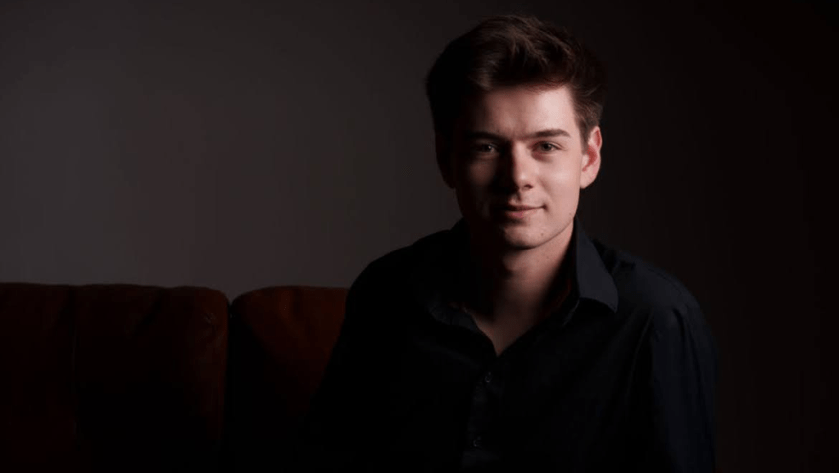
Who or what are the most significant influences on your musical life and career as a
composer?
I always make a distinct effort to draw inspirations from other mediums as much as possible. I am a huge fan of several contemporary architects – specifically Frank Gehry and Zaha Hadid – and their approach to form and structure has had a huge impact on how I perceive my music and how I compose. I’m also very into film as an artistic medium. Directors like Abbas Kiarostami and Wong Kar-Wai have had a huge impact on me in terms of how they cross relate really attractive
aesthetics with a deep and well-conceived message, and I often look to them for inspiration when
finding ways to expand the “universality” of my music.
Regarding musical influences, my work is strictly concert classical music but I find myself drawing
ideas from all sorts of genres. The most influential classical composers for me have to be
Messiaen, Bartók, Adams, Scelsi, and former mentors of mine like Andrew Norman and Sir James
MacMillan. Non-classical idioms that have left a large impact on me include the vast jazz canon,
artists from various genres such as Pink Floyd and Bon Iver, and many others. One specific
external musical practice that has had a particularly huge impact on my music is Gregorian chant.
Much of my language is intuitively derived from it.
What have been the greatest challenges of your career so far?
So far, I’d have to say that figuring out where “we” are collectively in the trajectory of art music
history feels rather difficult. It’s always been important to me to position my work as a composer
relative to both who I am and what I want to personally express, but also to where the rest of the
global concert music community is. I find that this understanding is necessary in order to identify
what ought to be innovated, and what can stay static.
What are the special challenges/pleasures of working on a commissioned piece?
I love the personal connection between the commissioner and the composer. I think it’s a
wonderful dynamic where the commissioner is entrusting their financial resources to a composer
and delegating the “artistic decision making” to them, handing off most control in a usually humble kind of way. Receiving commissions also comes with deadlines, which I personally enjoy.
Deadlines help me formulate a writing trajectory, and that immediateness of the deadline helps me stay creatively “fit”.
Regarding challenges, if the commissioner is bringing to the exchange a preformulated narrative or subject, this can sometimes be challenging to find a personal entry point into. This is especially the case when the commissioner has a very specific subject they’re commissioning in memory of, and if I don’t have an obvious personal connection to that specific thing, it requires some real mental gymnastics to find abstract ways to still genuinely relate to the subject while keeping the art authentic.
What are the special challenges/pleasures of working with particular musicians, singers,
ensembles or orchestras?
I really only see the pleasures in these kinds of collaborations. Composition as an art and a craft is all about that collaboration with musicians. The music we notate as composers is intentionally
“unerealized”, meaning that it requires a 3rd party to bring the music into the world. And the
process of working directly with a musician, especially during the writing process, creates a really
special dynamic and passageway of musical ideas that I find continuously inspiring.
On September 26th (2025), I had the privilege of releasing the premiere recording of Cello Sonata
with cellist Daniel Lelchuk – a premiere/project over a year in the making. This project felt to me to be the essence of that composer/performer collaboration, especially since I was able to record the piano accompaniment myself. This project took me out of a “deliverable” mindset, and instead made me constantly aware of the egalitarian relationship between Daniel and I. I’m super excited to be able to share this project for this reason among many others.
Of which works are you most proud?
Several works stick out to me. Again going back to Cello Sonata, which we released on September
26th, this is a particular one that I’m super proud of. I think this work is one of my most
adventurous regarding color and coordination, and really requires the players to both know the
music but to be in sync with each other. The music doesn’t grant an easy pass for the players, but I found it ended up being extremely rewarding.
I’m also still very fond of my first large scale piano work, 8 Sketches for Piano. This was my first
large scale work of any sort, which I wrote and recorded when I was 17 years old. This project
gave me the confidence that I needed to know I can curate and follow through with big projects,
and gave me the first large canvas to express ideas that I felt could only be expressed with that
longer duration. Lastly, my String Quartet was the second large scale work that took my large scale narrative capabilities to the next level for me, and I’m particularly proud of this work for that reason.
How would you characterise your compositional language?
Every time I think I know how to describe my compositional language, I find my language shifting.
But I’ve still found that all of my works tend to fall into one of two categories: music about a musical thing, or music about an idea. When I say music about a musical thing, I’m referring to pieces of mine that start with some sort of musical idea, whether it’s related to key, gesture, etc, and fully and completely sticking to a sort of linear development of that thing. Examples of this include my setting of Veni Creator, Spiritus for Seraphour, which is entirely a linear shift from more traditional modal counterpoint to a more modern cluster homophony:
Or my orchestral work Eleven Branches (悼念) for the San Gabriel Valley Symphony, in which
every single rhythm is fully committed to a fixed alteration of the Fibonacci sequence:
Eleven-branches-in-memoriam-for-orchestra
The second category, works about ideas, refers to the larger scale works of mine which use form to convey philosophical relationships or concepts. Examples of this include my String Quartet, which deals holistically with different applications of love, as well as my piano suite 8 Sketches for Piano.
Oftentimes I do find that my choral music makes an exception to this pattern, since my choral
music primarily serves the text, which drives any thematic content/development.
How do you work?
I work fast, in sprints, but take quite a while to come up with the concept beforehand. This goes
hand in hand with the characteristics mentioned earlier. Since my music is concept-oriented, I
always dwell on a piece until I have the right concept, which can often take longer than it does to
actually write the piece. Once I land on a concept, the piece often writes itself for me.
As a musician, what is your definition of success?
My personal definition of success is the volume of interactions that other people have with my
music. I find meaning in the compositional process through the chain of communication that occurs between my scores, performers of the scores, and the audience members. Thus, the more of those communications that occur, the more success I see in it.
What advice would you give to young/aspiring composers?
My advice would be to start putting serious thought into what your outlook behind composing even is. Do you want to reach people? Do you want to enrich communities with music? Do you want to engage in the musical arts for your own fulfilment? All of these motives and more are completely valid, and you don’t need to know the answer immediately – but I think it’s helpful to start thinking
early so you can align your career goals with these ambitions. If you want to reach people, start
thinking about what your “voice” is, explore different composition niches, and start to understand the business models of the classical music industry. If your goal is to meet a personal artistic fulfilment goal, expose yourself to as many artistic influences as possible and read up on the great philosophers on top of your compositional studies. This is not to say of course that these are motive-aligned tasks (meaning exposure minded composers shouldn’t be philosophically minded, in fact quite the opposite). But all-in-all, spending time early on discovering the underlying reasons you’re drawn to composition is quite vital and often overlooked in my opinion.
What do you feel needs to be done to grow classical music’s audiences?
I think the general classical music industry needs to think more about artist branding, particularly
as more gen-z performers and composers start to make names for themselves, and classical
music audiences shift to the current younger generations. I think there is a way to approach digital branding that makes composers and performers appear “cool” (in a healthy way) that doesn’t sacrifice the artistic excellence of their work.
What’s the one thing in the music industry we’re not talking about but you think we should
be?
I can’t speak for the music industry at large, but in the context of classical music, I think there isn’t
very much alignment currently on the mediums of consuming this music – as in, what is the
relationship between concerts and recordings, and to what extend are we fully adopting streaming as the first and foremost distribution platform? I think so much of the industry isn’t quite sure how streaming should co-exist with CDs and radio, especially in relation to the conversation around bringing young people into this music.
What is your idea of perfect happiness?
I’m a practicing Catholic – I find my happiness in the pursuit of things that are good, beautiful and
true, which ultimately bring me closer to my faith.
What do you enjoy doing most?
There are many things I enjoy in my free time. I love spending time with my wife, exploring new
cities, coffee chats with friends, and picking up new hobbies.
Aidan Vass’s Cello Sonata, performed by Daniel Lelchuk, is available now
Discover more from MEET THE ARTIST
Subscribe to get the latest posts sent to your email.
 MEET THE ARTIST