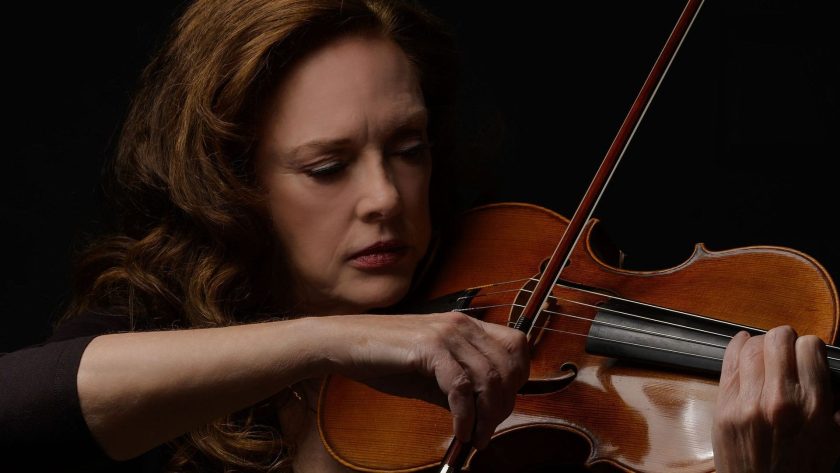
Who or what inspired you to pursue a career in music and who or what have been the most important influences on your musical life and career?
During my teenage years, attending the summer program at Interlochen, Michgan, performing major orchestral works and chamber music with talented young players from all over the world inspired the dream of a career in music. There I met my primary teacher, Francis Bundra, and later studied for six years with him at the University of Michigan. His devotion to producing a beautiful sound, creating tone colors to convey variety of mood and depth of emotion, was a constant inspiration, and he instilled in me the importance of being able to objectively listen to my practicing and maintain a consistent work ethic.
Years later at Tanglewood I was coached in chamber music by Boston Symphony Orchestra concertmaster Joseph Silverstein, who gave me the lesson of my life about bow control (advance planning, way more in advance than most think), and it was his encouragement which led me to take the audition for assistant principal of the orchestra, a position I held for fourteen years. Playing in the Boston Symphony Orchestra when Joseph Silverstein was concertmaster became a continued education about how to achieve chamber music subtleties from a large group of string players, with what we called his “designer” bowings coupled with an ear for everything happening on stage. This experience informs my solo and chamber music performance and teaching to this day.
What have been the greatest challenges of your career so far?
Since the viola neither dazzles with high pitched pyrotechnical display like the violin, nor does it have the range and power of the cello, it has been my life’s crusade to convince concert presenters and audiences that the viola and its repertoire are equally worth hearing. The viola’s range and tone more closely resemble the human voice, and it cannot be coincidence that a viola solo so often appears in film scores and opera to accompany especially tragic and touching moments in the story line. A surprising number of composers turned to the viola in their final years; we have very late works by Brahms, Bartok, Robert Fuchs, Max Reger, Shostakovich, as well as fragments of an unfinished Beethoven viola sonata.
Many musicians and audiences avoid unfamiliar composers, in the belief that they must be inferior to famous ones. However, in his time Georges Onslow was widely regarded to be “the French Beethoven,” Robert Fuchs was vigorously promoted by Brahms to his publisher, and Joseph Joachim’s Variations for viola and piano was proclaimed by Schumann to be “one of the greatest of masterpieces.” Inconceivable to us today, Bach was once performed so rarely that it took efforts by Mendelssohn, Beethoven and Schumann to revive interest in his music, so perhaps unfamiliar composers deserve more attention. Research of lesser known composers yields interesting and varied repertoire for viola – Hummel instead of Mozart, Onslow instead of Beethoven, Fuchs and Joachim in addition to Brahms and Schumann, plus the incredible wealth of mostly British composers from the first half of the 20th century who were writing in late romantic, impressionistic and exotic modern styles. We certainly do not lack works composed from 1950 to the present, and the puzzle is to discover pieces most likely to make friends for both the viola and contemporary music.
Which performances/recordings are you most proud of?
I initially established my independent record label Ashmont to maintain control of selection of repertoire, venue, producer and engineer, but quickly came to realize that my decisions would also need to address cover art, graphic design, promotion, digital distribution, mechanical licenses and even something so mundane as the size of the diameter of the hole in the middle of the CD! Fortunately, my small team of extremely competent professionals has navigated for me the mysterious and constantly changing world of metadata, pixels and bits. Each of my six previous Ashmont releases represents my best work performing music I love, as well as meticulous attention to every production detail.
My recent release with guitarist Bill Zito features music from Baroque to the present, in an intimate chamber music collaboration which has inspired me to explore a sonority of blend and tone colors at the softest end of the dynamic spectrum, since the guitar is not amplified, reminiscent of the whole new world revealed when a drop of pond water is viewed under a microscope. There are moments when we intend our sounds to blend in a way that seems like a single instrument not yet invented.
Which particular works/composers do you think you perform best?
Brahms and his friends Joseph Joachim and Robert Fuchs particularly speak to me for their beautiful melodies set against dark, romantic harmonies. Early 20th century British viola works by Bax, Britten, Bliss, Clarke, and Walton, among others, also offer great opportunities for poignant, intense personal expression in harmonically complex worlds.
What do you do off stage that provides inspiration on stage?
For me, inspiration on stage has its basis in lots of quiet time spent imagining how I want the music to sound, in addition to the obvious work in the practice room. This image needs to originate in the mind, before the hands will obey, and often music I’m working on percolates and runs through my head during walks in the woods, the occasional hike up a small mountain, and downhill skiing. An avid but careful late-in-life skier, I am amazed at the correlation between skiing and performing in terms of the discipline and thought process required to think ahead, control speed, make rhythmic turns, and give oneself positive technical instructions – all while having fun!
How do you make your repertoire choices from season to season?
As a young student, I was under the impression that there was so little music for viola that I could own and learn it all, which to my delighted surprise turned out to be an impossibility. For decades, I have collected viola and chamber music at a much faster rate than I actually learn it, and the collection now fills all my cabinets and closets! It is always an intriguing puzzle to add some undiscovered “treasure” from my library to a program as well as to revisit old favorites, to plan a varied and interesting menu of contrasting emotional content and styles. In my duo with guitarist Bill Zito, we seek both original works as well as ones we can arrange for this combination to design programs balanced with music from several eras, often including contemporary works by living composers.
When it comes to selecting repertoire, especially new music, I am drawn to pieces inspired by a poem, painting, or some other definable idea that can be conveyed to the audience.
British composer John Hawkins first came to my attention for his work Urizen for viola and piano (or strings), inspired by both the poetry and graphic art of William Blake. John wrote Crossings for us, and it has become the title piece of our CD for its reference to crossings of eras, cultures, musical aesthetics, and sonorities between viola and guitar.
Three other works on our CD also depict specific ideas. Puerto Rican composer Roberto Sierra’s 1991 Primera Crónica del Descubrimiento (First Chronicle of Discovery), originally for flute and guitar, portrays Sierra’s interpretation of the first bewildering meeting between the between the aboriginal Indian culture of the Caribbean islands and the Spanish Conquistadores.
Paul Kont’s Ballade, composed in 1950 and described by the composer as “retrospectively medival”, is derived from courtly dances and reflects the tragic 12th century love story of Abälard and Heloïse.
The movements of Cuban composer Joaquin Nin’s Seguida Española from 1930 are based on folk music from four different parts of the country – Vieja Castilla (Old Castille), a sixteenth century melody, Murciana, a stamping dance from Murcia, Asturiana, an expressive song from Asturias, and Andaluza, a gypsy dance from Andalusia.
Do you have a favourite concert venue to perform in and why?
For me, London’s Wigmore Hall and the Troy Savings Bank Music Hall in Troy, New York, offer the most perfect natural acoustic – resonant, warm and inspiring in all dynamic levels.
What is your most memorable concert experience?
Many are memorable for different reasons, but among the most satisfying are the concerts after which an audience member remarks that he/she came not expecting to like classical music (or the viola…) but was pleasantly surprised! I have also enjoyed challenging an audience to come up with a story line for an abstract contemporary piece without a prescribed programmatic idea, and hearing afterwards what they suggest, which can be enlightening.
As a musician, what is your definition of success?
When at a concert you create the intended mood and the audience is so quiet that one could hear the proverbial pin drop, when you know you have played as well as the image in your mind and really communicated the essence of the music – that is the ultimate success. But there is also another aspect to “success” that we’re not supposed to mention – being able to sustain oneself through one’s art, and to be able to earn a good living as a musician, artist, writer or dancer is becoming a more and more difficult accomplishment.
I am delighted when a former student enters the profession as orchestra musician, quartet member, college or preparatory school faculty, and I am tremendously impressed at the imagination and resourcefulness leading some to develop careers in conducting, arranging, composing, and recording string quartet scores for video games.
What advice would you give to young/aspiring musicians?
Listen to live concerts as well as the vast wealth of recorded works for your instrument and don’t be afraid to explore other styles – Baroque performance practice, jazz, ethnic folk music. Even if you ultimately decide they are not for you, the experience will affect your interpretations. Pursue every possible opportunity to play chamber music for its powerfully expressive repertoire and the personal collaborative interactions. Consider entering competitions, if advised to do so by a trusted professional, and if the required repertoire is something you would be working on anyway. Expect to pursue a multi-faceted career involving far more skills than playing the instrument, likely to include public speaking, teaching, writing grant applications, designing business models, and being an ambassador for classical music in your community. Learn how to practice as efficiently as possible, and enjoy the hours of solitary practice in pursuit of excellence as much as act of performing.
What do you feel needs to be done to grow classical music’s audiences?
Early childhood exposure to all of the arts, at home and/or at school, is essential to developing an appreciation for beauty and creative expression. While at a museum one can pass quickly by a painting which does not captivate, the audience at a classical concert is required to sit and actively listen to the entire work. Convincing people that classical music is not only for weddings and memorial services is a matter of exposure, and I am heartened to have recently heard Telemann at an airport baggage claim, Scarlatti while on hold on a phone call, energetic Mozart overtures accompanying a bicycle workout on YouTube, and to learn that a teacher plays my Bach Suites recording for her young students during their writing assignments. It is curious that an avant-garde soundtrack as background music so effectively sets the scene for the intensity of a mystery or horror film, but the same type of score by itself at a concert might not appeal to the same audience. Perhaps the first step is for people to begin to appreciate classical music as background music to daily life.
Outside major urban or academic centers, growing the audience for classical music may require imaginative and non-traditional programs to pique the curiosity of the first-time concert goer. A recent concert I organized in the mountains of upstate New York was a benefit for two local animal shelters, featuring an entire program of music from Baroque to present day about animals for various instruments, the centerpiece a piano four-hand arrangement of Saint-Saëns’ beloved Carnival of the Animals.
The persistent description of classical music as “elitist” needs to end. There has never been more opportunity to hear classical music for free on radio, online streaming and at YouTube. It seems to me that someone who pays $2000 for a concert ticket to hear a pop artist or rock band is more the true definition of “elitist…”
What’s the one thing in the music industry we’re not talking about which you think we should be?
While advances in technology have facilitated dissemination of a classical musician’s work online, the reality that very few music lovers listen to a CD or LP on good speakers in a quiet room these days is devastating to those of us who agonize over recording venue acoustic and a myriad of subtleties lost when music is played on a computer or phone. Each downloaded or streamed track pays the musician only a fraction of a cent…we can but hope for hundreds of thousands of streams…
What is your idea of perfect happiness?
To enjoy good health, be surrounded by people (and a couple of dogs) who love you, and to be happily immersed in interesting musical projects
Discover more from MEET THE ARTIST
Subscribe to get the latest posts sent to your email.
 MEET THE ARTIST