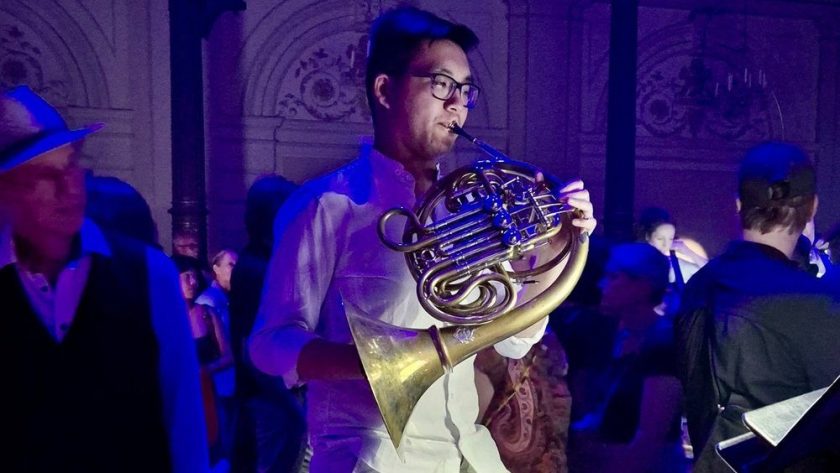
Who or what inspired you to pursue a career in music and who or what have been the most important influences on your musical life and career?
In all honesty, I stumbled into music by accident. I wanted to wear the band uniform in my primary school and the horn teacher, Shum Hing-Cheung, suggested I play the horn over 20 years ago. No one in my family knew anything about classical music, so we went along with it. During my undergraduate studies, my horn teacher Spiros Kessaris made me learn Mozart on the natural horn because it would benefit my modern horn playing. I did not see the point at that time, but I soon fell in love with the instrument and it became my voice. I moved to United Kingdom to study the natural horn with Anneke Scott and later Roger Montgomery, and they showed me what is possible on the instrument and guided me to become the musician I am today.
What have been the greatest challenges of your career so far?
The biggest challenge of my career was undoubtably when I became physically disabled in March 2019. I experienced the first of many Todd’s paralysis following seizures, and subsequent traumas resulted in a diagnosis of functional neurological disorder (FND) in which I experience functional weakness on the entire right side of my body. When it first happened, I thought it was the end of my career as a horn player. But it was also that moment that made me realise that I want to perform; I need to perform, and the natural horn is my voice.
As much as I wanted to play the natural horn, I also had to learn how to play the instrument again with my new reality. I had to adjust my embouchure and play with an off-centre mouthpiece placement given the reduced sensation and control on my right side of my face, and I had to find a different way of playing when my right arm has slightly reduced mobility. As hard as that was, the hardest part of this challenge was navigating and forging a path forward as a disabled musician within this unforgiving industry. I could not hide my disability as I was not able to walk unassisted at the time, and it was about being comfortable with my playing as well as my new identity. I did lose some work during this journey, but at the same time, I also had the opportunities to meet and work with some wonderful musicians and ensembles who accepted me for who I am, and I am eternally grateful to them.
Which performances/recordings are you most proud of?
I think I am most proud of the recordings in my debut solo album Caprice Reimagined. They are recordings of extremely virtuosic pieces written for me, and although I am proud of them because they reflect my growth as a musician, they also reflect my growth as a person adjusting and navigating to life as a disabled person. It’s not only my first project in which I was the main creative driver, but also the first time where I really embraced who I am as a person. Just as the natural horn is an ‘imperfect’ instrument full of its own idiosyncrasies, the fruits of these collaborations reflect my own characteristics and quirks.
Which particular works/composers do you think you perform best?
I have always had a close affinity to Jacques-François Gallay’s works. I am fond of his music and I feel like they have played a role in my development as a horn player. In particular, I really like his second caprice and have performed it regularly ever since I managed to learn it on the natural horn!
In terms of the new works I have commissioned, I have performed Grace-Evangeline Mason’s In the Garden of a Museum and Rockey Sun Keting’s Chuān II more than other pieces. Grace and I are really good friends and the piece grew out of that friendship. Rockey’s piece is perhaps the closest thing I have that reflects my faith and background. I feel both pieces capture my essence not only as a natural horn player, but also as a human being. I also think they are pieces that are accessible to both performers and audiences alike as well as being musically challenging, and my interpretations of these two works have grown over the years!
How do you make your repertoire choices from season to season?
The solo natural horn repertoire is quite small compared to other instruments, so it does make repertoire choices a lot easier. I am conscious of the fact that the natural horn is quite a niche instrument, and most people would never have heard it in a solo context, so it’s about creating a sonic journey that invites the audience in, and then explore the various qualities of the instrument together. Since commissioning the new works, I am quite lucky that I have a wide range of styles to choose from, and I can adjust the repertoire choice accordingly. I like mixing in new repertoire with the old, so for me it’s about finding a balance between different sound worlds, from tonal music to music that are microtonal. I want each programme to contain music that makes the audience feel comfortable, but also music that gently (or in some cases not so gently) challenge the comfort zones of the listeners.
Do you have a favourite concert venue to perform in and why?
I have been really fortunate in having the opportunity to perform in some of the most famous concert halls around the world, but for me, I love an intimate venue where I can interact with the audience, Heath Street Baptist Church in Hampstead holds a very special place in my heart. It is also the home of Baroquestock, a festival filled with amazing homemade meals and music making with friends!
I also love playing in the Angela Burgess Recital Hall in Royal Academy of Music, London. The Academy has given me so much support over the years, especially with my doctoral project Caprice Reimagined, and many of the pieces in the album were premiered and performed in that hall.
What do you do off stage that provides inspiration on stage?
I really like to switch off from music whenever I am not performing, and one of the things I love doing is playing bowls (the sport where people, usually old, roll a bowl on a green). All of my teammates and people at my club don’t have a clue what I do (they know I am a classical musician but they don’t really know what that means), and I really like chatting with people who live vastly different lives to me. They help me appreciate my profession even more, and inspire me to think about music and performance in a different light.
What is your most memorable concert experience?
I think Paraorchestra’s The Virtuous Circle at the BBC Proms in Bristol in 2024 really sticks in my mind as one of my most memorable concert experiences! I think it was especially special because it combined Mozart’s Symphony No. 40, a new commission, the natural horn, choreography, and some of my favourite people all into one performance! I have always wanted to do a project where I would also be moving, and it was amazing being a part of a team where we created and developed a show from start to finish. To top it off, it was a really extraordinary experience being able to share the whole process with audiences as we moved through the crowd!
As a musician, what is your definition of success?
I think there is a lot of expectation on winning an orchestral position as a reflection of success. Even though I have carved out a career doing collaborative and unconventional projects, I am guilty of falling into that trap, and at times I feel inadequate or unsuccessful because I am doing something outside of the traditional norm and not auditioning for a full-time orchestral position.
I think this is why I am particularly proud of my album Caprice Reimagined, as well as my collaborations with Dan Canham for dance films The Breath After and A Body I Can’t Hold (Paraorchestra), with Ann Wall for fragmented (ClimArts), and with Simeon Barclay for his performance work The Ruin (The Roberts Institute of Arts). These are projects where I stepped out of my comfort zone, explored and created works through collaborating with other artists. Ultimately, they reflect who I am.
What do you feel needs to be done to grow classical music’s audiences?
I think there is a lot of gatekeeping within Classical music, despite our best efforts in removing some of those barriers. The concert hall itself can be alienating, and there are a lot of “etiquettes” that can make the whole concert experience very intimidating for people new to classical music. I think we can all make an effort in making classical music as accessible as possible, enabling everyone to experience and enjoy it without judgments or expectations. Some people might want to clap or cheer in between movements; some might want to leave their seats and move to the music. We should create an environment in which people can express how they feel when they listen to music. These might be disruptive behaviours to the more seasoned concertgoers or the purists, but I think people should also be able to have a good time and interact with the music and the musicians in their own ways.
What’s the one thing in the music industry we’re not talking about which you think we should be?
I think our industry has created very narrow and specific definitions of what success and excellence look like, which mean that a lot of talented musicians who don’t fit those definitions are not celebrated, or in the worst case, discarded. Of course, different social and political climates over the years meant that those definitions have shifted, but those definitions are still quite limiting and only reward people who fit into very specific categories. I think we should have a more diverse understanding of what success and excellence in our industry looks like. Some of the most creative and inspirational people I know are friends who are balancing a freelance career with work outside performance such as advocacy and healthcare as well as friends who have dedicated their careers in providing excellent education and widening participation work. Success and excellence shouldn’t be defined only by how well you play an instrument or what position you hold in an orchestra, but rather by how you embrace who you are and do the things that make you feel fulfilled.
What advice would you give to young or aspiring musicians?
It sounds really cliched, but I would say dare to be who you are. I think there are a lot of expectations in our world, and we often feel the need to be someone else in order to fit in or succeed. But there is a lot of power in knowing who you are, and embracing your strengths and flaws.
What’s next? Where would you like to be in 10 years?
Caprice Reimagined is the first step of hopefully many to come. I think I needed to know what the natural horn and I are capable of doing on our own, and this project helped me realise my artistic potential and gave me clarity on future artistic directions.
My current project is actually on creating a triptych of films that explore lived experiences of disability through dance and music! I have already made two of them with Dan Canham as part of my residency with Paraorchestra featuring original music composed by me, and I am hoping to make the third one sometime soon to complete the triptych!
I have also started collaborating with other musicians to create collaborative works. It’s still very early days, but the direction for the next recording project is very much one that focuses on how the natural horn and I interact with other musicians. I also have plans for creating new works for chamber ensemble, and ultimately, to commission natural horn concertos!
What is your idea of perfect happiness?
Doing the things I love, with the people I love. I am lucky that I have some wonderful colleagues and friends that make work really enjoyable and fulfilling, and I have an incredibly supportive and loving family who makes me feel comfortable and cherished for who I am.
Caprice Reimagined, featuring twelve new commissions by twelve composers as well as Jacques-François Gallay’s Douze Grands Caprices, was released on 11th July, 2025 by New Focus Recordings. Find out more
Discover more from MEET THE ARTIST
Subscribe to get the latest posts sent to your email.
 MEET THE ARTIST