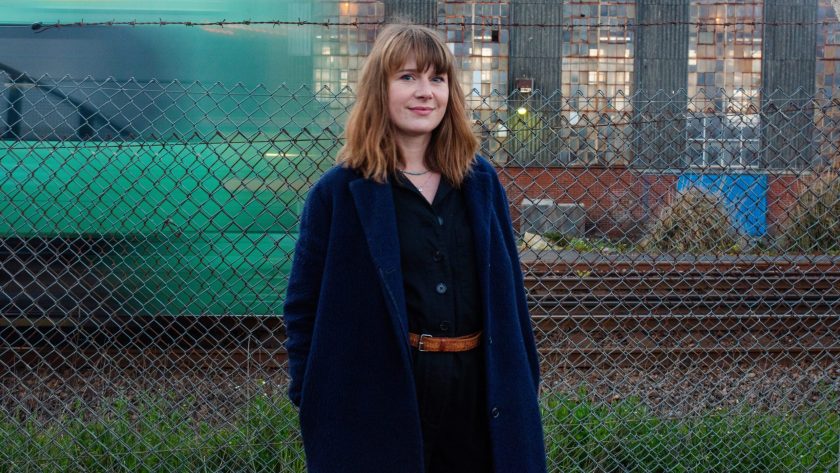
Who or what are the most significant influences on your musical life and career as a composer?
I don’t have musician parents; however they are artists. I feel grateful for having many artistic influences growing up, that provided a fertile and diverse palate for writing music now. I also had some key supporters very early in my musical learning, who believed in and encouraged me. Looking back, these folks were key to me pursuing a career in music. I sometimes wonder what I would have done without their input.
Composers include: Reich, Bach, Shaw, Ives. Electronic musicians, such as Murcof & Aphex Twin.
What have been the greatest challenges of your career so far?
When I was younger and trying to find my voice, and being somewhat isolated in what I wanted to do then. Being undiagnosed neurodivergent also at that time, I was dealing with a lot of challenges that I couldn’t quite understand. Additionally, becoming a mum and reestablishing a career in music as a parent has been extremely challenging, however it has focused me hugely.
What are the special challenges/pleasures of working on a commissioned piece?
Not having to mine one’s soul for material! I love working to brief. It allows a certain amount of play and exploration that self-led projects sometimes have less of, due to the amount responsibility it takes in leading them.
What are the special challenges/pleasures of working with particular musicians, singers, ensembles or orchestras?
I like to get to know the people/instruments I’m working with – what makes them tick as a musicians. The music flows better when I can establish some touch stone connections. I also want to understand the particular instrument I’m writing for, how the musician works with it as an individual. I am less interested in how something ‘should’ be played, but how the individual connects to their instrument.
Of which works are you most proud?
My most recent endeavour – Hello Halo (for 6 voice, violin and fixed media). It is my most authentic work to date. But then, with each new work, I feel the proudest of. With the next endeavour, there is always a learning curve that gets you to a new place, so watch this space!
How would you characterise your compositional language?
I like to blend familiarity with unexpected elements. I work primarily with texture as a jumping off point. I like to work with as much opposing texture as possible to create tension & release.
How do you work?
I need space, usually in a place that isn’t my usual place of work and to have a clear deadline. Which seems contradictory I know, but it’s more carving out an allotted time for space that is site specific, which I know will end at a specific time. This focuses me.
I always like to use field recording as a practice and as thematic launch pads for my work. This will always be part of the R&D of the any project I’m doing.
As a musician, what is your definition of success?
Following through on the ideas. Not letting them die on the vine.
And finding/maintaining balance – which is rarely easy, but when I feel there’s balance with my work/projects, I am feeling like some semblance of success has been achieved!
What advice would you give to young/aspiring composers?
Seek inspiration from everything. Not just classical music. All sorts of music, art, people & places.
Then make what you want to make. Never stop learning.
What do you feel needs to be done to grow classical music’s audiences?
That’s a huge question. I think more needs to be done to understand the barriers to classical music. Class, ableism, racism, misogyny, all have a part to play in why many people feel that classical music ‘isn’t for them’. Embedding classical music into communities is one way, however that needs to be a sustained endeavour rather than a one-off idea. The lack of funding in state schools also has a huge part to play. We need to cultivate an eco-system that functions beyond primary education, that acknowledges classical music needs to feel like it is from them, as well as for them. It needs to extend all the way to universities, venues, promoters, agents, labels.
What’s the one thing in the music industry we’re not talking about but you think we should be?
The issues stated above. And career gaps! They need to be normalised. They happen for all sorts of reasons, such as physical/mental health, becoming a parent, sabbaticals/retraining etc. The trajectory of a music career is rarely a straight line, but often a cyclical one. Time out can be crucial for a sustainable career, yet is often viewed negatively. Re-entering can often feel like one has to start all over again.
Developed alongside Ruby Colley’s brother, Paul, who is neurodivergent & non-speaking Ruby’s new work Hello Halo is a touching reminder that people can express themselves in other ways. Despite being termed “non-speaking,” Paul uses a rich repertoire of sounds & gestures. This composition transcribes these communication methods, using live voice and recordings of Paul, to make a vocal map of Pauls life & relationships. It is an intimate examination of communication, both subtle and nuanced, and asks questions of what it means to be human.
Performed by Exaudi Vocal Ensemble, conducted by James Weeks, ‘Hello Halo’ is shaped by Ruby’s own (a neurodiverse musician) & her brother’s lived experience, but is aimed at both neurodiverse & neurotypical audiences.
Discover more from MEET THE ARTIST
Subscribe to get the latest posts sent to your email.
 MEET THE ARTIST