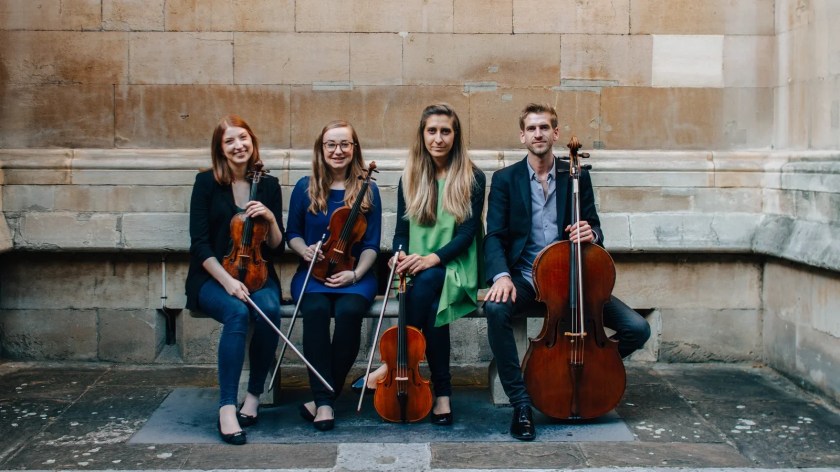
Consone Quartet are: Agata Daraškaite (violin), Magdalena Loth-Hill (violin), Elitsa Bogdanova (viola) and George Ross (cello)
Who or what inspired you to pursue a career in music and who or what have been the most important influences on your musical life and career?
Agata: WW2 started on my grandmother’s first day of school and her whole family got torn apart so she couldn’t pursue her dream of studying music. She took me to a music school at the age of 5 and I haven’t looked back since – perhaps I’m living her dream!
Magdalena: We always had the radio on at breakfast time before school, so I grew up listening to lots of music. My dad plays the piano (not professionally, but to a very high level) and although I hated practising as a child, I loved sight-reading any sheet music I could get my hands on with him!
Elitsa: My mum played the piano when she was little, so she introduced me and my sister to the piano at the age of 5. From that point music was always a key part of my life, mostly through singing, until I eventually discovered the viola at the age of 12 and never looked back.
George: My whole family are musical and my love for the cello really came from hearing my eldest brother, Laurie, practising his in the other room. He always made a beautiful sound and could also put his hand to many other instruments. Now he writes electronic music for a living. Laurie came to play the cello because my dad and Steven Isserlis were playing some recitals together at the time, and Laurie would sit in our music room, listening to them rehearsing which was apparently the only time that he shut up, as a child. He’s the complete opposite to that these days!
What have been the greatest challenges of your career so far?
COVID was a challenging time for all of us in the creative industries. All our concerts were cancelled for a time and it was hard to get together, both socially and also to keep the group going. We had to get creative with various projects, but nothing beats live music and we were all so grateful when we could finally meet and play music together again.
Another challenge we have faced is that we seem to sit in an interesting gap in the market – we don’t fit into the baroque music world, since the string quartet such as we know it didn’t exist during that period. Nor do we quite fit the “modern string quartet” model. It has been hard to know where to pitch ourselves and we often don’t fit the remit of specific festivals and concert series. On the other hand, it has also occasionally been very useful, meaning we can dip a toe in each camp!
Which performances/recordings are you most proud of?
We are particularly proud of the Barnstorming! videos we created with videographer Jessie Roger and sound engineer Brett Cox during the pandemic, in collaboration with some fantastic musician friends. This project was funded by Continuo Foundation, which was set up around this time and has supported 256 UK-based early music projects to date!
Which particular works/composers do you think you perform best?
We enjoy spending lots of time together on the works of a particular composer, finding a common “language”. The two stand-out composers for us in this regard would have to be Haydn, as the so-called ‘Father of the string quartet’ and Mendelssohn, the first of the Romantic composers whose music we obsessed over! We try and play from first or early editions as much as possible and with Mendelssohn’s music, we are particularly spoilt with the marked-up parts of players from the time. This has allowed us to experiment with different performance practices and also to push the boundaries of our 21st century tastes!
As far as boundaries go, we love a challenge and so a particular recent highlight has been playing Schoenberg’s “Verklarte Nacht”. It was obviously written over 100 years ago, so it’s not exactly avant garde, but for our set up and in the context of the music we usually play, this has been an exciting adventure.
What do you do off stage that provides inspiration on stage?
We all enjoy doing different activities – cycling, walking, reading, photography, cooking and listening to “juicy” old recordings that inspire us.
How do you make your repertoire choices from season to season?
We have an extensive repertoire ‘wish list’ and we will periodically have long meetings to discuss programme themes, how to pair various pieces up and so on. It’s a long process since the string quartet repertoire is so extensive!
Do you have a favourite concert venue to perform in and why?
We are lucky to perform in lots of fantastic venues around the world, but a particular local(ish) favourite would have to be the Holywell Music Room in Oxford. It is said to be the first purpose-built concert hall in Europe and has the most magical acoustic. The audience is always enthusiastic and it has a wonderful intimate quality, perfect for the kind of music we love playing.
What do you feel needs to be done to grow classical music’s audiences?
Music seems to have been woefully neglected in most schools and so we would probably say education. We have recently teamed up with Sheffield’s Music in the Round and have been going into schools to coach young musicians and to present concerts and workshops. It is really exciting to engage the next generation in this way and to show them that music is a universal language for everyone.
What is your most memorable concert experience?
We once did a concert at the Lapwing Festival where we performed in a marquee facing the Seven Sisters cliffs. After the concert we stayed in a cottage on the cliffs with no electricity, powered only by a generator that switched off at a certain point in the evening, after which you were in complete darkness.
As a musician, what is your definition of success?
Being able to do what you love for a living and feeling that it is making a difference to people’s lives.
What advice would you give to young/aspiring musicians?
To immerse themselves in as many different musical contexts/genres/experiences as they can and to keep asking the question “who do I want to be and what is my true musical voice?”. They mustn’t be afraid of the fact that the answer is likely to keep changing.
What do you feel needs to be done to grow classical music’s audiences?
Classical music in particular can often feel like an expensive and elitist hobby. Music needs to be valued and better funded. Through better music education, we can reach young people and find the musical experiences that speak to them.
What’s next? Where would you like to be in 10 years?
There is still so much good quartet music to explore. We always like to push the boundaries of what is possible on our gut string set up, so who knows, maybe one day we will get to Bartok and beyond…
What is your idea of perfect happiness?
Sometimes you get moments, or even whole movements in concerts where you feel completely as one with your three colleagues. Feeling like you’ve somehow found the three other quarters that challenge and perfectly complement you.
What is your most treasured possession?
Our instruments are our voices and therefore irreplaceable.
What is your present state of mind?
We are all looking forward to what 2026 has in store for us and we are particularly excited about some of the collaborative projects we have lined up.
Consone Quartet’s second instalment of quartet music by Felix and Fanny Mendelssohn is now out on Linn Records and all streaming platforms
Discover more from MEET THE ARTIST
Subscribe to get the latest posts sent to your email.
 MEET THE ARTIST