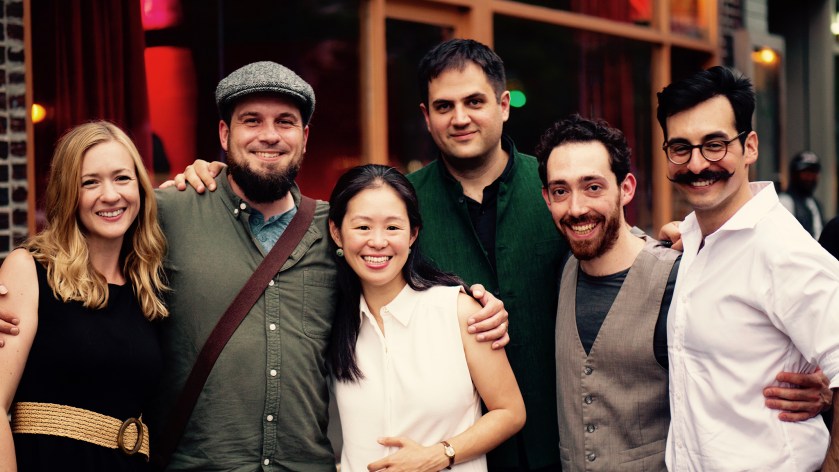
Who or what inspired you to pursue a career in music and who or what have been the most important influences on your musical life and career?
Chris Moyse (CM): I kind of fell into a music career. I think when I moved to Nashville many years ago, there was a vague notion of wanting to write songs and perform them in front of people. But the thought of monetizing it was too abstract at that point. I started to discover songwriters like Jason Isbell and Gillian Welch and Hayes Carll and I became obsessed. I had been playing guitar and singing since I was a kid and something just finally clicked. I knew I wanted to be an artist and in order to do so I knew I had to write a lot of bad songs first. So I did. And then eventually your batting average gets better. I remember the first time I wrote a song that said everything I wanted to say and didn’t make me cringe. It was a great feeling. After that, I was hooked.
Hailey Fuqua, soprano (HF): My uncle and nana were incredibly important in choosing a music career. From a very young age they would send me recordings and tell me about great singers and composers and tried to instill a love of classical music. It certainly sunk in as I took up piano at age 5 and then began singing lessons around 11. Recently I came across notes from my nana detailing which Mozart piano concerto was being played when I was born.
Asako Takeuchi, violin (AT):I have always been surrounded by musicians and couldn’t really imagine a life without doing music. There have been many people who influenced me on my musical life, but my time at the University of Southern California was a big turning point in my musical career, and Elizabeth Wallfish is perhaps my most memorable mentor and the reason why I could continue playing this long.” –
Andrew Arceci, bass & mandolin (AA): When I was young, music was always around—classical, jazz, opera, and other genres. I was fortunate to have several great teachers, but my two undergraduate professors were true mentors. I hold a deep reverence for them: Paul Johnson, with whom I studied double bass, and John Moran, with whom I studied viola da gamba (viol), violone, and musicology.” –
George Lykogiannis, accordion & piano (GL): I have always had an interest in music and in the piano, particularly. My mother and her mother were both musicians (my grandmother was an accordion teacher) and encouraged me to study. I started formal lessons when I was about ten, and it quickly became the only thing I really wanted to do. I have been fortunate to study under several incredible teachers, but it was my professor Emile Naoumoff at Indiana University who was one of the most inspirational; he is a veritable fountain of knowledge and I often think back to that time with gratitude for all the wisdom he imparted. I also have the great honor of playing music with many of my friends, who are top musicians in their fields – I have learned so much just by listening to them talk about music and hearing the way they express themselves through their instruments. In addition, I have been working as a ballet accompanist for the better part of a decade, and I have learned so much about phrasing, dynamics, and musicality from working with dancers for these many years.” –
What have been the greatest challenges of your career so far?
HF: The pandemic really hurt a lot of musicians and changed the way we find/connect with audiences (for good and for bad). I was leaving conservatory right as the financial crash was happening in the late aughts and for so many of us emerging professionals, opportunities were few and far between. As we were hitting our stride was right when the pandemic hit which really set a lot of us back. As we build back we have to find different ways to engage audiences and find new opportunities for ourselves. What a classical music career looked like in 2008 is a lot different from 2025.
AT: It’s been challenging to keep on performing after having children, since I have much less time to practice.
AA: The initial COVID-19 shutdown. In candor, the industry is still recovering from the pandemic.
Which performances/recordings are you most proud of?
AT: My Telemann concerto CD:
AA: In addition to soundtrack work for BBC’s Silent Witness, perhaps Love & Lust (with Elizabeth Hungerford, soprano), The Oxford Sessions (with Floyds Row), and Treasures of Devotion: European Spiritual Song ca. 1500 (with The Boston Camerata).
GL: I am proud of my performances as part of Floyds Row; I love any time I have the opportunity to play music with my friends, and I love the genre-bending music we play. The music itself is straightforward, but there is something so compelling about rearranging them for the group and making them our own, braiding together various styles and ideas to create something both timeless and fun.
Which particular works/composers do you think you perform best?
HF: Mozart is and has always been my favorite composer to sing. He knows the voice so well and has such an ingenious way of writing that can convey an entire range of emotions. For my voice type (coloratura soprano) there are so many great roles and arias that it fits like a glove. I also adore singing the music of French Baroque composers like Rameau, Lully, and Charpentier. There’s an effervescence and joy and dancing lilt to their music that makes it such a pleasure to sing.
AT: Folk music
GL: Probably my own music, which may be a cop-out, but it’s true!
How do you make your repertoire choices from season to season?
AT: I have a list of music that I’ve been wanting to play for a long time, so I tend to choose from that list or whatever is suitable for that particular concert theme.
AA: With Floyds Row, we arrange and/or collate repertoire as an ensemble.
Do you have a favourite concert venue to perform in and why?
HF: Symphony Hall in Boston. There’s such a special feeling to performing in such a hallowed hall that has seen many premieres and important performances. Not to mention the near-perfect acoustics, it’s a storied venue for a reason.”
AT: I like Sanders Theatre in Cambridge, MA, because I used to go see concerts there before I became a professional musician and now when I perform there it makes me realize how far I’ve come.
What do you do off stage that provides inspiration on stage?
CM: Offstage, I’m inspired by going out and seeing other artists play around town. I have my gripes about Nashville but one thing you can’t fault us for is lack of good live music. You can have your socks knocked off at 5pm on a Wednesday in a dive bar with only a few other people listening. It’s a little cliche but I’m also inspired by books. Honestly they don’t even have to be very good books. Something about seeing language and processing it seems to prime my brain for writing. Or it creates an openness to ideas. If I have writers block, I need to read.
AT: I can’t think of anything… practice?
GL: I try to keep my ears and eyes open, to try to absorb as much as I can from other artists and musicians. I also like to escape NYC and get out into nature if I can. I find that being outside and listening to the woods is both calming and inspirational. But when I’m in the city, I go to museums, I go see shows and performances, I walk around and look at the architecture, I go down various research rabbit holes; each has its own merit, and together, I feel like they all feed into my creative bank, and I can pull upon those ideas and impressions I was left with as I perform.
What is your most memorable concert experience?
HF: In 2015 and again in 2019 I was part of the premiere of Lee Mingwei’s “Sonic Blossom” here in the US. This is a living art piece that offers the gift of song to museum-goers. Once we’ve found and asked if we can offer our gift, we lead the listener back to a gallery where we perform a piece of Schubert lieder (German art song). Performing to one person at a time is such an intimate and profound experience for not only the singer but also the listener. You also don’t know what any person is going through when you offer this and the reactions ranged from pure joy to sorrow and everything in between. On any given day I might perform for 10-12 people (in addition to all the other museum-goers who heard the commotion and gathered into the gallery) and it was an incredibly meaningful experience both spiritually and as an artist.
AT: When I played a Sound of Music concert in Los Angeles with my sister as my stand-partner, about 25 years ago, because that was our favorite movie growing up.
GL: The most memorable concert experience for me was performing at the Keller Auditorium for TEDxPortland in 2024. I was commissioned to write a short piano ballet for Open Space, a contemporary dance collective in Portland, OR. I was playing the score live on stage as the dancers were performing the choreography that was set to the score I wrote. It was an incredible experience to be there on stage as part of this original dance piece; the energy was palpable, and I was so honored to be featured and to have been a part of such a giant undertaking. See the performance here:
As a musician, what is your definition of success?
AT: To be able to make a living and raise a family, playing music.
GL: Honestly, I feel that success is simply being able to have music in your life and being able to do it daily.
What do you feel needs to be done to grow classical music’s audiences?
HF: It’s hard for so many to see classical music as something that’s cool or engaging and not just the activity of our grandparents. But in reality, classical music and opera have plots that are just as salacious and juicy as any reality TV show. Affairs, disguises, lies, questions of paternity, it’s all there! As our viewing and consumption habits have changed over the past few decades we need shorter and more approachable venues to encounter this music. Whether that’s at a restaurant, bar, park, or any other venue that is casual and available to anyone, we need to meet more people where they are.
AT: I think people have to be less on their devices and learn to enjoy real-life experiences, to appreciate calm and quiet time with music.
AA: Many American schools have reduced art, music, and/or gym programs. In addition to academic subjects, these are vital situations where children learn creativity.
What’s the one thing in the music industry we’re not talking about which you think we should be?
HF: How we fund and support the arts here in America. We rely so heavily on individual donations and severely lack the government support and protections that many other countries provide. Every musician I know has multiple ways they make income, none make it solely from performing. If we had better safety nets and changed our model of funding (unlikely) we might have a more ingrained system of classical arts in our lives.
AT: I think the music industry in the US is doing a really good job, especially the Musician’s union. There are not many other countries that have a union to protect the musicians and we should be proud of it.
What advice would you give to young or aspiring musicians?
HF: Know that the path you think you should take is not often the one that will bring you happiness or success. There are so many different paths and ways to have a career in music and to understand how that fits into your life for your creative and economical needs will help you move forward. The prescribed path for training is no longer clear cut or viable in the same way it was 20, 30, or 40 years ago. You have to find ways to make your own opportunities but also to advocate for yourself and your art. Finding that balance of what drives you and sustains you creatively will be the key to being a lifelong musician.
AT: Being a musician is not an easy job but if you really like music then don’t give up.
AA: Listen to everything—western genres, as well as non-western genres. Additionally, read books (not just material online), visit museums, and meditate.
GL: Just keep doing it. The people who are still in the business are the people who have not stopped. Keep honing your craft, keep doing it, and keep getting yourself out there to be a part of the community.
What’s next? Where would you like to be in 10 years?
AT: If I can still be performing and teaching in 10 years, I’d be happy.
What is your idea of perfect happiness?
AT: There is no such thing!
What is your most treasured possession?
CM: My most treasured possession is a 1967 Guild semi-hollow body guitar that may father gave me. He bought it when he was 14 and it’s definitely not in perfect shape. But there’s something alive in it and I don’t mean the cobwebs. When I play it on stage, it’s like it does half of the heavy lifting for you. Like it says “You just play the notes right and I’ll cover the rest” or something. Just pure soul. I love that guitar.
HF: My mother gifted me a string of pearls for Christmas when I was 16. As I auditioned for conservatories and attended and continue to perform I often wear them as a reminder of where I came from and what I value most at my core. My mom passed about two years ago and to have this gift that I’ve carried with me for the last 20 plus years has been a beautiful connection to her, my home, and the young aspiring musician I was.
Floyds Row just completed a New England tour, including the Winchendon Music Festival. Visit their website for details of upcoming concerts in 2026
Discover more from MEET THE ARTIST
Subscribe to get the latest posts sent to your email.
 MEET THE ARTIST