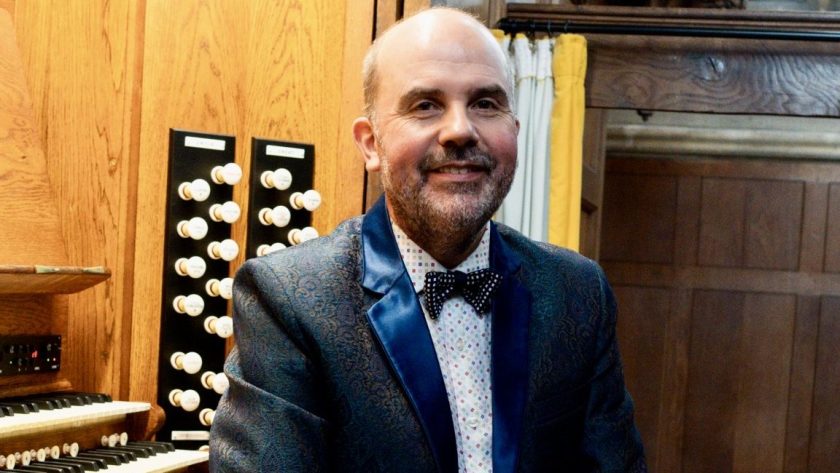
Who or what inspired you to pursue a career in music and who or what have been the most
important influences on your musical life and career?
To begin with I would like to thank my wonderful parents. I grew up in a household where I could not have failed to find inspiration during my formative years. My father was a well-known poet and biographical writer, and my mother was a Speech and Drama teacher. I was fortunate to benefit from the assurance of their support, along with their kind encouragement and endurance. Furthermore, I was very lucky to study with brilliant musicians at school, and I remain eternally indebted to them for finding and teaching me.
My damascene moment was when I first experienced Puccini’s Tosca performed by a company
visiting my school when I was 11. Little did I know Puccini started as an organist or that I would
become one, but I certainly knew that something inside resonated and I knew I had to follow it. I had already been taking piano lessons and was just starting to play the organ, but the flair was well and truly lit by Puccini’s music. Who can resist the De Sabata, Callas, Di Stefano and Gobbi 1953 recording of Tosca?
It was not until the age of 22, having completed College and University studies, that I was to focus on the organ alone. So, my second transformative moment was when I first heard Thomas Trotter who for me is the greatest British organist of our time, perform live. I had not experienced the organ in concert like this before. It was both momentous and revolutionary, and I wanted to find out how far I could tread along this path.
What have been the greatest challenges of your career so far?
The greatest challenge with becoming an organist is defining a sustaining pattern of work with which you can make a living and have access to realistic instruments for practise and improvement. Unlike most other instruments, you cannot take the organ with you, and you will need to go to where it is.
This means you must find a place to be where you can make a realistic living, and this can take some time. I made attempts to secure this in several locations before I eventually succeeded in settling where I am now.
The thread which has continuously run through however is my love of learning repertoire, teaching and taking lessons, planning and giving concerts and making recordings. All things come with their own individual challenges in music, but the rewards possible are essentially the lifeforce of any career.
Today I am not long into my third decade as the organist of Cheltenham College; I have been very
fortunate to hold this post where I both teach young musicians and play a fine instrument for some 700 of them at the start of their day. I am facing a generation with the power to instantly access the music they want to at any time and trust me, it’s not likely to be original organ music!
So, to capture their attention, I have enjoyed making arrangements of music not normally associated with the organ in order to present them with music they hear elsewhere. Connecting this younger generation with the organ is my greatest challenge and it is something I work with every day.
Which performances/recordings are you most proud of?
I aspire to a performance where I firstly can achieve freedom in movement to express the music;
manage my sound-world well; communicate the rationale behind the music; become confident and focused on my touch and technique; finally, and most importantly, where the audience have an enjoyable time and go home satisfied and enriched.
The most important thing to always remember is that while I always find something I need to
improve for next time, my accurate self-evaluation, dedication and self-awareness is the way
forwards from that point. My learning and improving must therefore come from a place where I
should be both humble and modest in order to become receptive to change.
Having said this yes, it is right to be proud of recordings and performances when we put so much
energy and work into them, but still this feels less awkward and more honest for me when I have
done all I can to stay true to my aims and aspirations in any related performances as well.
Which particular works/composers do you think you perform best?
All organists learn to play J.S. Bach, and his music is always both testing and a great discipline to
perform. Learning to play Bach has been the foundation and key to everything for me. I began this life-long journey as a student at the Royal College of Music. I am still on that journey.
My greatest passion also is probably for 19th century-onwards symphonic organ repertoire. I love to play any music where there are opportunities to include orchestral colour to portray dramatic themes and stories.
The organ has so many different and obvious personalities you can portray, and this is why I love
playing arrangements of orchestral, instrumental, film and sometimes even pop/rock music. I
increasingly realise I play an eclectic instrument which not only has its own majestic, wonderful
repertoire, but highly effective when playing arrangements of music it is not usually associated with; something which is very much in vogue with the organ in today’s classical music world.
I have recorded works by Liszt, Tchaikovsky, Elgar, Holst, Saint-Saëns and Coldplay and my next
album Expectations (due for release on 16th January 2026), pairs music by the towering French organ composer Marcel Dupré with another towering figure of the Rock/Pop world, David Bowie.
How do you make your repertoire choices from season to season?
The seasons by default form a map for the organist’s annual repertoire. This can be both liturgical and commercial, but most helpful of all is that this instrument probably has the largest repertoire of any stretching back from almost 1000 years ago to the present day. My criteria for a recital programme is to reflect this. I usually include a work by J.S. Bach, and earlier work if the instrument is appropriate, a contemporary piece and an arrangement of a piece you would not think you might hear played on the organ.
Do you have a favourite concert venue to perform in and why?
I am looking forward to next year because I will get to play in twice in Paris. First at La Madaleine in April, and then at Notre Dame Cathedral in October. Paris is pretty much heaven for organists, and I cannot wait for these concerts to come round! My invitation to play in Notre Dame first came in 2017 and it was going to be for the for 14th August 2019, so I am sure you can imagine how excited I am for this now! The newly rebuilt Grand Orgue stands 12 metres high in the west gallery as it always used to. Its console has five keyboards, and this legendary instrument is one of the largest in France with roughly 8,000 pipes.
What do you do off stage that provides inspiration on stage?
I am always happy when travelling and I enjoy discovering new places. My inspiration is found from meeting people and experiencing culture at home and when away. I also love to cook and go out to restaurants; particularly after something creative. I am already thinking about restaurants I would like to go to after my concerts in Paris next year.
What is your most memorable concert experience?
When I first played at St Thomas Church 5th Avenue in New York on March 25th, 2012, I was warmly welcomed by the eminent John Scott LVO. I greatly admire his groundbreaking recordings of Dupré and Duruflé on the organ of St Paul’s Cathedral and I had therefore programmed works by both composers in my concert that day. Unknown to me however, John had invited some very important organists to St Thomas Church that day: James McVinnie; Benjamin Nicholas; and Christopher Robinson all of whom happened to be in New York that weekend. They all attended my concert, and we spent an enjoyable private cocktail hour at MOMA afterwards. I was quite relieved to learn my recital had been well received by the assembled party!
As a musician, what is your definition of success?
Being both aware and prepared. All organs are different and making sure you have programmed
correctly for the instrument you will be playing is vital. It is also important to make sure you can
organise enough rehearsal time to acclimatise and adjust to differences which you will encounter.
This usually takes 3-4 hours. Ensuring you have done everything you can to reach your goals is the key to success and to being satisfied for me.
What do you feel needs to be done to grow classical music’s audiences?
Central to this is variety of repertoire the way that we as performers communicate with our
audiences. Most of the time this relationship must obviously be non-verbal, but inclusivity is so
important today and the concert experience you want your audience to have needs careful planning and a uniformity of style.
Being seen and talking to your audience is a vital part of this communication as an organist. At best a camera and screen relaying your performance from the organ loft makes all the difference to the way your audience engages. As some of our original repertoire sometimes comes over as a little bit niche, a spoken introduction is always a good way to break the ice. Easy-reading programme notes are helpful; I keep meaning to build a database of my programme notes for future use. I think live streaming concerts widens availability and can sometimes be a good way to increase audience numbers, but nothing can beat the excitement of witnessing live music for real.
What’s the one thing in the music industry we’re not talking about which you think we should be?
The ever widening gulf between perseverance and immediate gratification is the area which affects me most in today’s fast changing world. I follow the battle between music written by people and AI very carefully and recent reports of how AI could supersede need to be heard and taken very seriously by the present government.
I know I need a certain amount of time to learn and embed new music but find increasingly that
these essential elements are becoming eroded by the demands of the speed at which everything
moves today. I feel the advent of social media is indeed amazing but also think it is still in its infancy and requires skill and experience to handle for the good of all.
Mental health in music is thankfully being addressed now and the other various stigmas facing my generation as music students have now also thankfully also faded into insignificance through bravery and hard work.
What advice would you give to young or aspiring musicians?
Art requires honesty! We must command its respect which requires learning, time and dedication. In other words, remain true to the decision you made to follow a career in music remembering that although it is wonderful when you are appreciated by others, you are responsible for this and yes, it is worth it.
What’s next? Where would you like to be in 10 years?
More concerts and hopefully more recordings. I hope continuing to play to 750+ young people at the start of their school day; let’s see…
What is your most treasured possession?
My organ shoes. I have had the same pair since I was 22. They have travelled widely with me and I would be lost without them.
Alexander Ffinch’s latest album Expectations is out now on the Divine Art label. Find out more
Discover more from MEET THE ARTIST
Subscribe to get the latest posts sent to your email.
 MEET THE ARTIST