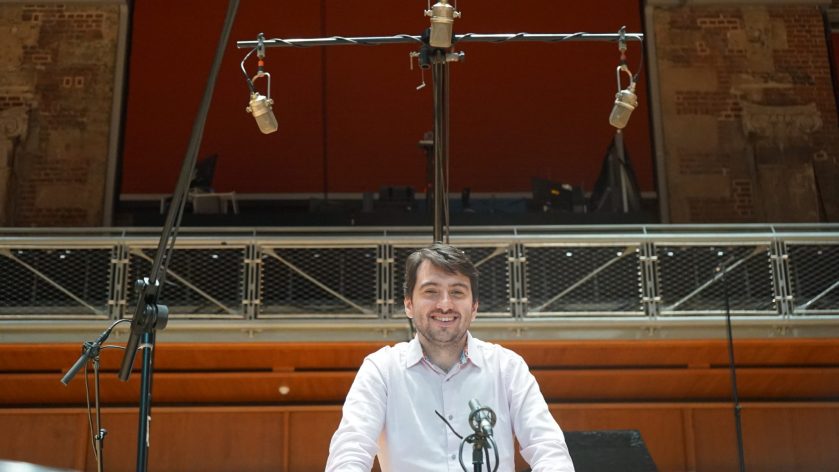
Who or what are the most significant influences on your musical life and career as a composer?
I have been so lucky to be surrounded by people always pushing me forward and encouraging me, especially my family, who have been hugely supportive, as have my friends and teachers. Without them I wouldn’t be where I am today. Books have also shaped my musical knowledge and have always been important in my life. The first book that had a massive impact on my early music education was an old 1940s book called ‘Forms in Music’, which I studied relentlessly day and night. I still have the book, and I always look back on it with fondness, as it laid the foundation of my musical knowledge.
My love for music was first sown when I was about eight or nine years old at school. The teacher sat down at the beaten-up and ill-treated piano we all know from our school days. She made the most beautiful music out of the most unlikely of instruments, and I was instantly captivated. I walked over to the teacher and saw her fingers glide over the keys so gracefully, playing Beethoven’s Für Elise. I looked on with fascination, seeing the keys bounce up and down as she played them. And when the teacher had finished playing, I went up to the piano and stabbed a few keys with my finger, wishing to try to replicate that heavenly sound, but unfortunately I only heard the horrible jabbing of my finger against a few disagreeable notes. But this was a turning point, as I soon realised that I wanted to become a musician and make beautiful music like my teacher had played.
My formal music education started when I went to Morley College in London to study composition and orchestral conducting. This is where I first met Paul Sarcich, PhD, for the first time, and he has become one of my main influencers in my music development. Paul would become hugely influential in my career. From Morley College I then went on to gain my BMus (Hon) degree from Goldsmiths, University of London. I had many lecturers, but Paul is the only one that has supported me on my journey and continues to be my greatest inspiration behind my development and professional career. He has also helped me with the editing and proofing of my music for my album, Primo.
The two other people that have had the most significant influence on my career are my great friend who is a music producer and my manager, Karl Fallon. With Karl and our late great friend Patrick McNamara, both of them have been pushing me forward by encouraging me relentlessly and believing in me right from the very start. I simply wouldn’t be where I am today without them both.
What have been the greatest challenges of your career so far?
The greatest challenges for me have been keeping focused and sometimes battling my confidence and self-doubt. I’m a highly private person who loves the peace and quiet, and over the years it’s been a long journey of personal growth, as well as a musical one. Growing up I was always the kid in the back of the classroom trying to blend into the wall, so it has taken me a long time to grow into the person I am today, one that proudly and confidently steps out into the limelight when needed.
I am proud of the person and musician I have become; on occasions having to step blindly into the unknown takes lots of courage. And at times when things do start to feel overwhelming, I have learnt to step back and take a breath, just reminding myself that it’s not life or death!
What are the special challenges/pleasures of working on a commissioned piece?
I love to have commissioned pieces. They are all usually different in their own way, and quite often they open you up to different ideas and ways of working. Writing for commissioned pieces is just one aspect of the work, as in the case of writing for TV and film. For me, the pleasure also comes from the resulting teamwork and collaboration in creating a new piece and ends up in creating the end result. I really enjoy all the collective collaboration in the creation of the piece(s) and that it’s not just my ideas. I love to get input from others too, which can be a challenge, of course, but I enjoy that. It is always good to have a fresh pair of ears to guide the piece in the right direction. This way of working has been such a valuable experience and resource for my writing. I have been very lucky, as I’ve been given the opportunity to explore and write music in varied styles and forms, which has then helped me to develop into a versatile composer and allowed me to be able to dip in and out of different styles at any given time during a commissioned project. However, it does have its challenges, and these can be for a number of reasons, which can arise when there is, for example, the obvious one being a difference of opinion maybe. But it’s all about compromise and making sure the piece fits the brief, thus creating a piece that all parties are happy with.
What are the special challenges/pleasures of working with particular musicians, singers, ensembles or orchestras?
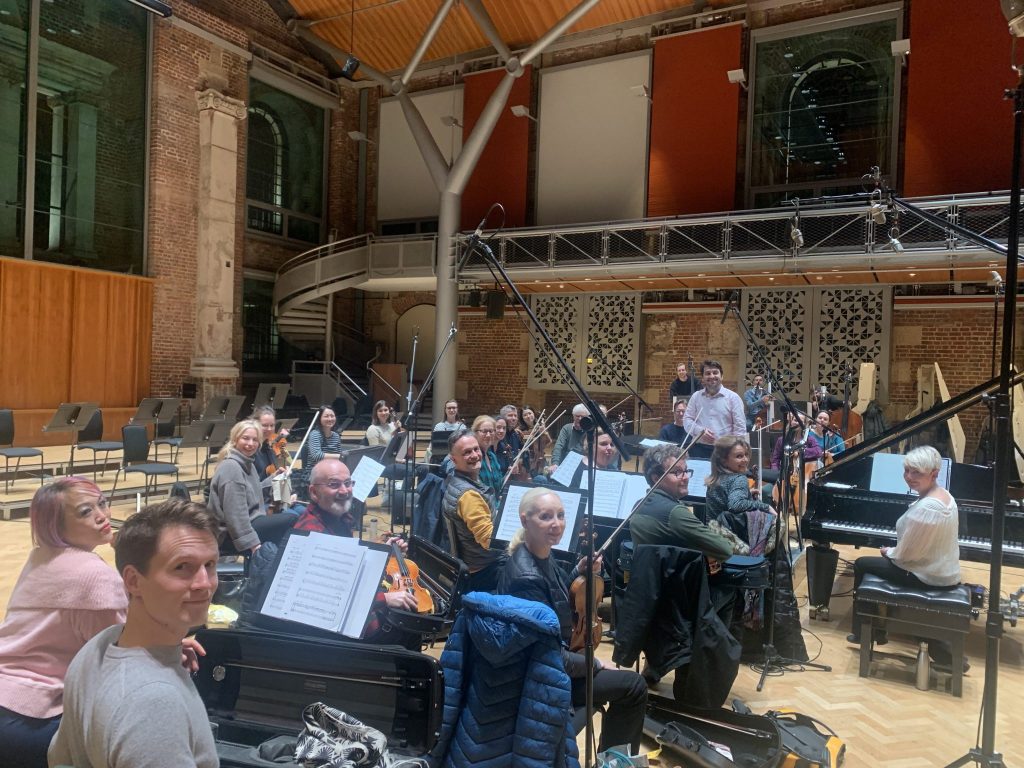
Working with the LSO was the most thrilling and yet the most terrifying thing I have ever done in my life. I had before me some of the greatest musicians at the height of their careers. We had never worked together before, so at the beginning it was a challenge trying to get used to each other’s style of working. Another thing I found is that when the down beat happened in the recording, the sound coming back just hit me like a wave, and it took me a while to get used to that. This was mainly because the musicians were all spread widely across the hall, so there was a split-second delay, which threw me off at first. I soon got to grips with it, of course, and the nervousness just fell away. It wasn’t long before a rapport began to build between us, and that’s when the magic started happening.
One of the biggest pleasures was hearing all of the music that has been with me for many years being played by such highly skilled players, each line, each phrase, and every solo played with such nuanced precision – the whole experience was intense and extremely emotional.
Of which works are you most proud?
I am proud of all my work, but the piece that particularly stands out to me is called Schloss Erichsburg from my debut album ‘Primo’. It was inspired by a filming trip to the castle of the same name and is a 16th-century castle in Lower Saxony, Germany. I call this piece my swashbuckling piece, as the inspiration came from the castle’s varied history and even being used to breed horses for the German military in World War II. There are lots of horn calls and jarring 7/8 interjections in the whole orchestra, almost like being thrown this way and that by a charging horse and even the castle’s bell tower can be heard in this piece. I built up the narrative in my mind and ran with it. Out of the whole piece, I am most proud of the fugato section after the main theme; it’s one of the best I’ve written and I find it exhilarating.
How would you characterise your compositional language?
I’m pretty sure most composers would agree that their style is always evolving; you never stop learning and growing. My compositional language has taken decades to develop. I love music that moves and has that feeling like it’s going somewhere. I don’t like staying stagnant harmonically and can move through keys very quickly. I think time and life experience have made my music more introspective and emotionally rich. Having said that, I can’t resist writing fast-paced music with lots of swashbuckling – I love the feeling of adventure.
I also have a penchant for writing minimalist music, especially for the piano. I know this is at odds with my previous statement, but for me, it’s been a personal challenge to bring emotion and warmth to what can be cold music. It also allows me to slowly unfold and develop an idea over a much longer period instead of writing in a clearly structured format. I really enjoy developing my ideas and squeezing every drop of potential out of them, whether it’s in a single piece or through multiple separate pieces.
How do you work?
I don’t really have a set way of working. Each idea has its own way of forming or coming to life. The most common way I get ideas and inspiration is through improvising on the piano and then writing them down. I can also get ideas when I’m out and about. I travel into London frequently by train, so that gives me a lot of time to mull ideas over. I often compose in my head when travelling, so inspiration can strike at the unlikeliest of times during my journey, or in various ways. For example, sometimes I hear it in my head, or I start humming a tune, or very rarely I can see the music written out in my mind, which is great, and all I need to do is just write it down. Another way is that I get a harmonic, or chord sequence idea, and I can then build the piece around that. So each time is different.
Once I have my ideas, I start by sketching out the architecture/form in my head, and then I sit down and begin to work on the ideas. Sometimes the form I have chosen changes, so I often let the music guide me to where it wants to go. Other times, I have an idea that wants to be developed to its fullest potential, whilst another is quite happy to be stated a few times, and then that’s it. I know some authors say their characters speak to them and tell them how they would act, etc. I find that melodic ideas are just the same; they speak to me, and if I don’t follow them, it always leads to frustration on my part.
When I first started writing music, I would write a block of music, and then I found that it would stop abruptly. It would leave me not knowing where to go for the next stage, and anything that I wrote after that section just wouldn’t fit. So now before finishing for the day, I always leave a phrase unfinished or the harmony partially complete, so when I come back later, it’s easy for me to get back into the flow of the piece. I find that is a great way to get back into the creative and writing process. Movement is also very helpful, especially when I’m working at home. I’m always moving around and pacing around the room, as it really helps my creativity – there’s just something about movement and the creative flow.
As a musician, what is your definition of success?
Well, as a composer it’s great seeing my work published or being performed and recorded by great musicians. But of course, nobody sees the years of hard work and frustrations or even the personal struggles that go on behind the scenes. So, it’s very rewarding to have all that hard work acknowledged, and also, for all the effort and sacrifices by those that have supported me, I’m so happy that everything they did for me has all been worthwhile.
However, more importantly for me, success is about two things: firstly, I want to add to the creative content of the world, leaving it better in some way than I found it, hopefully with some beautiful music for all to enjoy. I believe that music is like turning a light on in people’s minds, which is used to push out the darkness from their lives, which, as we know, can be very tough and stressful. So, if I can add some more light into people’s minds, then the better it will be for all of us. Secondly, I love the idea that music is able to reach out and inspire others. Music is so powerful and can change lives. My love for music grew in my early teens and was an escape for me when things got tough. I want to give back to others the strength that music gave me, and I believe it was the composer Handel who once said, “I should be sorry if I only entertained them. I wish to make them better”.
What advice would you give to young/aspiring composers?
I think it is important to be yourself and to write as much as you can. The actual act of writing music will consolidate all you have learnt, and within time, you will see your style change and evolve. It’s important not to rush; take your time and write as much as you can. Composing is a craft, and the more you practise, the more you will master it. As you write a piece, even if it does not work for the current project, keep everything, as it will enable you to build up a portfolio of work so that when you get commissions or need a piece, you have ideas and scores ready to go.
Another aspect of this craft is self-editing and analysis. When the muse is on you, don’t analyse; just let it flow, and then once the ideas are down, you can go back and edit. Self-editing is another powerful tool to have – the ability to step back and look at your work from the perspective of the player(s) and the audience – I always ask myself: Does this passage have something to say? Does it say something new? Is it in keeping with the rest of the piece? Am I repeating myself too often? Self-editing has been a very steep learning curve for me and is something that I learnt very quickly when editing the pieces for my album, and I would urge aspiring composers to start to develop this skill very early on in their careers.
One last thing I wanted to say is to never be scared or run away from criticism. Criticism is highly important, as it may highlight some weak areas that need to be worked on in your music. It can also draw attention to something that you have overlooked or missed during the process, and it will enable you to see how your work is being received and perceived. Just keep in mind it is nothing personal; it is only their opinion, but it is highly useful to your work as a composer going forward, as it is something you are going to have to deal with and face with commissioned work.
What do you feel needs to be done to grow classical music’s audiences?
I’m not the best person to ask about this, but I find that classical music still hasn’t completely shaken off its highbrow stereotype. Despite the music being so steeped in the collective psyche, classical music is everywhere, from TV advertising to film and games music, yet it still retains its stereotype. To overcome this, I think more and more concert halls and venues should host various genres of music, not just one type. I know that some big venues do this, like the Royal Albert Hall, for example, but we need more. And also keeping the venue tickets affordable for all is important – I know that this is a big ask, but surely if venues diversify, they will have more people through the doors.
What’s the one thing in the music industry we’re not talking about but you think we should be?
One thing that always concerns me is that the arts funding is always the first to be cut in schools and in the local community. Creativity through the arts is, in my opinion, absolutely a vital part of people’s education. This is especially important now for your mental health and wellbeing, which is a big topic these days. It breaks my heart to see that children are not encouraged enough to be creative. We already know how beneficial music is in education; it encourages self-expression, especially for those who have communication or learning difficulties, and it helps our brain motor neuron skills, promotes emotional wellbeing, and develops social connections. Cutting funding for the arts is a huge loss, and it saddens me that the arts are attacked so viciously leaving everyone with a massive void because they play such an important role.
It’s not just about music; it’s the arts in general. They have taken hundreds, if not thousands of years to cultivate, and throughout history, the arts have been so highly valued. So why are we devaluing our arts as a drain on resources? I think we are leaving not just ourselves artistically and creatively poorer, but also future generations will be disadvantaged by doing this.
What is your idea of perfect happiness?
My idea of perfect happiness is knowing that I’ve done my best and also helping people along the way in any way I can. I have a small but close circle of friends and seeing each of them achieve their dreams makes me so happy.
What is your most treasured possession?
I have multiple possessions around me, and it’s hard for me to point out a single one, but my most treasured possessions are my books. As I’ve mentioned previously, books and reading have played an important role in my life from the very beginning of my journey, and I have collected many books since then on various subjects. They are like old friends, and I love the feeling of being surrounded by books.
What do you enjoy doing most?
There are lots of things I enjoy doing, and I have lots of different interests. I have a passion for collecting antiques; our home is crammed with antique furniture. My study contains mostly Edwardian and late Victorian furniture, and we nickname it the ‘Edwardian’ room. As stated above, I also like to collect old books, particularly signed and first editions on both music and psychical phenomena, and I have a very large collection of Victorian sheet music. I love trawling through junk shops, antique shops and charity shops, as you never know what bargains you’ll find – I’ve found many interesting things this way, and I also love exploring old stately homes owned by the National Trust to just enjoy looking at the creativity displayed inside them and soaking up all that history of a bygone era.
Aside from my interests, I mostly enjoy spending my time reading and learning new things. My mind needs constant stimulation, and I find that books are a perfect way to do this. My mind can race and can be quickly overwhelmed, and I recently discovered the joys of meditation. I now meditate first thing in the morning, and I’ve found this has helped keep my mind calm and clear of mind fog and has actually increased my creativity. I truly recommend everyone to give meditation a try, as it is extremely beneficial to the mind as well as the body.
Jamie Wilkins’ new Classical Album “Primo” was recorded with the London Symphony Orchestra at LSO St. Luke’s, in London over two days. During the recording Jamie conducted his twelve tracks with the LSO in 5 sessions over the two days. The album released in 2025 is his first of many to come. The composition of the tracks was a re-working of existing music composed for a TV series called “Ghostcircle” and the end result culminated in 12 separate pieces for the new album which were re-edited into these new works.
https://www.instagram.com/jamiewilkinscomposer
https://www.youtube.com/@JamieWilkinsComposer
https://www.jamiewilkinscomposer.com
https://jamiewilkins.ffm.to/jamiewilkinsprimo
Discover more from MEET THE ARTIST
Subscribe to get the latest posts sent to your email.
 MEET THE ARTIST