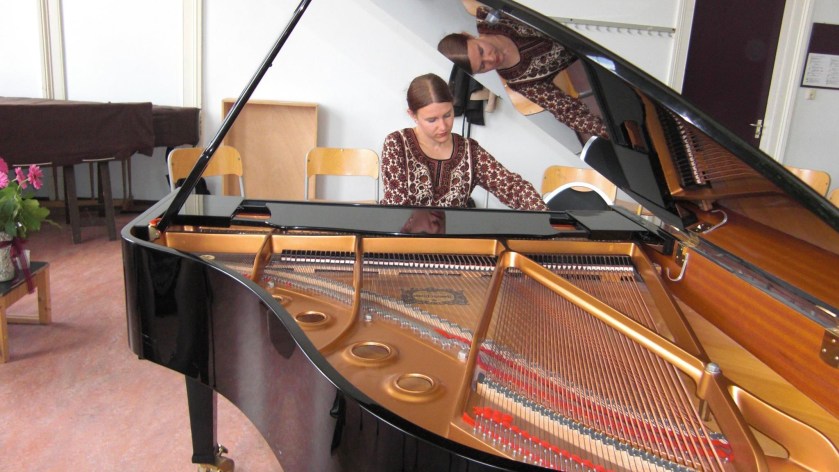
What have been the greatest challenges of your career so far?
The greatest challenges in my career have all, in one way or another, stemmed from navigating an autistic mind in non-autistic societies. They range from practical obstacles to deeper existential questions about how to define and sustain a career that honours my unique way of thinking.
The first challenge is planning—a difficulty that may feel universal but takes on added layers with autism. Like most musicians, I sometimes underestimate how long it will take to prepare a concert programme. But for me, the hurdles extend beyond time management to include the practicalities of arriving at the right place, at the right time, with the right equipment. There have been moments of near-panic, like sprinting to a nearby shop ten minutes before a concert because I remembered my concert dress but forgot stockings.
The second challenge lies in my wide-ranging interests and insatiable curiosity. I am captivated by every facet of music: from exploring different styles and learning multiple instruments to arranging, improvising, and composing. While this versatility can be an asset, it often makes it hard to focus, and I sometimes feel pulled in too many directions at once.
This leads to the third challenge: I don’t fit neatly into conventional boxes. For example, during my pre-conservatory training, I was introduced to a piano piece by Jan Křtitel Vaňhal, a composer I had never encountered before. My curiosity was instantly piqued, and I delved into research, digging through library archives and Czech websites to learn about his life and work. Inspired, I created a little pop-up book about him—an idea that spiralled into dreams of an EP, live performances with visual projections, and more. My teacher gently reminded me that while this was creative and interesting, perhaps the time could have been better spent perfecting my scales. It’s a moment that has stayed with me, emblematic of the tension between my interdisciplinary inclinations and the traditional structures of the music world.
Despite these challenges, I graduated from the preparatory course cum laude, with additional subjects beyond the standard curriculum. Yet, life took a more difficult turn. Personal circumstances, including an abusive relationship, led to me leaving the conservatory. Determined to continue my journey, I shifted my focus to musicology, completed my theory courses in evening classes (just barely, given my ongoing struggles with planning), and eventually re-entered conservatory training to earn my teaching qualification. From there, I went on to win several scholarships, complete my performance exams (MMus), and pursue musicology at master’s and research master’s levels.
Now, as a PhD student, I find that the challenge of navigating a neurotypical world remains. My way of reasoning and functioning is not “standard,” but I don’t see that as a flaw—it’s simply different and can sometimes be my “unfair advantage” as well. I often describe it as being like a Linux machine: everything works perfectly, just not in the same way as a PC or Mac. The difficulty arises when I need to communicate in a world optimised for those other systems; translation, whether literal or metaphorical, doesn’t always come easily. What sustains me through these challenges is the belief that difference is not a weakness, but a strength. The unique perspective I bring as an autistic musician and researcher has allowed me to create projects and connections that feel authentic and meaningful. While the path isn’t always smooth, it is deeply rewarding, and I wouldn’t trade it for anything.
Who or what inspired you to pursue a career in music and who or what have been the most important influences on your musical life and career?
A difficult question, for I owe so much to many people. First of all I am grateful that my parents always encouraged me to follow what made me happy, to seek out what gave me both joy and fulfillment. I also owe much to the teachers who saw potential in me during times when I struggled to realise it myself.
A special mention must also go to my harpsichord teacher, a “merchant of music and stories,” as he likes to call himself. His support and belief in me have been a constant source of strength, even to this day. I’m deeply grateful for the way he has championed my work and inspired me to keep pursuing my artistic dreams. The same holds true for the Maestro, our choir conductor, who has been a steadfast source of encouragement and support. His quiet gestures of access and understanding have made a profound difference in my life. It is his non-judgmental acceptance, his quiet belief in my abilities, that makes me feel not only capable but truly seen, not despite my differences but because of the unique perspectives and skills I bring.
Inspiration often came from the lives of remarkable women—artists, mystics, and musicians whose stories resonated deeply with me. Figures like Hildegard von Bingen and Hadewych, who combined spirituality and creativity, have always felt like guiding lights. Clara Schumann, too, has been a profound influence, not only as a composer but as a symbol of grace, strength, and resilience in a world that rarely celebrated women’s artistry.
As a child, I spent many quiet afternoons tucked away in the school library, captivated by the stories hidden within its shelves. One day, I came across “Polonaise”, a slim book by the Flemish author Gerda Van Cleemput. Its title intrigued me, and as I read, I was transported into the world of Clara Schumann. At that moment, I decided I wanted to play the piano too—though I quickly abandoned the dream of becoming as famous as her! Still, Clara’s music stayed with me. I began playing her pieces, including her Polonaises, and later returned to her compositions during my musicology studies. Recently, Clara’s song “Ich stand in dunkeln Träumen” became part of my project The Fipple Flutist. This hauntingly beautiful work, written in 1844 and set to a text by Heinrich Heine, speaks to Clara’s poetic depth. It was a privilege to explore Clara’s music in this way, and it deepened my connection to her story.
Ich stand in dunklen Träumen – flute & piano
Which performances/recordings are you most proud of?
Rather than feeling proud, I would say I feel profoundly grateful for the opportunities I’ve had to make music and share it with others. Each project has brought its own kind of joy and growth, and I’m lucky to have been able to record music both in professional settings and at home.
My first true recording was for Radio 4, the national Dutch classical music station, as part of their “Jong Talent” series. As a teenager, I played Chopin’s Nocturne Op. 9 No. 2, my favorite and most well-known piece at the time. This Nocturne holds special meaning for me—it was the piece I performed at the International Klavier Wettbewerb in Nordhorn, where I won the top prize in the highest category. But it also has a personal connection: this was the piece that led my very first love—Bear—to fall for me. It carries with it a sense of nostalgia and sweetness, but also a bittersweet edge. For a long time, I couldn’t bear to listen to the recording, as it felt like a chapter of my life closed off. Now, I see it as the start of my musical journey, and I think I can be content with how I played at that age.
Chopin Nocturne opus 9 nr 2 (Radio 4, Jong Talent) .
Since then, I’ve had the chance to contribute to several recordings, and I’ve been fortunate to play in various musical contexts. I’ve been a guest musician on several non-classical albums, mostly playing the cello. I even spent some time in a rock band, an experience that deepened my love for music beyond classical genres. As a teenager, I dreamed of becoming a recording artist, staring longingly at vinyl records, cassette tapes, and CDs. Today, I can proudly say that dream has come true. It all began with Home Strung, a project I started in the summer of 2020. With all my concerts and ensemble work cancelled due to the pandemic, I decided to create my own music at home. Home Strung is a collection of intimate, unedited guitar recordings—just me and my guitar, the same one I received from my late friend Walter.
Another project close to my heart is Medievalisms: Adrian Le Roy on Modern Instruments. In late 2023, my harpsichord teacher (the “merchant of music and stories” I mentioned earlier) surprised me with a collection of lute tablature by the composer Adrian Le Roy. I couldn’t resist diving in and spent countless hours transcribing and arranging the pieces for various instruments, including guitars, ukuleles, mandolin, and harp. I’ve recorded these performances at home and shared them with friends digitally, and now I’m compiling them into an album to showcase how fresh and vibrant this music is, even centuries after it was composed.
This year, my friend Selene and I also recorded the album 海の音楽 (Japanese Sea Music), with traditional Japanese folk songs about the sea. Selene plays a self-made chromatic harp and I play different flutes and harps, including my own instrument, the “harpij.” This project, supported by Japan Fans and the Japanese Cultural Centre in Utrecht, holds a special place in my heart, as it’s a true labour of friendship.
As for the future, I have many hopes and dreams! Last year, I received an unexpected and very special gift—a clarinet—from a kind couple in my church. I’m currently studying the instrument with great enthusiasm. It’s such a beautiful and versatile instrument, and I’m excited to explore its full potential. Who knows, this may become part of a future recording project? The Maestro keeps “feeding” me with beautiful Anglican melodies traditionally sung in liturgical settings and rarely heard outside their vocal context. I think they deserve to be enjoyed even without the lyrics, and as the Bible says, “Praise him with the sound of the trumpet; praise him with the psaltery and harp” (Psalm 150:3). Church music and concert music are too often viewed as separate—this, in my opinion, is a missed opportunity to share this beautiful repertoire more widely.
Another side project that might end up on a CD one day is a collection of Bardcore/Taverncore music inspired by King Alfred. It’s a fun and imaginative project that blends historical themes with modern influences, and I’m eager to explore where it might take me in the future. Looking ahead, I have many plans. To accompany my PhD research, I hope to create a solo album that features musical collages representing mythological water women, such as Achtamar. Another ongoing project is The Fipple Flutist, which will include my Sonatina for Shvi and Piano along with other recorder pieces. This year, I’m also preparing an EP of improvisations inspired by Japanese birds, composed by New York-based composer Patrick Meagher. These pieces have been very well received in concerts, and I’m thrilled to release them as an album around Christmas.
Achtamar – cello & sea sounds
Every recording feels like a gift—an opportunity to share a piece of my musical journey with others, and for that, I am incredibly thankful.
Which particular works/composers do you think you perform best?
The works I think I perform best are, perhaps unsurprisingly, my own compositions. These are literally written for me—they fit my abilities perfectly, celebrating what I can do while creatively navigating around the things I find more challenging.
Beyond my own pieces, I am deeply drawn to programmatic music, especially works that tell stories or evoke imagery, such as music about animals or fairy tales. I’m fascinated by the small, poetic, and fantastical. Fairy tales, myths, legends, Bible stories, and similar narratives captivate me. Music that taps into these rich traditions allows me to connect with the audience in a unique way, blending sound with imagination. For instance, I often play pieces inspired by mermaids and other mythological water creatures—figures that represent both the mystery and depth of storytelling in sound.
I also love to experiment and “play,” both literally and figuratively. For example, I explore the whimsical side of music by using children’s instruments or reconnecting with childlike emotions. A delightful example of this is Boredom by Lera Auerbach (*1973), a miniature I played on an old violin I was given, despite never having taken violin lessons. It was a simple yet liberating response to a moment of idle curiosity—making music just for the sake of it:
As a pianist, I enjoy performing in libraries for children, creating programs from piano works in children’s albums by composers such as Robert Schumann (1810–1856). I’ve also curated entire concerts featuring music by Russian composers like Pyotr Ilyich Tchaikovsky (1840–1893), Alexander Tikhonovich Gretchaninov (1864–1956), and Sofia Gubaidulina (*1931). These concerts weave together the charm of childhood, nostalgia, and storytelling in unique ways.
Another favorite theme has been music from children’s television shows and Disney films, which never fail to delight audiences young and old. The summer of ‘22, I embarked on a special tour of nursing homes, performing an entire program of Japanese music from Studio Ghibli films. The reactions were heartwarming, as this music resonates with people of all ages, evoking memories and sparking joy. And because of this tour, my piano playing was featured on our national radio again, so the circle is complete.
Japan Fans Concert Series with Ghibli Music on Dutch Radio 4
For me, the act of performing isn’t just about playing notes—it’s about connecting, imagining, and sharing moments of wonder with others. Whether it’s through the playful simplicity of children’s music or the rich storytelling of myth-inspired compositions, I find joy in exploring the depth of human emotions and imagination.
What do you do off stage that provides inspiration on stage?
I find inspiration everywhere, both within and beyond the realm of music. One of my most enduring sources of creative energy is my practice of Budo, the traditional Japanese martial arts. The discipline, focus, and philosophy inherent in these arts deeply influence not just how I approach music, but also how I strive to inhabit the stories behind it. It’s no surprise, then, that my love of Budo eventually led me to explore Japanese music, which has become a significant part of my repertoire.
Travel is another major source of inspiration. Each journey introduces me to new landscapes, cultures, and sounds. This past summer, I had the pleasure of visiting Slovenia, and I’ve since been immersing myself in Slovenian folk songs. It’s not just about the music itself but also about the stories it carries—how it reflects the lives and histories of the people who sing it.
In daily life, I am often inspired by literature, folklore, mythology, fairy tales, history, and even films and television series. I’m fascinated by stories of all kinds, whether they’re ancient myths or personal anecdotes. Poetry also holds a special place in my heart. On my way to Slovenia, I had a longer-than-expected stopover in Düsseldorf due to a delayed train. During that pause, I stumbled across a collection of German poetry in the station bookshop—works by Mörike, Falke, Huch, and others. Since then, I’ve been setting some of these beautiful texts to music, letting their lyricism guide my melodies.
For me, music is always intertwined with narrative.
How do you make your repertoire choices from season to season?
Intuitive, always. I never find myself waiting for inspiration—it’s constantly present—but what I do lack is time. Over the years, I’ve recorded countless memos on my phone, just me at the piano, improvising. These are fleeting moments of creativity captured in sound, and I’ve saved the best ideas in a dedicated folder, knowing I’ll revisit them one day.
Every so often, I select one or two of these sketches to develop into full compositions. However, I can’t help but feel that I’d need three or four lifetimes to truly explore and refine all the ideas I’ve gathered. Perhaps I should consider outsourcing some of them—though I’d have a hard time letting go of such personal fragments of creativity!
Ultimately, my repertoire is shaped by a blend of these stored inspirations and the endless stream of new ideas that continue to present themselves. It’s an organic process, driven by curiosity, passion… and a bit of pragmatic prioritising.
Do you have a favourite concert venue to perform in and why?
It’s impossible for me to choose between two cherished venues in my hometown: the Dom Church and the Neude Library.
The Dom Church, with its soaring Gothic architecture and ethereal acoustics, is a place where history and spirituality merge. Performing there feels like stepping into another world, where every note becomes part of something timeless. It’s an awe-inspiring experience to bring music to life in such a sacred and resonant space.
On the other hand, the Neude Library has a more intimate and lively atmosphere, bustling with curiosity and discovery. I love the way music connects with people there—whether it’s a planned concert or a spontaneous moment shared among shelves of books. It’s a space where art and learning come together, and it’s deeply rewarding to be part of that blend.
Both venues offer such unique and meaningful experiences that I couldn’t possibly favour one over the other—they each reflect a different facet of what makes music special to me.
What is your most memorable concert experience?
When I was seven years old, I sang as a young soprano in Thomas Luis de Victoria’s O Magnum Mysterium. It was a moment that resonated deeply within me—a sense of awe and wonder that I had never experienced before. In that instant I knew I wanted to be a musician, even though I had no idea what that would look like or how to achieve it. The beauty of that piece and the feeling of being part of something so profound planted a seed in my heart that has grown ever since. It wasn’t just about the music; it was about the magic of creating something greater than oneself. That moment has stayed with me.
As a musician, what is your definition of success?
Success, for me, is being able to touch people through music—to be a meaningful addition to their lives. Music is not an end in itself but a means of creating connection. It’s about forging bonds, evoking emotions, and sharing something deeply human that transcends words. If my music can resonate with someone, even for a moment, that is the greatest success I could hope for.
What advice would you give to young/aspiring musicians?
Stay true to yourself. Let others inspire you, but don’t compare yourself to them—you are walking your own unique path. Embrace your individuality, trust your instincts, and remember that your journey as a musician is unlike anyone else’s.
What do you feel needs to be done to grow classical music’s audiences?
In my opinion, education is key. It’s about lowering barriers and helping people step over them—demystifying classical music and making it accessible to everyone. By offering opportunities to engage with the music, whether through workshops, interactive concerts, or simply creating welcoming spaces, we can show that classical music is for anyone willing to listen and explore. It’s about creating connections and inviting people to experience the joy and depth of this art form.
What’s the one thing in the music industry we’re not talking about which you think we should be?
There are a few important issues, and I believe they’re interconnected. Mental health, particularly stage fright and the pressures musicians face, isn’t discussed enough. It’s important to acknowledge how it affects performance and creativity. Alongside that, we need to address the lack of diversity in many areas of the music industry, which still needs a lot of work. There’s also the uncomfortable truth that no one plays as perfectly live as they do on their recordings, which sets unrealistic expectations. And of course, the rise of clickbait algorithms that often prioritize attention-grabbing content over quality, making it harder for meaningful art to get the exposure it deserves. Lastly, there’s the issue of computers not just imitating humans, but starting to shape how humans make music and interact with it, which creates a new set of challenges. These are all important conversations we need to have to ensure the future of music is healthy, diverse, and meaningful.
What’s next? Where would you like to be in 10 years?
It has always been my dream to publish a book, and I made that dream a reality last year. It became a bestseller, and this winter, a revised edition will be released in hardcover, paperback, and ebook formats. It was incredibly exciting and meaningful to finally share this work with the world. I had held onto it for so long, and I just knew it was the right time. There’s a little bit of fear in releasing something so personal, but I wouldn’t change it for the world. I truly believe that when we are honest and share our vulnerabilities, it brings us closer together and helps everyone feel less alone, more loved, and understood.
Now, I am working on my second book. Meanwhile, along with my dear friend Jolijn, we’ve created a Toolbox, and I’m also working on a planner specifically designed for neurodiverse (I like to say “neurospicy”) people, to help them shape their dream lives. Beyond that, I still have so many ideas for publications, albums, performances, and more – and those ideas are only multiplying!
In addition to my work as a musician and researcher, I have been diving deeper into neuroscience, particularly the fascinating ways in which music influences the brain. Understanding the cognitive and emotional effects of music not only enriches my academic work but also informs my compositions and performances. I hope to integrate this knowledge into future projects, exploring the intersection of music, neurodiversity, and well-being.
Creatively, I aspire to expand my work as a composer. I want to write more songs with piano accompaniment and explore the possibilities of composing a larger vocal piece—perhaps for four voices and xylophone. Additionally, I am currently working on a piece for organ and flute, an exciting challenge that allows me to blend my love for historical instruments with contemporary ideas. It is my dream to further establish myself as a professional composer, creating works that resonate with both musicians and audiences.
In 10 years, I hope to have more passive income streams and to have published more of my own compositions, both for solo instruments and ensembles. A major milestone will be establishing a centre for Asian studies that serves as a vibrant hub for language learning, cultural exchange, and artistic research. But who knows what the world will look like in 10 years? I’m constantly growing and excited for whatever comes next!
What is your idea of perfect happiness?
Being at home – playing, reading, creating – with good coffee and my lovely Bengal tigercat called Boris.
What is your most treasured possession?
I would say “Boris”, but he’s not really a possession, is he? I am more of his loyal servant. So, I would choose my piano – a beautifully renovated Bechstein from the interbellum, which I got from the German piano service Dragstra in Gronau. It’s a true treasure, and it holds so many memories of music and inspiration.
What is your present state of mind?
The last months of the calendar year always feel like a transitional period for me, with the darkness, cold rain, and brisk wind. I prefer to close myself off at home, cozy with Boris curled up under a blanket by the heater, reading books and watching films. Since last year, I’ve also started setting intentional goals for the “Q4,” as it’s called in marketing jargon (I am currently preparing for the Utrecht Marketing Annual Conference, so I’m fully back up to speed with the terminology, haha). This year, I hope to release the hardcover revised edition of Inside the Autside, as well as the EP of flute music about Japanese birds and the planner I talked about. Perhaps I’ll even manage to finish my second book by the end of 2024, though that will take some work… and, of course, I’m behind on all my own (too) ambitious plans!
But that’s alright. It’s often the very chaos of juggling so many projects, the unfinished ideas, and the constant search for fresh inspiration that makes it all so meaningful. It’s about finding a balance between striving for progress and fully embracing the process itself. During the day, I immerse myself in my work, from music to writing, and in the evenings, Budo provides me with the space to let go of everything and challenge myself physically. Rehearsals with the choir also ground me in the essence of making music together, of finding harmony. Ultimately, it’s the journey that matters. And in the grand scheme of things, it’s humbling to realise that we are all just small cogs in a much larger machine, each contributing to something far greater than ourselves. It’s this sense of interconnectedness, of being part of a bigger picture, that keeps me grounded and inspired.
https://martinemussies.nl/web/
Discover more from MEET THE ARTIST
Subscribe to get the latest posts sent to your email.
 MEET THE ARTIST