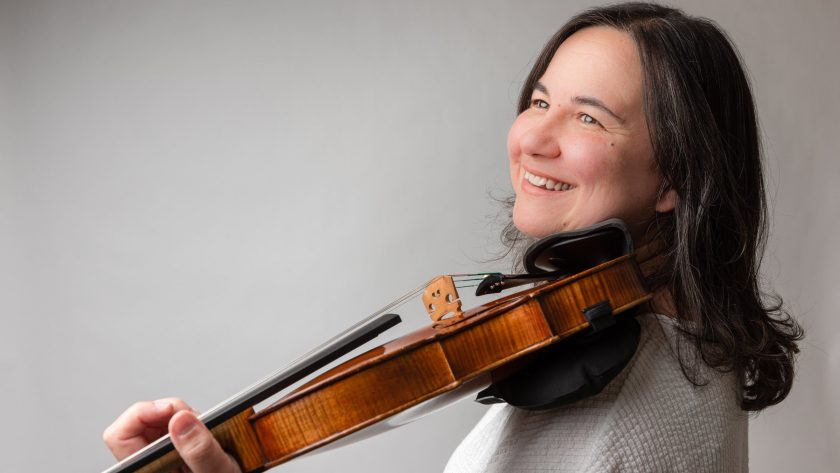
Who or what inspired you to pursue a career in music and who or what have been the most important influences on your musical life and career?
Both my parents were musicians, and they would play sonatas together in our living room. I vividly remember being around three years old and absolutely furious that I couldn’t join in….!! My father would cave and let me hold his bow to play the rhythm of a nursery rhyme while he fingered the left hand on the violin. When I was about five, he started teaching me and – because he was a truly fabulous teacher andmade it feel extremely important but also enormously fun – I loved it. Since then,so many musicians have inspired me… I still draw upon what I learnt from master-classes with the wonderful Joseph Silverstein, and I think back to them almost every time I touch the violin. And then there are less direct influences that also shaped me as a musician, like playing in the orchestra with great soloists or conductors. There are too many to mention, but artists such as Murray Perahia, Simon Rattle, John Eliot Gardiner, Howard Shelley… Then there are pop legends like Paul McCartney, as well as the great musicians I work alongside in the movie studios here who constantly inspire me.
What have been the greatest challenges of your career so far?
Oh, I don’t know… every piece is a new challenge!! But that’s what makes it fun! Moving continents from the UK to the USA was a whole different challenge, but it was also a unique opportunity to start from scratch where no one knew me in a place famous for reinvention!
Which performances/recordings are you most proud of?
Performances are more ‘real’ than recordings, and, if they’ve gone well, there’s a real feeling of euphoria and intense pride …but it doesn’t last!! I do vividly remember performing Dvorak’s‘Romance’ in the Royal Albert Hall when I was around 16 or 17. It went really well, but then it was back to school the next day!
And then recordings are kind of the reverse… I feelvery proud of them eventually with distance, but after all the scrutiny of editing and hyper critical listening, it’s hard to feel much pride until some time later!
I am really proud of the two albums I recorded during the pandemic, as they were so challenging but also forced me to think creatively. “Consolations” was an enormous labour of love as pianist Hsin-I Huang and I had to record separately but maintain a creative dialogue, making things like rubato happen almost magically. And “Canons” perhaps even more so, with more players across different parts of the globe.
More recently, Matthew Schellhorn and I created the world premiere recording of Samuel Coleridge-Taylor’s “ four characteristic waltzes” for violin and piano, for the CRD label. I’m so proud of having found it and brought it to light, as it’s shameful that this piece (and more of his work) isn’t in the core repertoire.
Many of Matthew’s and my recordings have been received really well and had a lot of streams, which has been delightful, but there’s one lesser-known recordingI’m also very proud of: Liszt’s “Consolation Rhapsody” (also on CRD). This was an arrangement I made, incorporating two piano works by Liszt. I think it works incredibly well as a conversation between violin and piano, and I’m really happy with both our performances on the recording. It was one of those rare days where everything flowed effortlessly with seemingly endless possibilities!
I found my way into arranging kind of by accident, but it’s something I’m enjoying more and more. Most recently I did a little arrangement of a 500-year-old Irish Christmas Carol, The Wexford Carol, for violin and voice, which is sung by my 16-year-old daughter Clara. So that was a very joyful arranging, performing, and recording experience!
Which particular works/composers do you think you perform best?
I played a LOT of Mozart in my 20s and 30s, in my time with the London Mozart Players, and I think I had always felt most at home with Mozart and Bach, even before that.
Nowadays, though I’m lucky enough to have so much variety in what I do, and I love it all in different ways. I feel as comfortable playing a pop song or a film score, or a virtuosic Romantic piece.
How do you make your repertoire choices from season to season?
They are often made for me!! But I have been lucky enough to have recorded for the CRD label now for some years, and that has become a truly creative collaboration. We have many back-and-forth discussions about ideas for future projects and arrive at something exciting together.
Do you have a favourite concert venue to perform in and why?
In the UK, Wigmore Hall of course. And I absolutely adore recording at Menuhin Hall. It has the most wonderful acoustic, both natural and generous.
What do you do off stage that provides inspiration on stage?
As I get older I have realised that everything provides inspiration for everything else. For example, I love playing around with ceramics (although I have much less patience with it!), and I’m constantly noticing similarities. When centring clay, you need to feel grounded and exert a lot ofstrength without fighting the clay. Both hands sometimes need to be doing different things whilst working together. But in terms of inspiration, I think absolutely anything that excites or interests me in life probably provides inspiration on stage.
What is your most memorable concert experience?
Actually, playing guest second violin in the Calder Quartet, here in California – the magic of playing with three incredibly inspiring musicians who play as one and with an astonishing range of musical colours.
As a musician, what is your definition of success?
Having a personal musical voice that brings genuine pleasure to a listener. But also being able to deliver what one sets out to do – being well prepared enough for things to happen spontaneously, but by design and not by accident. But I’m not sure anyone ever feels truly successful in art. It’s something you’re always reaching for, and maybe if you feel that you’ve attained it, it’s time to stop!
What do you feel needs to be done to grow classical music’s audiences?
I hate everything that makes classical music feel elitist – I definitely don’t want it ‘dumbed down’, but it is a language that everyone needs to be exposed to in order for it to make sense. It needs to be a part of every child’s education, not as an add-on but as a real subject. Meanwhile, I also think as professional classical musicians, we need to be much more open to other types of music and collaborations between styles.
What’s the one thing in the music industry we’re not talking about which you think we should be?
AI….
(And no, I didn’t use ChatGPT to answer all of these questions… but hey, maybe I should have..?!…)
What advice would you give to young or aspiring musicians?
Never underestimate the importance of being a great team player. You could be a fabulous instrumentalist, possibly even a fabulous musician, but without good communication skills, respect and careful awareness every time you join a new group of musicians, talent alone may not get you very far.
What is your most treasured possession?
I’m a violinist… I think that answers that question…!! Though I would also include my bow with that.
I think any string player who has read ‘Harry Potter’ must have identified with that feeling of choosing their wizarding wand!! With both the instrument and the bow, finding the right fit for any player is a slightly mysterious, magical journey. There is something so incredibly special about the history and legacy of old instruments, but however great an instrumentis, it also needs to fit the player. My violin for many years was a veryfine Gagliano that had belonged to my father. I knew how lucky I was to have it, and of course I appreciated its strengths, but it was never my ‘voice’. When I was handed the Lupot I play today, it took me less than five minutes to want to play on it forever. And the funny thing is that the Gagliano has been played on by three very fine violinists since, who have all said similar things about that violin!
Discover more from MEET THE ARTIST
Subscribe to get the latest posts sent to your email.
 MEET THE ARTIST