Who or what are the most significant influences on your musical life and career as a composer?
Bach, Beethoven, Chopin, Brahms, Sibelius, Mahler, Rachmaninov, Ravel, Bartók, Prokofiev, Shostakovich, Messiaen, Ligeti.
Visual artists including Terry Frost, John Hoyland, Doris Salcedo, Antony Gormley, Gerhard Richter and Anselm Kiefer.
My collaborations and friendships with musicians and artists.
Dissociation into landscapes.
What have been the greatest challenges of your career so far?
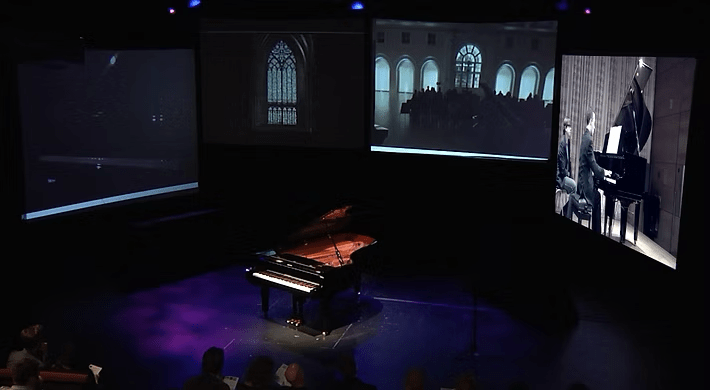
By far the greatest artistic and logistical challenge was acting as both project lead and sole composer for Portraits for a Study, a large-scale multimedia project after paintings by Gerhard Richter. The project involved coordinating simultaneous distributed live audiovisual performances across more than 300 miles and four different venues via the internet, using four Yamaha Disklaviers and a string quartet (with Roderick Chadwick and the Kreutzer Quartet) sited at the Royal Academy of Music, Goldsmiths, Yamaha UK and Falmouth University. Balancing artistic obligations with logistical, technical and musical complexity was exhausting and came with huge risks. There is more information about the project here: https://www.jimaitchison.org/gerhard-richter
The greatest psychological challenge has been dealing with musical-artistic failures on several occasions, but one has to risk and endure this in order to make art that feels significant and alive, even if only to me.
What are the special challenges or pleasures of working on a commissioned piece?
Working within restrictions can be very much usefully generative. Collaborating closely with performers often reveals approaches to material I would never have discovered otherwise, and these discoveries can sometimes reshape different aspects of a piece considerably.
What are the special challenges or pleasures of working with particular musicians and ensembles?
Long-term collaboration fosters a depth of trust that cannot be manufactured quickly, and in my experience has been an incredible privilege. My work with friends Peter Sheppard Skærved, Roderick Chadwick and the Kreutzer Quartet, Philippa Mo, and others, has developed a shared frame of reference that allows genuine artistic risk. Performers who engage with the conceptual and aesthetic domains of a piece, rather than only its surface, invariably deepen performances.
My most recent commission was through the Marchus Trust to compose a new clarinet quintet for Linda Merrick CBE and the Kreutzer Quartet. Linda has been a fantastic collaborator: generous, supportive and receptive, and yet also so tactful in sparing my blushes when I made some schoolboy errors in my clarinet writing. Her insights and advice altered my approaches to the piece considerably, and indeed, I made three short films documenting the process of working with her to create the quintet:
Black Ferns: Diary of a Composition Part I
Black Ferns: Diary of a Composition Part II
Black Ferns: Diary of a Composition Part III
Of which works are you most proud?
My piano quintets Margarete (2023) and Transience Patterns (2024), recorded by Roderick Chadwick and the Kreutzer Quartet, feel like the most integrated mature statements I have made to date. The quintets have just been released on the Metier label. The first quintet engages closely with Anselm Kiefer’s 1981 painting, Margarete, and the second responds to the experience of a passage from dark to partial light at Tremenheere Sculpture Gardens. The music is available as either CD or to stream online on all the major platforms.
It was also wonderful to hear a different approach to the first quintet when Quatuor Danel gave an amazing performance at Manchester University last year.
I am also particularly proud of my piano quartet Tributaries (2021) – yet to be performed!
Other significant works include Panorama for solo piano after Gerhard Richter, premiered by Roderick Chadwick at King’s College London;
Memory Field after Antony Gormley, performed by the Kreutzer Quartet and Nicholas Clapton in Antony Gormley’s studio;
and Shibboleth after Doris Salcedo, performed by Peter Sheppard Skærved in the Turbine Hall at Tate Modern and later by Philippa Mo at the Patrick Heron studio at Porthmeor Studios in St Ives, Cornwall.
How would you characterise your compositional language?
Quotation and resonance; passing one thing through the lens of another. Using imprints of past forms to explore contemporary objects, spaces and ideas. Mosaic-sculpted construction. Seeking coherent yet imaginatively stimulating processes, sometimes as self-building machines. An ongoing search for expressive richness, ambiguity and paradox; chance versus preconceived structure; the creation of internal landscapes.
How do you work?
I start by immersing myself in an object, place or situation. If this produces a sufficiently powerful internal imaginative response, I begin accruing ideas, often initially visual or text based. This is followed by a lengthy, often chaotic, period of generating large repositories of material, like bacterial cultures in Petri dishes, watching what grows and what withers.
Eventually a critical mass accumulates. Once I feel I have learned the ‘language’ of the material (which is different for each piece) and have a vague apprehension of the work as a whole, I begin the painstaking process of assembling the mosaic: first small segments usually, then larger and larger sections, constantly oscillating back and forth between local detail and large-scale form, modifying both as I go.
Sometimes there are rapid leaps forward when a process establishes and the music appears to write itself; these may either collapse under scrutiny or hold together and be used. At other times progress is glacial and may either disappoint or unexpectedly reveal a new musical landscape. Chance plays a significant role in this process – more a matter of searching for diamonds than making them.
As a musician, what is your definition of success?
I genuinely don’t know.
What advice would you give to young composers?
Sadly, don’t, unless you cannot do anything else. And even then, don’t, unless you also have a great deal of personal wealth and/or are well enough connected within the private education music system and the related wider upper middle class cultural milieu. There are exceptions to this, of course, but less and less so more recently. I hope I’m wrong about this.
What needs to be done to grow classical music’s audiences?
There is no magic solution. Stop patronising audiences. Stop apologising for the music. Stop offering “spoons of sugar to help the medicine go down” through unnecessary add-ons that mostly get in the way. If the music is not resilient enough to survive on its own terms, it won’t. Much of it is resilient enough to remain central to human experience, but if there is a collective societal decision otherwise, this cannot be reversed only with ‘better’ marketing strategies.
That said, it would be a start to begin clawing back the centre of gravity of classical music education from the private sector while radically improving instrumental teaching in state schools and rebuilding a genuinely inclusive approach that also includes classical music for all, regardless of background. Unfortunately, I don’t think anyone can see this happening.
What’s the one thing in the music industry we’re not talking about but should be?
Following on from the previous question, the targeting of classical music within ideological campaigns, sometimes from within academia and the institutional cultural sphere, not always carried out in good faith, is a serious issue, largely unrelated to the actual sounding fabric or artistic content of the work. If anything is to be done, it lies in confronting this where possible, while continuing to create intellectually and artistically rich musical experiences at grassroots level, engaging authentically with audiences over time, despite the huge practical and logistical challenges.
What next?
I am currently composing a new string quartet for the Kreutzer Quartet inspired by Frank Auerbach’s Charcoal Heads series and developing a chamber opera exploring the counterpoint between human emotion and artificial intelligence, based upon a contemporary retelling of E. T. A. Hoffmann’s The Sandman, both as part of my PhD at the University of Leeds.
Jim Aitchison’s Piano Quintets is released on the Metier label and available CD and on all major streaming platforms.
Jim Aitchison at Composer’s Edition
Discover more from MEET THE ARTIST
Subscribe to get the latest posts sent to your email.
 MEET THE ARTIST