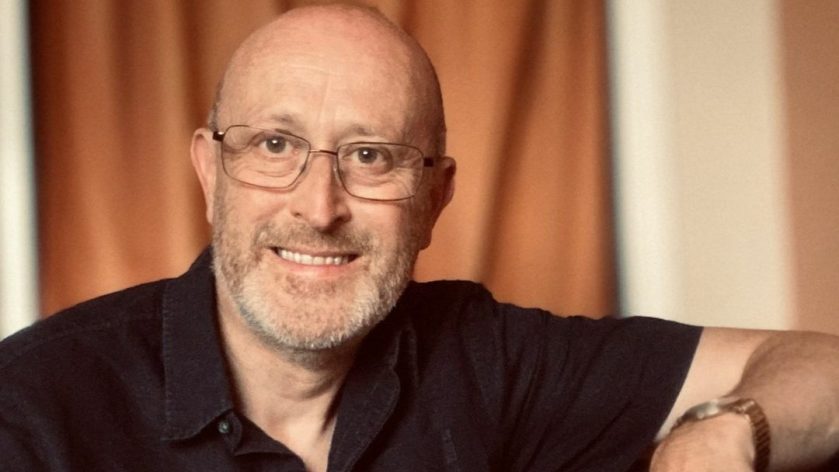
Who or what are the most significant influences on your musical life and career as a composer?
The teachers in my formative years when I was an undergraduate in the 80s. Derek Bourgeois tutored me in composition at Bristol University, and conveyed so much pragmatism and common sense in his own writing, being fearless to compose in a late Romantic style (which was very uncool at the time!) – the message being that we young composers trying to evolve a musical language did not need to adhere to mainstream peer pressure to write in a particular way, but could be true to ourselves, so long as this was a conscious choice, and not merely a lack of imagination.
In performance (I am a pianist, organist, and conductor – mainly choral), it was my organ teacher, Glyn Jenkins, who taught me pretty much everything I know about technique and interpretation, not to mention choral training. There has barely been a day in my professional life when I did not have something specific to thank him for.
What have been the greatest challenges of your career so far?
In truth, gaining any sort of recognition as a composer. Publishers are generally reluctant to consider new work; many reject unsolicited manuscripts, and most, for very sound economic reasons stick with the composers already on their books. Only since retiring from teaching in the last few years have I been able to concentrate on recordings and video performances, which has become a good way of getting music ‘out there’ – though I still need to get better at it.
What are the special challenges/pleasures of working on a commissioned piece?
It depends of course on the commission. One of the most exacting things I have ever had to do was to write an examination piece for the ABRSM Piano Prep Test – the pre-Grade 1 exam aimed at beginners with 6-9 months of tuition. The brief was so specific – that one hand must stay in the same 5-finger position throughout; the other may move by one degree up or down, but only once. No black keys; one 2-note chord allowed. Must have some examinable dynamics and articulations. I wrote a piece called “Balancing Act” though it was published as “Summer Fair” – it went through six or seven rewrites before ABRSM and I were happy!
What are the special challenges/pleasures of working with particular musicians, singers, ensembles or orchestras?
My approach is to hear them performing (this applies equally to soloists and ensembles) – a range of repertoire, to get a feel for what best suits them; then to try to emulate as many of those musical features in their bespoke composition. The most recent was a setting of “Gabriel’s Message” for Loughborough High School which they performed last Christmas.
Of which works are you most proud?
The Twenty-Four Preludes for Piano are the one piece I would wish to be remembered for if I could only have one! Which is why this new release of the recording by Da-Hee Kim is so special. If I could have more than one, there are three particular choral works (choir and orchestra) – my Magnificat (1998), the Missa Canonica (2010), and the Te Deum (2022) in memory of my teacher Glyn Jenkins. The Te Deum is yet to be performed – all three are yet to find a publisher!
How would you characterise your compositional language?
That’s a tough one! I’ve got it down to one pithy soundbite – “Three primary colours, and all the shades in between: neo-classicism (new wine in old bottles); post-modernism (old wine in new bottles); and jazz (never mind the bottles, let’s just drink the wine)”.
“A Little jazz Piano Sonata in C” – 3rd movement Allegro Vivo (filmed in lockdown 2020)
How do you work?
It varies. Of late I’ve gone back to pencil and paper, after many years of writing straight into notation software. Often, and particularly if I’m writing keyboard music, there will be a fair bit of improvisation involved as I play with the ideas. But sometimes I like to get as far away from the piano or computer as I can, which forces me to hear the sounds in my head. I composed my 2024 “Sinfonietta: The Western Cape” for the Cape Town and Stellenbosch Youth Orchestras in twelve days whilst on holiday in Crete – ‘short score’, into an old-fashioned spiral bound manuscript book, though I did then spend 6 weeks orchestrating when I got home!
Umhlaba – 3rd movement of Sinfonietta – The Western Cape
As a musician, what is your definition of success?
For a composer, to write the very music you want to hear, and to believe that it is beautiful – that no changes would improve it – and that it is wholly genuine. That is success. If anyone else wants to hear it then that’s a bonus. If both those things are true, and someone is happy to pay you for it then you are truly winning.
What advice would you give to young/aspiring composers?
Take every opportunity which comes your way. Be fearless. And always be prepared to step outside your comfort zone, for that makes your comfort zone all the bigger. I wish someone had told me that when I was 20.
What do you feel needs to be done to grow classical music’s audiences?
Education, at grassroots level. Music needs to be taught, properly, in all schools – it should be as ubiquitous and normal as maths or English. But more than that, it needs to be made relevant to children of today, who, if they think about it at all, think it’s all about dead white Europeans from hundreds of years ago, in curly wigs and fancy frocks. Music education today is how we get adult audiences in the future. And not to forget that for those schools which do teach it well, the music department is often the coolest place to hang out.
What’s the one thing in the music industry we’re not talking about but you think we should be?
See my previous answer! But also, let’s take the stuffiness out of classical music – keep it relevant to real life, not blindly adhering to the very formal conventions of fifty or a hundred years ago (Overture – concerto – interval – symphony – and all ones we’ve heard before). We have very nearly managed to ditch the tail suits and the black ball gowns, but there’s a lot further we can go.
And let’s fund it properly too, so that the prospect for a current conservatoire student of becoming a professional musician in 21st century Britain is actually a reasonable career plan.
What next – where would you like to be in 10 years?
Still alive, healthy, and successful (see above for definition!)
What is your idea of perfect happiness?
Doing anything I love with those whom I love, and knowing that they love it too.
What is your most treasured possession?
My wedding ring.
What do you enjoy doing most?
Depends on my mood. Eating and drinking lovely things in beautiful, warm places springs most to mind.
What is your present state of mind?
Slightly stressed – currently putting the whole dining room into boxes ready for re-decoration. But otherwise happy and contented!
Nicholas Scott-Burt’s 24 Preludes for Piano, performed by pianist Da-Hee Kim, is released on 6 March on the Divine Art label. Album launch concert at the 1901 Arts Club on 16 March.
Discover more from MEET THE ARTIST
Subscribe to get the latest posts sent to your email.
 MEET THE ARTIST