Who or what inspired you to pursue a career in music?
I grew up in a musical family, my grandmother was a piano teacher and both she and my mother were both active as church musicians, playing piano, leading and singing in choirs. I was attracted to music as long as I can remember, but hearing the Beatles on the Ed Sullivan Show certainly had a big influence on my initial interest. I started playing trumpet in elementary school, and in around 7th grade a professional brass quintet gave a concert there. The contemporary pieces they played and the virtuosity they displayed were like a revelation to me. In my mind I said to myself, “that’s what I want to do.” I started studying trumpet privately at the North Carolina School of the Arts after that with one of the players in the quintet, Ned Gardner.
Who or what have been the most significant influences on your musical life and career as a composer?
Studying private trumpet at NCSA in Winston-Salem got me started with a more serious approach to music. I lived near Wake Forest University, and I got a library subscription there where I began reading books by John Cage which were eye-opening. Wake Forest also had a late-night radio program called Deacon Light which played a lot of progressive rock music – that was where I first heard David Bowie, Brian Eno, Todd Rundgren, and many others. I would lie in bed every night with headphones on listening to these new sounds which were extremely compelling to me. Eventually I became friends with several of the DJs and would hang around the station while the broadcast was happening. While still in high school, I started performing in a cover band that did a wide range of music from the Allman Brothers to Bowie – I played trumpet and sang in that group. So I developed a dual interest in music – classical trumpet, which I was studying, and art rock, which moved me more than classical music I most cases.
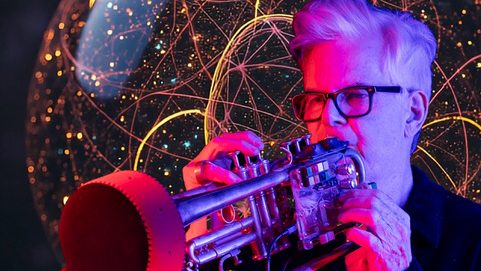
My trumpet teacher in undergraduate school, Esotto Pellegrini, encouraged me to consider trying my hand at composition since I was so interested in contemporary music. I was studying at Youngstown State University in the early 1980’s, and there was a lively punk and new wave scene there thanks to Devo, Pere Ubu, and other groups that had reached national audiences. The scene was very compelling, and the DIY ethos was a great outlet for creative experimentation. I came to the realization that if I continued to pursue a straight classical music performance career, I would be cutting myself off from the music of my own time that I was most passionate about. I started writing songs and performing on multiple instruments with a new wave band and became an active participant in the Ohio/Pittsburgh music scene for three years. It was in that context that I began developing the first version of my instrument, the
Mutantrumpet, with the goal of integrating my trumpet playing skills and a creative musical path. My early songs were influenced heavily by Talking Heads, Devo, Echo and the Bunnymen, Teardrop Explodes, and Joy Division.
When I moved to New York City in 1983, my focus had completely shifted away from rock to creating music for my Mutantrumpet/electronics system, which I had developed further with synthesizer pioneer Robert Moog. I immediately started looking for another scene to join. I sought out Jon Hassell, a musician who I had admired from afar for years, who introduced me to several musicians that I shared musical interests with. Most of them were considerably older than I was. This helped me greatly in my development as a creative musician. Then in the late 1980s I became very interested in the emerging DJ/electronica scene that was happening in New York. I began performing my music alongside DJs in clubs in a similar way to my participation in punk and new wave ten years earlier. Then, in 1992, I was appointed the Music Curator of The Kitchen, an experimental performance space in New York City that had launched the careers of Laurie Anderson, Talking Heads, and many others. I began booking artists from the burgeoning New York electronic music scene and brought in other musicians and DJs from the UK and west coast, while continuing to perform in other clubs around the country. In the 2000’s I was part of the emerging dubstep scene in New York City, which shaped several of my records from that period.
What have been the greatest challenges/frustrations of your career so far?
The biggest challenge for me came when the music industry basically collapsed in the early 2000’s. I had a record deal and a publishing deal with Verve Records and was touring a lot internationally. It was everything I had every hoped for professionally, and I had a young family to support, so everything felt great. Polygram, which owned Verve, was sold in 1998 and many of the artists were dropped shortly after, including me. Also, Napster had recently appeared on the scene, further disrupting the recording industry. This created a financial crisis for me and forced me to shift my focus in different directions including writing music for television and teaching.
How do you work? What methods do you use and how do ideas come to you?
I usually start with a concept – a pattern like the harmonic series, Fibonacci sequences, notes translated from words, or a sample that has particular meaning for me. I then implement these structures across different aspects of the music using a process I call rhytharmonics. This sets a process in motion based on the germ idea through a combination of programming and improvisations on the Mutantrumpet. I always try and cultivate a situation where the music takes off on its own rather than shaping every detail myself. That is the most satisfying aspect of creating for me, when I can generate something that I didn’t expect using technology which surprises me and results in something expressive.
How would you characterise your compositional language/musical style?
I come out of a minimalist background, so I am always looking to create music out of the fewest elements possible; “maximum output for minimum input.” Making the most out of the least is always a goal for me. My music is mostly in the electronica/ambient genre, and it usually has some kind of steady pulse as well as drones or sustaining sounds. Sometimes it’s just pure ambient too. The Mutantrumpet is always there, even though it might not always be heard as a trumpet, but rather electronic sounds. Since 2020, I make all of the sounds in my music by live-sampling the acoustic tones of the Mutantrumpet, with the exception of some of the drum sounds.
Of which works are you most proud?
I measure the success first by the listener response; my most successful songs in terms of audience are probably from my Automotive album, which is made up of music I created for a series of Volkswagen car commercials. As far as the music itself, I’d say the tracks I’ve created since 2020 in which I use only the sounds of the Mutantrumpet to generate the entire musical texture. One of the records I made using that approach is Prana Cantos, a collaboration with my daughter, Kadence Neill. That was a particularly satisfying release.
As a musician, what is your definition of success?
Audience response and the successful execution of my musical concepts, in that order of importance
What advice would you give to young or aspiring composers?
Become part of a scene or community, or even better lead one. And always think about challenging the expectations of your listeners at least once or twice in everything you make.
What’s the one thing we’re not talking about in the music industry which you really feel we should be?
The redefinition of the art form through technological democratization. My book, ‘Diffusing Music: Trajectories of Sonic Democratization’, is all about this phenomenon.
What is your most treasured possession?
My Mutantrumpet
What is your present state of mind?
Disturbed and alarmed by political developments, ambivalent about the future of music and art
Discover more from MEET THE ARTIST
Subscribe to get the latest posts sent to your email.
 MEET THE ARTIST