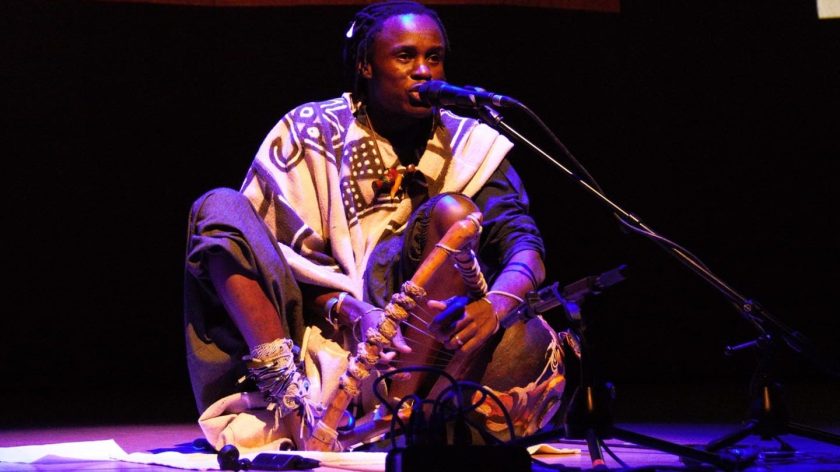
Who or what inspired you to pursue a career in music?
Music was omnipresent as I grew up in Luo Land in Kenya. When I visited my mother’s family as a boy I was exposed to nyatiti music and echoes of it were found in Benga tunes that my mother played. It was when I approached manhood that the nyatiti instrument came back into my life in a way I did not expect and I never turned back.
Who or what have been the most significant influences on your musical life and
career?
My style is very rooted in tradition which echoes throughout my music as taught by my nyatiti master Nyamungu who I shadowed for sometime until it was time for me to find my own way. Other masters I spent time with include the late Ayub Ogada, Matara Obondi, Nyagweno and Ogutu William. Though rooted in tradition, I compose and perform what we could call contemporary nyatiti music. My music has also been influenced by collaborative work I have done over the years with peers globally. Another source of inspiration is Benga music, which I dedicated to a whole album called JOPANGO, composed on the road in East Africa, the United States and the United Kingdom.
What have been the greatest challenges of your career so far?
Overcoming the barriers which prevent people from enjoying sounds that they are not necessarily familiar with has been the most challenging for me when I moved to the North East
of England.
Of which performances/recordings are you most proud?
I am proud of all the works I have produced in all the 3 albums ‘’TiPONA, KWEChE, JOPANGO and EP – SONGS OF EQUALITY. They have their unique energy, they all played a role in finding my way. TiPONA was significant in finding my voice. KWEChE is contemplation of my tradition, where I come from and JOPANGO is looking back at traditions from outside of the community. I am also happy for the collaborative works I have done along the way with other artists in different disciplines.
What do you do offstage that provides inspiration on stage?
My music is a mirror to the current society with echoes from the past. I reflect on current situations and how my tradition is in transient flux. What is the relevance of tradition in the world of today? What can we learn from our elders? I observe people and life in general and through my work in the community which I mostly operate under a Community Interest Company called Nyatiti NyaDala CIC which I founded.
Within this frame a dialogue is engaged with the audience which replicates the process of “pakruok”, the learner becomes the teacher. In Luoland, Western Kenya, “pakruok” is poetic dialogue with the community in which the audience takes active part in the lyrics creation during performances as such it informs the content in that moment. It is a practice which is empowering for youngsters which I integrate in my workshops here in England particularly school workshops.
On the other hand, tunes come to me during intimate moments of practice with my instrument. My exploration of nyatiti making has also deepened my relationship with this instrument and the music I create. A balance between Innovation and integrity is important. I feel the instruments’ soul as I compose and play and in the making it adds depth to our relationship.
As a musician, what is your definition of success?
What is success? Though we live in an age where we heavily rely on external approval, success for me is knowing the value of our own work and actions. It is found within oneself.
What advice would you give to young or aspiring musicians?
Resilience and determination are key. Believe in yourself and cultivate your wellbeing so great art can be achieved from your heart.
What’s the one thing we’re not talking about in the music industry which you really
feel we should be?
I would like to see no boundaries in music genres. Categorising restricts freedom and
makes it difficult for independent creators to fit their music when approaching the industry.
What next? Where would you like to be in 10 years time?
I live in the moment, I think we call this carpe diem!
What is your idea of perfect happiness?
Perfect happiness is an illusion. What I strive for is to be present and content.
What is your most treasured possession?
Do we really possess anything? Everything around us is an experience that shows up
and gets passed to another space.
Rapasa Nyatrapasa Otieno performs with flautist Rowland Sutherland in the African Concert Series at London’s Wigmore Hall on Saturday 21 March. Find out more
Discover more from MEET THE ARTIST
Subscribe to get the latest posts sent to your email.
 MEET THE ARTIST