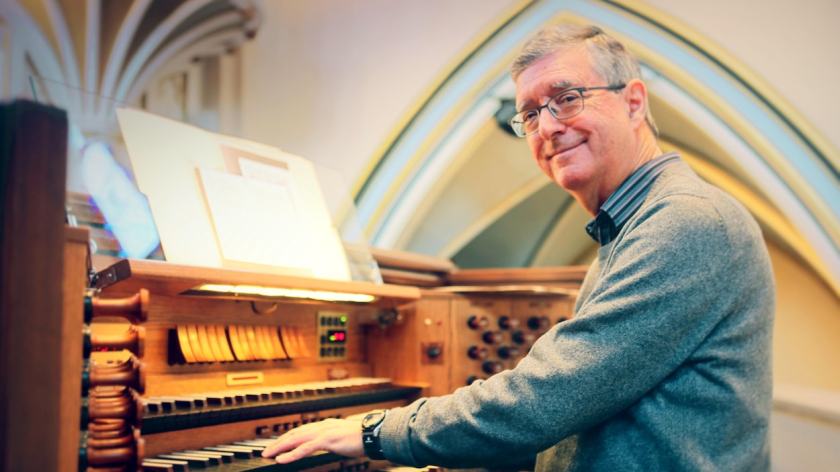
Who or what are the most significant influences on your musical life and career as a composer?
When I started to compose, I was influenced by Messiaen and Hindemith. I was also very impressed by Ernest Ansermet’s book about music philosophy Les fondements de la musique dans la conscience humaine. This book strongly supported what I was feeling about some modern music. Later, I discovered and explored the music of Poulenc, which is close to mine in some respects. I also like jazz harmonic language.
What have been the greatest challenges of your career so far?
Composing big orchestral works is certainly more challenging than writing a solo organ piece. Also, as I have been composing since nearly 60 years, I always have to be careful not to repeat myself! And it’s often a challenge to find an interesting title for a new work!
What are the special challenges/pleasures of working on a commissioned piece?
When the commissioner gives me a lot of freedom in composing a piece, it’s very pleasant. When he/she has many requirements and restrictions, it’s more challenging!
What are the special challenges/pleasures of working with particular musicians, singers, ensembles or orchestras?
As a composer, I don’t really work with musicians who perform my music. Sometimes they will contact me to ask questions about interpretation, and I will be pleased to give them advice, but apart from that composition is solitary work. Of course, in my career as an organist, I very often played my own music. I don’t remember having had challenges from myself when doing this!!
Of which works are you most proud?
Difficult question! I think my Fantaisie for soprano saxophone and piano is a particularly attractive and successful work. Among my more recent works, I would say my Concerto for organ and strings and my Variations on Amazing Grace for organ.
How would you characterize your compositional language?
My music is tonal-modal, essentially melodic, with a love for lush harmony, and with a touch of jazz and humour. Also, I take great care with the clarity and good balance of the structure of the music.
How do you work?
I normally compose at the organ or piano and write my music by hand. When this is all done, I transcribe it on the computer and add the musical details (dynamics, articulations, metronomic tempo, etc.). But before all this, I very often find my themes and develop them in my head before trying them at the instrument.
As a musician, what is your definition of success?
As a Canadian composer, just being commissioned by The Organ Club and the Royal School of Church Music to compose works on the occasion of their centenaries is a good definition of success! And I’m very grateful for this!
What advice would you give to young/aspiring composers?
I think studying traditional harmony, counterpoint and fugue is excellent discipline for an aspiring composer. After that, when he/she composes music, he/she will do what he/she wants with this knowledge – use it or reject it – the discipline will have been acquired.
What do you feel needs to be done to grow classical music’s audiences?
Education is essential. Maybe a course about classical music history at school? Some students would certainly be attracted by this, explore classical music and join concert audiences.
Here in Canada, some years ago, there was a radio channel entirely devoted to classical music. This doesn’t exist anymore and it’s a pity.
What’s the one thing in the music industry we’re not talking about but you think we should be?
For many people, especially those who are more interested in pop music, music = song, which means a singer singing a song based on a text with instrumental accompaniment. They will know only the name of the singer, never the name of the song’s composer or the text’s author, and of course never the names of the musicians who accompany the singer. These people should understand that the composer of the music and the author of the text are at least as important as the singer, not to mention the musicians who accompany him/her.
Where would you like to be in 10 years?
In 10 years I will be 86 years old, so I hope I will be in good health, with my wonderful wife Rachel in our house in Vancouver, and with our two adorable cats Darius and Camille, and that I will still be composing music (which I enjoy very much).
Denis Bédard’s Variations on ‘Westminster Abbey’, commissioned to celebrate the centenary of The Organ Club, will be premiered by Jan Lieberman at The Organ Club’s Centenary event at All Soul’s Langham Place, London, on 21 March 2026. The score is published by the Royal School of Church Music, available through their Music Shop.
Discover more from MEET THE ARTIST
Subscribe to get the latest posts sent to your email.
 MEET THE ARTIST