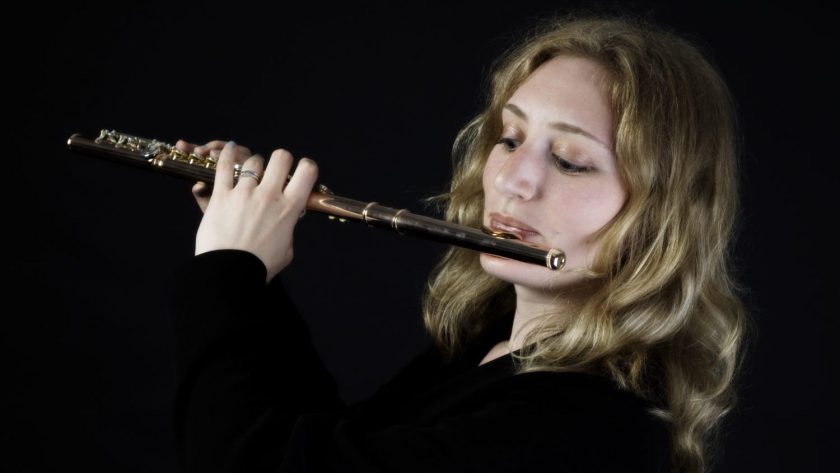
Who or what inspired you to pursue a career in music and who or what have been the most important influences on your musical life and career?
I actually started life in a totally different direction – with a Maths degree and a job as a computer programmer. All through school and university I was able to be academic but have lots of high-level music-making in my life, with other great musicians, and I just assumed that would continue when I joined the workforce. Unfortunately, I struggled to find any rewarding music-making experiences outside work, so 3 years into my job I took a week of holiday and went on a summer school run by Clare Southworth and Ian Clarke. There I met so many great flautists all wanting to get into conservatoires and I got swept up with the crowd! I got into the Royal Academy of Music to do a Masters, quit my job and the rest is history!
What have been the greatest challenges of your career so far?
Obviously the pandemic was hard – not for the usual money reason as we actually spent so much on childcare at the time that cancelling all our performing left us no worse-off financially! Eek. It was hard for me because I found it very difficult to motivate myself without any performances – I live off that live performance buzz, and the immediate feedback it gives, so without that I didn’t want to get my flute out of the box…
Which performances/recordings are you most proud of?
I am deeply proud of my trio’s show “A Pocket Opera”: it’s a mix between a concert, a play, and stand-up comedy, with loads of audience interaction, beautiful tunes played all from memory, movement, storyline and so much humour. I don’t think there is anything else like that out there, and we get such a great reception every single time we perform it (which is over 50 times now!). I am so proud that we wrote and developed this show ourselves, and of how both it and we have evolved over the time we have been performing it.
Which particular works/composers do you think you perform best?
I really don’t know. But it’s been a lot of fun working on Steve Goss’s music, and I think I’ve done a great job with it: I’m not afraid to push the boundaries of traditional flute sound, I love being given the freedom to improvise and make the music my own, and my experience as a singer has given me a real melodic sense, while the large amount of Brazilian and Colombian folk music I’ve worked on over the years with Francisco have given me a groove and rhythmic sense which has come in really handy for making some of these rhythms click together.
How do you make your repertoire choices from season to season?
Often the repertoire choice is driven by the concerts, if that makes sense? We have some music constantly on the go – for example Carmen and Spanish music from our show A Pocket Opera, which we perform every couple of weeks at the least, and our Colombian and Latin programme “Music from the land of 1000 rhythms”. Then right now we’re playing a lot of Goss due to our album launch, and pleasingly we’ve found a way to tie that with the 1000 rhythms programme so we skip between the two in a meaningful way. I have an exciting potential new project coming up, based on a concert given in Bristol in 1885 featuring entirely female composers(!), which would lead to a whole new concert programme for 2027, but it’s funding dependent – fingers crossed.
Do you have a favourite concert venue to perform in and why?
I’ve played in every type of venue, but actually my favourite is playing in village halls, which we do a lot through rural touring. The closeness with the audience is brilliant and there’s always an amazing atmosphere. Plus it’s often volunteers running the concerts, who cook delicious meals for us and look after us very well.
What do you do off stage that provides inspiration on stage?
Silliness, fun and storytelling. I think today’s audiences have shorter attention spans than in the past (perhaps trained by 30s reels), and it’s our job as a performer to keep it absolutely fascinating, so the time flies. I love doing accents, and love telling jokes in silly accents. I think that has played a bit part in shaping my character of “Carmen” in our show “A Pocket Opera”. Obviously languages help a lot with singing – and I am a huge opera fan.
What is your most memorable concert experience?
Well I have some hilarious concert experiences – like the time in Tetbury Goods Shed when we asked for a blackout to start the concert, (lights on, we’d already be there, and play!), but the blackout was so black we couldn’t find out way to the stage! Then we got the giggles at the end of a concert in Kings Place once… All this makes me sound very unprofessional but it’s the bloopers that make the best stories – it’s not interesting to tell you about all the times we perform and it goes perfectly.
As a musician, what is your definition of success?
That’s a very tricky one. It’s hard not to measure success by how much money you are earning, and that’s really problematic for me as I do a lot of unpaid work (teaching 120 recorder players a week as a volunteer, running a music festival, working with the local council to get professional music concerts and workshops to all the local school children, to name a few things I do). I get paid to perform, but I spend over half my time doing work I feel is vitally important, really changing lives, and isn’t paid a penny. In the end I think it comes down to making a difference, and recognition – I want people to notice me, both what a great performer I am (lots of praise, great reviews, repeat bookings, buying CDs etc) and also what good work I’m doing (an OBE or a knighthood perhaps 😉 !)
What do you feel needs to be done to grow classical music’s audiences?
That links to the question above. We need to be working hard to make concerts fun, enjoyable and accessible. That’s true for adults as well as children, although the way we make it fun and accessible changes depending on age. Most people no longer have the time or attention span to truly enjoy concerts with two 50 minute halves all on a solo instrument, no matter how well it’s played. As a basic rule we need to vary instrumentation, genre, people playing, perform from memory and engage audiences, use storytelling and humour, and keep concerts short (two 45 minute halves max). It’s a tough ask but we’re competing with social media, Netflix, and Taylor Swift!
We also need to be getting into schools – if we don’t manage to interest children in classical music we won’t have anyone to perform to in 20 years’ time. To do this we need to work with schools, councils, funding bodies. Kids can’t take themselves to a concert, and we must assume most people’s parents won’t bring them. All this is part of our work.
What’s the one thing in the music industry we’re not talking about which you think we should be?
The systematic underpayment of most Music Hub staff. Music Hubs run across the country, sending musicians into state schools to provide instrumental lessons. They employ a workforce of hundreds of thousands of musicians, and pay typically £24 an hour, which is half the MU rate now. The contracts are zero hours, there are no pay rises in line with inflation, and staff are asked to do unpaid milage between schools, and write reports, attend inset days and training, often completely unpaid. When asked, they’ll say they’re “in line with other music hubs”. They have a monopoly, and many musicians rely on this work as it’s done in school hours, when their own children are at school, as opposed to private teaching which happens when you need to look after your own kids, after school. To make it worse, the local hub charges parents more than the local private rate (more than double what they pay the teachers) so it’s not even making music lessons affordable for families. This whole situation makes me furious. It’s got to stop.
What advice would you give to young or aspiring musicians?
Be creative, keep learning, and work with musicians you like as well as admire. If it works you’ll spend an awful lot of time together, so actually the very best chamber groups I know started as great friends
From Honey to Ashes, a 2-disc set of music by composer Stephen Goss, played by Emily Andrews and guitarist Francisco Correa, is released on 20 March on the Deux-Elles label. Pre-save link https://tunelink.to/FHTA
Discover more from MEET THE ARTIST
Subscribe to get the latest posts sent to your email.
 MEET THE ARTIST