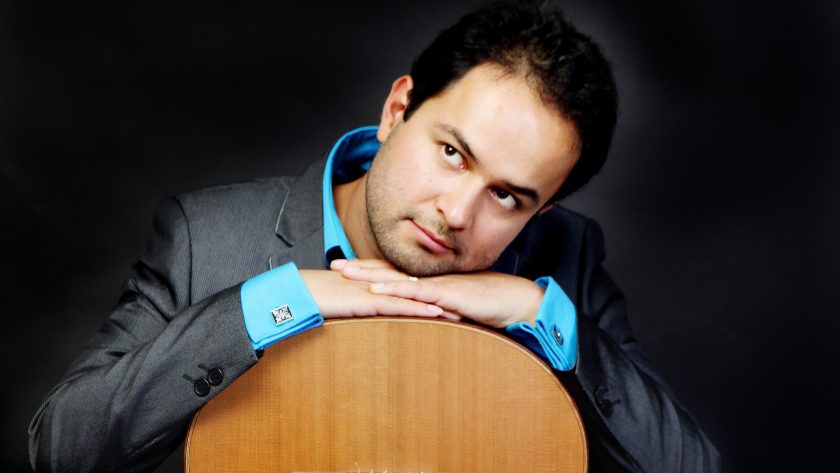
Who or what inspired you to pursue a career in music and who or what have been the most important influences on your musical life and career?
I grew up in Colombia surrounded by music. My late father was a history teacher by day and a musician by night and weekends, and our home was often filled with the sound of Colombian folk songs. Some of my earliest memories are from when I was about five years old, listening to his trio rehearsing in the living room.
When they paused for coffee, I would climb onto the chair, grab his guitar, and begin experimenting, searching for sounds and trying to make sense of the instrument. I’m sure I thought I was contributing something meaningful; I suspect the trio experienced it rather differently.
Music, for me, began as something shared — something human and communal rather than formal or distant — and that spirit has stayed with me ever since. While many teachers, colleagues, and composers have shaped my path, the deepest influence remains those early moments at home, hearing Colombian folk melodies and watching my father make music simply for the joy of it.
What have been the greatest challenges of your career so far?
One of the most difficult periods in my career was dealing with physical issues, including RSI, which forced me to stop playing for a couple of months. For any musician, being unable to play your instrument feels like losing your voice. It was frightening, not only physically, but psychologically. You begin to question everything: your technique, your future, even your identity.
At the same time, freelancing brings its own pressures. As performers today, we are expected to be many things at once, artist, promoter, programmer, social media manager, fundraiser. We create our own opportunities, design attractive programmes, market concerts, stay visible online — all while trying to protect the quiet space needed to practise and grow musically.
Learning to manage pain, both physical and emotional, while meeting those expectations has been one of my greatest challenges. But it has also taught me resilience, patience, and a deeper awareness of my body and priorities. In a way, it forced me to build a more sustainable relationship with music.
Which performances/recordings are you most proud of?
I have consciously chosen to stay away from the mainstream repertoire in my recordings. Rather than focusing on works that already have a long and celebrated history, I have dedicated many of my projects to close collaboration with living composers and to bringing new music into the world.
Each recording feels deeply special to me — not just as a finished product, but as a creative journey. Working side by side with a composer, shaping a piece together, discussing colours and possibilities, and finally sharing that music with audiences for the first time is profoundly meaningful.
For me, recording is not only about interpretation, but about commitment — a commitment to expanding the repertoire of the guitar and contributing something new to its future.
Which particular works/composers do you think you perform best?
I feel most at home performing music with a strong sense of narrative and colour — works that invite imagination and emotional depth rather than purely technical display.
I’m particularly drawn to Latin American repertoire and contemporary works. The connection to Latin American music feels instinctive — the rhythms, gestures and phrasing are part of my musical DNA. With contemporary composers, I value the collaborative element. When I’ve worked closely with a composer, the performance becomes an extension of a shared creative process.
Ultimately, I perform best the music I feel deeply connected to, where technique serves expression and the music tells a story I genuinely believe in.
How do you make your repertoire choices from season to season?
My repertoire choices are closely linked to my recording projects. Over recent years, I’ve released on average an album each year, so my seasons often revolve around either preparing repertoire for an upcoming recording or sharing music from a newly released one.
I tend to think in terms of artistic chapters rather than isolated pieces. A recording project usually begins as a deep exploration of a theme or collaboration, and the concert programmes grow organically from that research.
I also enjoy placing contemporary works alongside repertoire that offers context — often Latin American music or lesser-known pieces that deserve greater exposure. Ultimately, the repertoire must feel meaningful and connected to my broader artistic vision. Each season becomes part of a larger story I am trying to tell through recordings and live performance combined.
Do you have a favourite concert venue to perform in and why?
Rather than one single venue, I feel especially at home in spaces where there is a sense of closeness between performer and audience. I love halls and churches where you can almost feel the audience breathing with you — where silence has weight and intimacy.
The guitar is a very personal instrument. It invites listeners in rather than dominating a space. In venues with warm acoustics and attentive audiences, that intimacy becomes magical. The concerts that stay with me are those where there is a genuine sense of shared presence — when the music seems to suspend time for a few seconds.
What do you do off stage that provides inspiration on stage?
Spending time away from the instrument is surprisingly important for me. Walking, reading, travelling, and simply observing everyday life all feed my musical imagination. Music reflects stories, landscapes and human experience.
Collaboration is another source of inspiration — rehearsing, exchanging ideas, even debating interpretations expands my perspective. And perhaps most importantly, rest. After experiencing physical challenges in the past, I have learned that stepping away allows me to return to the instrument with greater clarity and depth.
What happens on stage is shaped by how fully one lives off stage.
What is your most memorable concert experience?
One of my most memorable concert experiences was at Kings Place in London, performing The Winterbourne Preludes, a work I commissioned from Stephen Goss.
What made the evening especially meaningful was sharing the stage with Stephen himself. He introduced each prelude before I performed it, offering insights into the inspiration behind the music. It transformed the concert into something deeply collaborative — the audience witnessed a living dialogue between composer and performer.
Standing there, performing a piece that existed because of that creative partnership, was incredibly moving and remains one of the most special moments of my career.
As a musician, what is your definition of success?
For me, success is not measured by how many concerts I play or how visible I am, but by the depth of connection I create — with audiences, collaborators and the music itself.
At its core, success means continuing to make music for the love of it, and not simply because it has become a job to pay the bills. The moment music becomes purely functional, something essential is lost.
If I can continue to feel curious, bring new music into the world, move audiences, and sustain a healthy and balanced relationship with my art, I consider that true success.
What do you feel needs to be done to grow classical music’s audiences?
We need to rethink how we present classical music without compromising its artistic depth. Through my work with CarmenCo, we aim to present classical music in an accessible way — weaving narrative, storytelling and humour into our programmes while maintaining the highest technical and musical standards.
Accessibility is about creating entry points. When audiences feel included and engaged, the experience becomes immediate and human.
Educational work is equally vital. Bringing workshops into schools and allowing children to experience world-class live performance in their own school hall can be transformative. If we want to grow audiences, we must meet people where they are and make this art form visible and accessible to them.
What’s the one thing in the music industry we’re not talking about which you think we should be?
We don’t talk enough about sustainability — both physical and emotional — in the music industry.
There is an unspoken expectation that musicians should perform at the highest level while also managing their own promotion, funding, administration and online presence. That pressure can be intense.
We need more open conversations about burnout, physical injuries and mental health. If we truly value artistry, we must also value the well-being of artists. Sustainable careers are essential for the future of the profession.
What advice would you give to young or aspiring musicians?
Protect your love for music. Technique and career planning matter, but the reason you began is the most important thing.
Take care of your body and mind from the beginning. Longevity depends on sustainability.
Be curious and courageous. Don’t feel confined to conventional paths — explore new repertoire, collaborate, and create your own opportunities. The classical world needs fresh voices.
Above all, stay human. The music will follow.
From Honey to Ashes, a 2-disc set of music by composer Stephen Goss, played by Emily Andrews and guitarist Francisco Correa, is released on 20 March on the Deux-Elles label https://tunelink.to/FHTA
Discover more from MEET THE ARTIST
Subscribe to get the latest posts sent to your email.
 MEET THE ARTIST