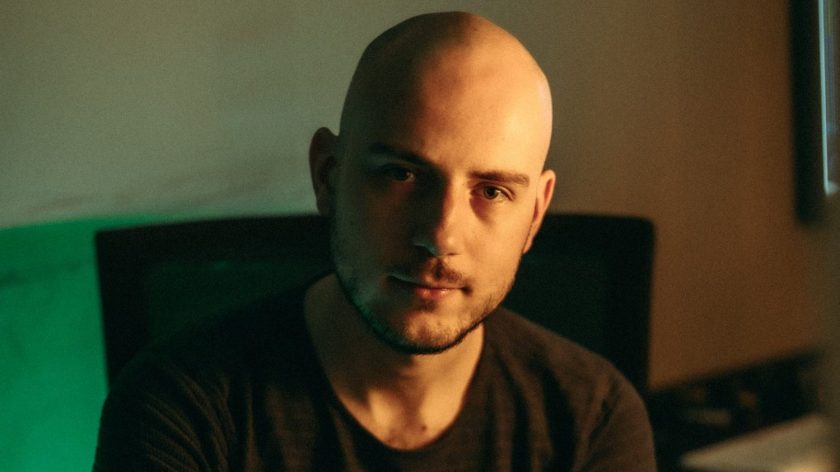
Who or what inspired you to pursue a career in music?
It all started with a pirated copy of Need for Speed Underground 2. The opening song on the soundtrack was Riders on the Storm, and as an easily obsessed 8-year-old, I loved it. So, I asked my father, not the most pop-aware person in the world, what it was, and he guessed it might be Dire Straits. He asked a colleague to lend me a CD and from that moment on I knew: I would become a guitarist. Mark Knopfler had such a wonderful way of phrasing, it had me hooked.
Later, of course, I learned that Riders on the Storm is in fact a song by The Doors. Except the NFS-version, which is actually a sample used by Snoop Dogg. Snoop Dogg got me into music, the horror.
Now, I always envisioned becoming a guitarist, but as I progressed my playing career, I kind of ‘discovered’ that I spent more time writing music than playing guitar. At first as a way of creating a platform to showcase my skills as a guitarist, but the compositions tended to be better than my guitar skills. Over the years, I’ve started to take that side of my profession more seriously, acting as a composer and ghost-writer for multiple projects, as well as releasing my own music. The story there is less exciting, that just gradually kind of happened over time.
Who or what have been the most significant influences on your musical life and career as a composer?
Mark Knopfler, as previously stated, but also Beethoven, Berlioz, Sting, Steven Wilson and Alan Parsons. People who bring craftsmanship to the musical medium. People who don’t deliberately tread on rules but expand on them and have found their own voice that way. I specifically remember the first time I hear Les Nuits d’Été by Berlioz and being completely blown away by his novel use of the (quite archaic) Napels sixth chord. It’s these things, reframing old techniques, that can endlessly inspire me.
What have been the greatest challenges/frustrations of your career so far?
My body doesn’t always agree with me. Multiple injuries and inflammations have kept me out for sometimes months at a time. It has forced me to restructure my career, so that I don’t need to depend on always being available.
How do you work? What methods do you use and how do ideas come to you?
Composing is 10% inspiration and 90% transpiration, as the worn-out saying goes. It’s a cliché because it’s true. For me anyway. So, I plan the moments I compose or record in advance, but I usually look for a hook beforehand. I can expand on any idea without needing to be inspired, but the idea itself must be good.
Now, to filter out the good ideas, 19-year-old me had a dumb idea that kind of stuck: I don’t write any ideas down. If I remember them after a week, they must be good. Bad memory acts as a filter, removing the sub-par ideas. That way, when I am writing something down, I tend to end up with a complete sketch instead of just the idea. After that it’s just a matter of fine-tuning and finishing touches.
How would you characterise your compositional language/musical style?
Wouldn’t life be easier if I knew… I call my own music Progressive Rock, but I guess I’m really a sum of all my inspirations. There’s of course Pop, Rock and some Folk, but also Jazz, Blues and modern Classical music in there. When I write for ensembles, such as my latest Brass Quintet Playgrounds, I even tend to lean into the harmonic language of Charles Ives a bit. I pursue whatever interests me, and it gets absorbed into an ever-growing overarching musical style. Please don’t make me put a label on it, haha.
Of which works are you most proud?
It’s always easy to say it’s your latest record. But for me, right now it actually is. Parkinson’s Law is a project I took up while being in between jobs. It’s a mostly instrumental concept album exploring the way we relate ourselves to the passing of time. That’s also why it’s called Parkinson’s Law, it means: any project always expands to fill all the available time.
As a musician, what is your definition of success?
If I’m able to keep making records I enjoy, and I have fun while I’m doing it, I’m happy. The rest is extra.
What advice would you give to young or aspiring composers?
Just start writing. Yes, you will probably suck at first, but that’s the point. Think of it as a clogged drain. If you want to see clear water running through it, you first must push out all the rubbish that’s clogging it. To become a skilled composer (and I’m by no means suggesting I am, I’m still always learning), you need to hone your craft. The 10.000-hours thing is probably a myth, but make them anyway, just to be safe.
What’s the one thing we’re not talking about in the music industry which you really feel we should be?
We Western people tend to look at everything through the lens of two questions: is it useful (is there a discernible positive effect), and does it have value (does it generate money)? Music is neither. It shouldn’t be. Music should be fun, beautiful, challenging, life-transforming. In the end it’s entertainment. It shouldn’t be “important,” that’s the whole point of what makes music so cool. Music is just a thing we do as human beings. It brings us together.
What next? Where would you like to be in 10 years time?
Probably still making records, hopefully to a broader audience. But if that audience doesn’t come, I’ll still be making records. It’s my calling in life.
What is your most treasured possession?
Around the time I met my wife, I bought an ’84 stratocaster by Fernandes (the Japanese Fender factory that decided to sell guitars themselves). It’s a horrendous shade of sea foam green. I had a luthier install two handwound PAF-style pickups that turned the guitar in the most versatile instrument I’ve ever had. So much so that I’ve almost grown incapable of playing any other electric guitar. It has become an extension of myself. I’ll never get rid of it.
Discover more from MEET THE ARTIST
Subscribe to get the latest posts sent to your email.
 MEET THE ARTIST