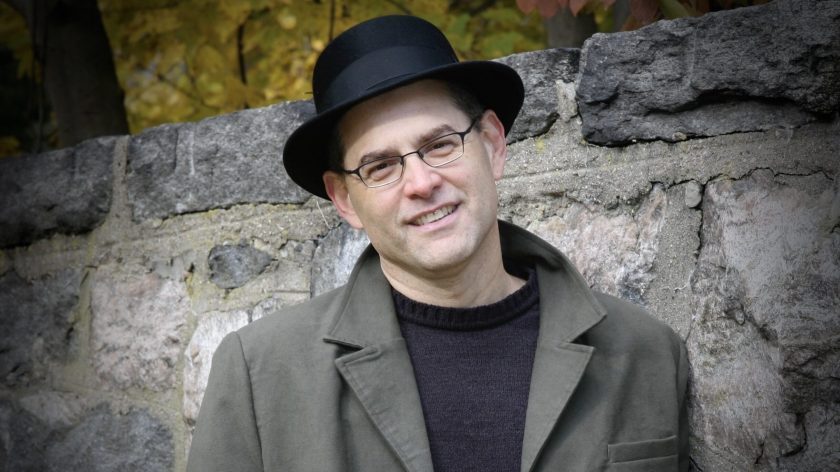
Who or what inspired you to pursue a career in music?
I’m not sure I even know, exactly. From the time I was about 14 I just had a very strong wish to be a musician. But I wasn’t immediately that good, and certainly wasn’t at all a standout or wildly gifted at. I didn’t really figure out what I could do well for many years, and that took a long struggle that lasted well into my adulthood and even well into my “career”. I do feel now that I do have a gift now, which is I think some ability to write music that can be meaningful for me and sometimes moving for others. It took a long time for that gift to become evident, and lthough I
really worked hard at music, I don’t really have any idea how or why I can do it.
Who or what have been the most significant influences on your musical life and career as
a composer?
Internally, my Buddhist practice. Externally, artists of all kinds, often not musicians, who have a strong, unique vision and have been able to keep at it. One person who comes to mind now is the visual artist Theaster Gates.
What have been the greatest challenges and pleasures of your career so far?
The greatest pleasure is to have had such fantastic collaborators. I’ve learned a lot from all of them, plus it’s just fun to work with people at that level. And it really elevated my own work. An incomplete list includes Joe Lovano, Pepe Romero, Nels Cline, Denyce Graves, Christine Brewer, John Patrick Shanley, Juliet Ellis, Badal Roy, Maya Beiser, Sandbox Percussion, Jeffrey Zeigler. And I know I’m leaving people out — I’m lucky that it’s a long list.
The greatest challenge, which is ongoing, has been coming to understand what I can do, what my abilities are, and what my music can do for others.
How do you work? What methods do you use and how do ideas come to you?
Often ideas come to me from a desire to address something spiritually meaningful to me. It’s not so much that I want to convey a particular message to a listener – it’s that I want to have that internal inspiration for myself while I’m writing.
In terms of what the music is like, I don’t have a particular method. It depends on the project. But I can say that I have a desire to make my work more and more intuitively created.
And inspiration for both these types of ideas, the extra-musical and the musical, is sparked by knowing what particular performers I’m writing for.
How would you characterise your compositional language/musical style?
I’m not trying to be vague, but I just try to write in the way that makes sense for each piece. And of course that’s colored by all my musical experiences, having written music for theatre, opera, television, film in various idioms. And it’s coloured by my life experience too.
Of which works are you most proud?
I’m not sure proud is the right word – that implies there’s a lot of me in my work. I’m trying to have less and less of that, so that I can let the work come into being on its own somehow, and I’m just getting out of the way and letting that happen.
Each piece in some way represents where I’m at at the time it was written, so I’m generally most happy with the most recent one, and most excited about the next one.
Tell us more about ‘a raft, the sky, the wild sea’. How did the project come about, and what do you hope audiences will take away from this music?
I’ve been a huge fan of Joe Lovano’s playing forever. We first met in 2010 and he heard a concert of another orchestra piece of mine, Black Diamond Express Train to Hell and we started talking about my writing a concerto for him. And then in 2020 (10 years later!) I was able to get a co-commission from the London Philharmonic Orchestra, the Fort Worth Symphony Orchestra and the Winston-Salem Orchestra. The orchestra’s part would is fully notated, and in the contemporary classical or “new music” tradition, whatever that exactly means. It could mean all sorts of things, but in this case it means that it isn’t “jazz” (whoever that exactly means) – i.e. it doesn’t have traditional jazz harmonies and forms.
I listened to Joe’s playing a lot and very deeply, to get a feel for what inspires him musically – rhythmically, melodically, harmonically. Then I wrote the orchestra part and tried to fill it with the
kind of things that would inspire him. Joe’s part is 95% improvised, and there’s very little specific direction in his part. In fact in his part he basically sees only what the orchestra is playing, and when he should play and when he should not play. So he doesn’t see what he should play – there’s no suggestion of mood, or musical intention written in. Instead it’s the sounds of the orchestra that “tells” him what he should play – he’s responding to them.
Instead of writing what Joe should play directly, I indicated it to him by what I wrote for the orchestra. There’s a huge amount of freedom for him, and each performance is different. The piece is very collaborative between Joe and me, which requires that we trust each other completely, and this feeling of trust is a beautiful state of mind to be in, for him and for me.
That’s the musical inspiration. The extra-musical inspiration is a landscape describing an internal, spiritual journey. Composing this piece, I imagined an inner voyage. You’re on a raft, under the wide open sky, on the wild sea. That sea is sometimes calm, sometimes startling and turbulent. You’re being taken somewhere, but you’re unsure where you’re going or how you’ll get there. So it’s all about the present moment connecting to the next moment, and the next — now, now, now, now. This is all of us, each on our own metaphysical raft under the open sky, trying to cross the wild sea.
This is of course a metaphor. But for so many people throughout the world, those who are forced to flee their homeland to seek safety and a better life, it’s not metaphoric, but a description of a harrowing physical reality. This piece also recognizes these children, women, and men, for whom the raft, the sky and the sea are indescribably dangerous, and for whom the journey is real.
I’m trying to access an unseen world for myself when I write any music. Then that gets presented to the listener, who can take anything or nothing from it, depending on what’s going on in their mind and their lives when they listen.
As a musician, what is your definition of success?
Just being able to spend time writing music is a success for me.
What advice would you give to young or aspiring composers?
Do your best to be true to what you want to do with your life and your art. And be a good person.
What’s the one thing we’re not talking about in the music industry that you feel we should
be?
I’m not sure I know what’s being talked about, but I think the thing that always should be in mind is the unique power of music to move people, to bring them together in a shared experience, and to give them joy.
What next? Where would you like to be in 10 years?
Still breathing, still meditating, still writing music
a raft, the sky, the wild sea by Douglas J. Cuomo, with Joe Lovano (tenor saxophone), Winston-Salem Symphony, conducted by Michelle Merrill is released on streaming and vinyl on the Blue Cloud Music label
Discover more from MEET THE ARTIST
Subscribe to get the latest posts sent to your email.
 MEET THE ARTIST