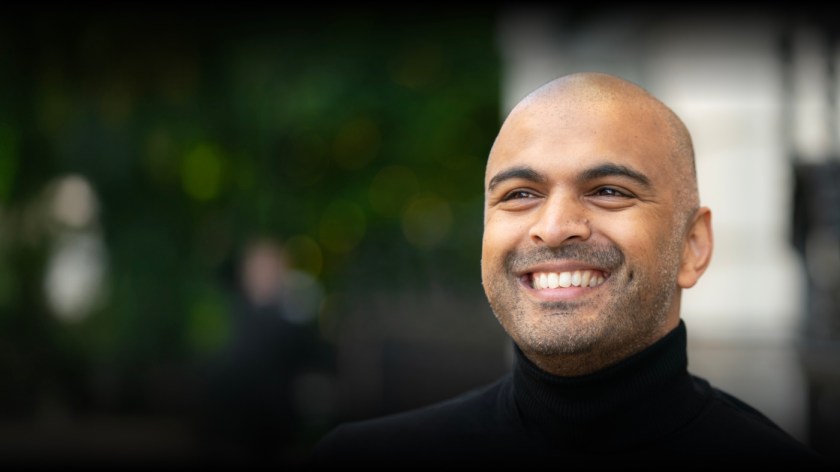
Who or what are the most significant influences on your musical life and career as a composer?
Some of my earliest memories of music include: my mother playing the piano to me, watching musicals such as Willy Wonka and the Chocolate Factory (1971) on repeat, and hearing my brother practice his solos with the choir at Ipswich Minster (then St Mary-le-Tower). I followed in my brother’s footsteps at the age of 6, and loved singing pieces such as Bring Us, O Lord God (Harris), Like as the Hart (Howells), and O Sacrum Convivium (Messiaen). I enjoyed learning pieces by Scriabin and Poulenc on the piano in my teenage years, and I had a few jazz piano lessons in my early twenties that led to a creative burst of jazz-infused choral pieces, particularly in terms of jazz harmony.
I have improvised on the piano since the age of 2, and having jazz piano lessons improved my improvisation skills immensely. This has led to me being a versatile composer, from sacred and secular choral works to instrumental writing, film scoring, and most recently, musical theatre with my new show Jabberwocky. At the heart of everything I write is the same impulse I had as a child: to turn emotion into sound.
What have been the greatest challenges of your career so far?
Like many composers, one of the greatest challenges has been building a sustainable career with regular commissions and performances, while balancing this with other professional commitments. There are inevitably periods of uncertainty, when projects are sparse and self-belief is tested. However, I simply must create music, so there is no other option for me!
What are the special challenges/pleasures of working on a commissioned piece?
One of the greatest joys for me is collaborating with ensembles to bring a new piece into existence. Some of the challenges include honouring the commissioner’s brief, the performers’ strengths, and the context of the performance, while still remaining true to one’s own musical voice. The most pleasure comes when I hear the piece brought to life in a concert or recording, and hearing that the piece has been enjoyed by both performers and audiences.
What are the special challenges/pleasures of working with particular musicians, singers, ensembles or orchestras?
Pitching the music at the appropriate level can be challenging. Many factors have to be considered, such as how long does the ensemble have to learn the piece and what is their level of skill. I will speak to conductors about what they have performed in the past, what they enjoy performing and what has worked particularly well. This gives me useful context before I sit down to write. A pleasure of working with musicians is hearing how they interpret the dots through their artistry. Sometimes, the performance is better than I had imagined in my head, which is such a heavenly experience!
Of which works are you most proud?
Three pieces spring to my mind most readily. Firstly, Carry Me Home, which is a cantata for alto saxophone, solo bass, choir, piano and strings. It is a truly unique choral work, written in memory of Alex Young who died in 2014. I went to primary school with Alex and sang with him in the choir at Ipswich Minster. I worked closely with Sir Nick and Lady Young, Alex’s parents, on both text and music until they felt it was right. I have yet to find another example in classical choral music where this level of family involvement shaped the composition from start to finish. Carry Me Home is a phrase from the African-American spiritual Swing Low, Sweet Chariot, which has long been an anthem of English rugby fans; Alex was a great rugby player, so there is a small excerpt from this spiritual in the piece. There is also an arrangement of a song written by Alex’s younger brother Tom, as well as an arrangement of the family’s favourite hymn, Lord of all hopefulness. Finally, there are many saxophone solos, because Al played the saxophone. Funds raised from the premiere on 21st March 2026 will support the young suicide prevention charity Papyrus. More information about this choral work can be found here: https://benponniah.com/work/carry-me-home-als-piece/.
Secondly, Seeing the Star, which is my most popular piece at the time of writing. I wrote it as a thank you to St Mary-le-Tower (Ipswich Minster) for providing such an inspiring choral education. In this piece, the wonderment of the Wise Men is captured, as they look up at the star on their journey to the baby Jesus. The soprano part is initially characterised by increasing intervals, to reflect the upward gaze of the Wise Men. Tone clusters are used to create a shimmering starlight effect. Anna Lapwood was particularly taken with this piece and released it as a single with the Choirs of Pembroke College, Cambridge. It has had almost 400,000 plays on Spotify at the time of writing:
The professional choir Recordare filmed a sublime video featuring Seeing the star, which is available on YouTube:
Thirdly, I was pleased with my Maida Vale Service that I wrote for the BBC Singers in just 6 days. It was a tight deadline, and my first Magnificat and Nunc Dimittis, but it was enjoyed by the performers, and Anna Lapwood bought a copy soon after the Radio 3 broadcast to perform it with the Choirs of Pembroke College, Cambridge. It is now published by the Royal School of Church Music.
Thirdly, I am particularly proud of my Maida Vale Service, written for the BBC Singers. Despite a lightning-fast six-day commission window, this debut Magnificat and Nunc Dimittis resonated immediately with the performers. Following its BBC Radio 3 broadcast, I was thrilled when Anna Lapwood acquired the score to perform it with the Choirs of Pembroke College, Cambridge. It has since found a permanent home in the RSCM catalogue.
How would you characterise your compositional language?
There are three major strands woven into my choral textures: Anglican church music, holy minimalism, and jazz-infused harmony. I grew up singing Anglican church music, and discovered holy minimalism while singing in a chamber choir as an undergraduate: I particularly enjoyed singing Totus Tuus by Górecki. I started exploring jazz piano towards the end of my time at the University of Nottingham. During my PhD in Composition at the University of Aberdeen, I started experimenting with tone clusters, and these feature in many of my compositions.
How do you work?
My process often involves writing out the text in my sketchbook. I then analyse the text, highlight keywords, sketch images or colours and improvise around the associated emotions on the piano. Fragments of chord progressions and melodies start to appear and I jot these down. I often have too many ideas for one piece. I then work on refining and developing my initial ideas, much like a sculptor chipping away at a block of marble until I am happy with the end result.
As a musician, what is your definition of success?
For me, success is the bridge between the internal and the external: it’s creating music that resonates deeply with my own soul, and in turn, moves the listener to a place of genuine emotion – whether that be joy, reflection, or a shared sense of melancholy.
What advice would you give to young/aspiring composers?
1. Write music that lights you up; write from your heart.
2. Be disciplined and carefully plan the time you have available, so you can be as productive as possible.
3. Think carefully about the ensemble you are composing for e.g. their skill level and how much time they have to rehearse.
4. Collaborate with your existing contacts to put on performances of your music.
5. Keep growing your network.
6. Don’t give up!
What do you feel needs to be done to grow classical music’s audiences?
Pre-concert chats to bring the music to life by starting with the story of the music or composer. Inform audiences in an engaging manner, through brief demonstrations before the performance starts. Perhaps some audience participation e.g. getting them to sing along to one of the simpler melodies.
Curating programmes based on emotion would increase accessibility. For example, a programme entitled A Space for Stillness might pique the interest of a potential classical music enthusiast.
Pairing classical pieces with related non-classical pieces, such as film music. For instance, looking at the influence of classical pieces on the film music of John Williams. There is lots of room for creativity here.
Another thought is changing venues, where possible, to somewhere markedly different to a concert hall e.g. a brewery. Jazz it up!
What’s the one thing in the music industry we’re not talking about but you think we should be?
The increased time and effort required to grow classical music’s audiences is a barrier. We need to think of ways to help make this cultural shift easier for ensembles.
Discover more from MEET THE ARTIST
Subscribe to get the latest posts sent to your email.
 MEET THE ARTIST