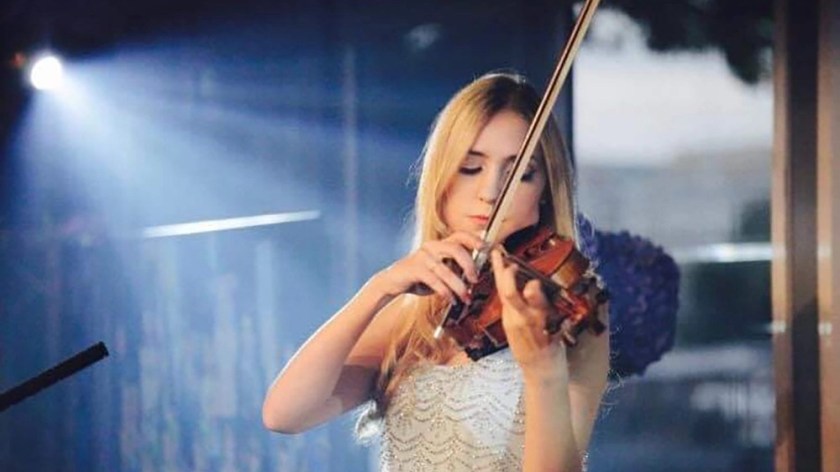
Who or what inspired you to pursue a career in music and who or what have been the most important influences on your musical life and career?
My parents were not musical but one Christmas a serendipitous event unfolded and a family friend gifted me a cassette of violin music which I played ceaselessly until it eventually wore out! There was something so exciting about classical music and the tone and timbre of the violin really captivated me. It was fortuitous that at the time my school were offering free lessons and I immediately fell in love with the challenges and complexity of the instrument – it was a never ending puzzle! I owe a lot to my very first violin teacher for inspiring and encouraging me, I am also incredibly grateful to the head of my local arts service who recognised my potential and referred me to the Purcell School. Later down the line it was my professor at the Royal College of Music Dr Felix Andrievsky who truly grounded and inspired me whilst helping to develop my musical ideas.
What have been the greatest challenges of your career so far?
My life has not been without hardship, I survived a number of traumatic events in my 20s that shaped the artist I am today. The greatest challenge in my career has been managing to keep going, keep performing and to not lose focus during the harder times. Whilst those early career challenges were undoubtedly difficult they also served as the catalyst for my musical growth. Music is about life after all, and finding the resilience to weave these experiences into my sound is something I am incredibly proud of.
Which performances/recordings are you most proud of?
One might expect me to highlight performances at prestigious venues such as Carnegie Hall but I think the performances I cherish the most are the ones when I know I have touched someone’s heart. It isn’t always about performing in the grandest hall or mastering the most complex concerto, it’s the gentleman in the second row sharing with me that the music reminded him of his beloved late wife, or the young girl smiling and lingering at the end of the concert seeking a photo because she dreams of becoming a violinist one day. Those heartfelt encounters are what make me proud.
Which particular works/composers do you think you perform best?
Colourful music! I have a passion for French repertoire. I am a synaesthete, which means I hear certain colours for specific notes, and there is something in the ethereal realm of this music that draws out the most vivid colours in my minds eye. I adore Debussy and I am very much looking forward to performing his violin sonata in my next recital for Hertfordshire Festival of Music on 11th June.
What do you do off stage that provides inspiration on stage?
Beyond the stage, my synaesthesic perception of music compels me to draw on other forms of artistic expression. I often sketch and chart the way the music presents visually to better comprehend the intricate interplay of colours and lines within a piece. I’ve recently returned to ballet and am enjoying the freedom that movement and dance can bring to my understanding of form and structure and in my free time I love to get outdoors to be inspired by nature.
How do you make your repertoire choices from season to season?
When devising repertoire for each season, I adopt a deliberate approach that involves selecting a focal work or element that resonates with me. This may entail choosing a new piece I have yet to perform or revisiting a specific colour or key that has been absent from my repertoire for some time. Guided by this theme I then curate a programme that complements and enhances the chosen focal piece.
Recently, I had the privilege of being invited to perform at a festival where I was presented with the opportunity to premiere a new sonata composed by Tom Randle. Instantly, I sensed a connection between this contemporary piece and the works of Prokofiev and Debussy. The sonata incorporated jazzy influences, captivatingly lyrical lines, and virtuosic flourishes, all of which beautifully intertwined to create a cohesive musical experience.
The process of programming repertoire holds an instinctive quality for me, and I get satisfaction from introducing audiences to new compositions. Through careful selection and thoughtful presentation, I strive to create an enriching experience that engages and inspires both the listeners and myself.
Do you have a favourite concert venue to perform in and why?
I love the Purcell Room; it’s where I made my recital debut and I guess I’ll always feel at home performing there.
What do you feel needs to be done to grow classical music’s audiences?
This is the perfect time for classical music to grow. Following the pandemic, people emerged from behind their zoom screens with a passion for emotion and human connection. Those who during lockdown were introduced to new music via social media and online platforms are beginning to filter into live performances now and I’m seeing a real shift where younger audiences are seeking out classical music that truly moves them.
What is your most memorable concert experience?
Performing Paganini on the Southbank with the Royal Philharmonic Concert Orchestra followed by their performance of Tchaikovsky’s 1812 overture with accompanying cannons fired from the HMS Belfast was certainly memorable!
As a musician, what is your definition of success?
Success is doing what you love and having fun with it.
What advice would you give to young/aspiring musicians?
To any young aspiring musicians I would say get out there and play! Don’t hold back until you feel you’re ‘ready’ build experience and learn from it, and most importantly fill your life with moments that inspire you musically, your time outside of the practice room is equally as important as all those hours playing Flesch and Kreutzer.
What’s next? Where would you like to be in 10 years?
At the moment I’m really inspired by film music and working with new composers, I’d love to see how that side of my career develops over the next decade and I’m looking forward to doing more recording work. I’m also on the brink of launching my own music school and I’m very excited about that too !
What is your idea of perfect happiness?
Happiness is in the balance between personal success and supporting others; for me that is in my work as a soloist and as a teacher.
What is your present state of mind?
Content. I’m truly excited to see the life I always dreamt of coming to fruition.
Litsa Tunnah appears at this year’s Hertfordshire Festival of Music in two events on Sunday 11 June. In Music and Image: Colour for Sounds she will be in conversation with Artistic Director James Francis Brown about how music can evoke different sensations in our brains, and for some people, create visual impressions – the rare perceptual phenomenon called synaesthesia. Later that afternoon, she will be in recital with pianist Daniel Grimwood, playing music by Debussy, Tom Randle and Prokofiev.
Discover more from MEET THE ARTIST
Subscribe to get the latest posts sent to your email.

