Who or what inspired you to pursue a career in music and who or what have been the most important influences on your musical life and career?
My piano journey began at the age of 4, when my late mother wanted to instil discipline in me.
I continued to take piano lessons with notable pianists in Jakarta Indonesia (who mainly graduated from Conservatoriums in Holland and Accademia Nazionale di Santa Cecilia). I participated in an audition conducted by a Professor from Monash University/School of Music Australia and she offered me opportunity to join the “enhancement” programme for selected students which meant to skip Year 12 and go directly into their music program. Based on my parents’ advice, I waited until I completed all necessary secondary education before joining Monash University. In Monash, my passion (and confidence) grew tremendously. My piano professor was a graduate from Juilliard Dr Elyane Laussade (who had studied from Abbey Simon- renowned pianist and a pupil of Godowski). She saw my potential and nurtured my passion in piano playing. After graduating with Master of Music, I took the offer from Monash to continue with a Doctorate (DMA) in piano performance majoring in Dance Music repertoire. I only did 1 year of DMA and decided it was not for me at that stage. I believed there has to be more to life than just sitting in practice room and practice piano!
I then started a music school with my husband (who is a classically-trained violinist and holds a Master of Music as well), wrote music arrangements for advertisements, Indonesian Government PSA’s and immersed myself in the other side of the fence of music business.
My husband and I created a Foundation for Arts to help musicians getting performance opportunities, music students paying for music lessons and holding competitions for young musicians and we organised benefit concerts where I and fellow musicians performed, donated the proceeds to Cancer Organisations, Charity organisations that help the Zoo in Jakarta and Bali, homeless people and Children with multiple disabilities.
Just before the Pandemic, I decided to get back into the daily practice to be back on the other side of the of music business fence again! I have been studying under the guidance of Graham Fitch.
I think all of my teachers have been influential on me in different ways. I am continually inspired by Daniel Barenboim for his musicianship, brilliance and for what he does for music and humanity.
What have been the greatest challenges of your career so far?
The greatest challenge would be to be at peace with myself. Growing up, I was not a very confident child. Hearing so many people advising me not to pursue music brought out many insecurities in my life. Only a few years ago that I decided that I do not need others to write my future: I will pursue music in ways that I am passionate about.
The second-guessing, anxiety and insecurity often creeps in to my daily life. So it is a continuous fight.
Which performances/recordings are you most proud of?
The French Connection Album – it is special because it is my debut album and I had the opportunity to learn from industry’s finest (Graham Fitch and Dr Mok who is Perlemuter’s student; Perlemuter was Ravel’s student) and I actually was able to record Ravel’s rarely-played La Valse. For me, the album signifies that “nothing is impossible”. It is not impossible to perform a virtuosic work; to record album without winning major competition (although I have participated and won numerous competitions in Indonesia and Melbourne Australia, I do not see them as a peak of my achievements but rather as a process in my music journey. I never know what to say when people ask how many competitions I have won- in my opinion, why should we keeping count on these? They are important but in no way a summary of my ability).
Which particular works/composers do you think you perform best?
I am not sure I can give an objective opinion. I know people love hearing me playing Chopin (but that could also be because Chopin’s music is very special and loved by many). Although lately, I often get requests to perform Ravel and Debussy (maybe because this is because of The French Connection Album).
For me, I do not want to limit myself to be a “specialist” in one composer. I feel that I need to play as much music as I can to continue my music exploration and develop my potential further.
What do you do off stage that provides inspiration on stage?
When I perform in benefit recitals, thinking about the cause really touches my heart.
How do you make your repertoire choices from season to season?
I don’t specifically hunt for the most difficult works to learn (despite I have been learning virtuosic works in the past years), I listen to the music and choose which one speaks to me the most. I do try to plan not to do the same composer too much.
Do you have a favourite concert venue to perform in and why?
No. And growing up I have never been enticed in playing in big concert halls. When I studied music in University, my friends actually made plans on how to play in Sydney Opera House and then hopefully Carnegie Hall. But for me, big or small halls are not main purpose.
I am always inspired when reading about Chopin and his preference of playing for a small audience. I think sharing music in big or small scale are equally important. These “measurements” do not add or reduce value to my music journey.
What do you feel needs to be done to grow classical music’s audiences?
It was so refreshing to see that a lot of classical music workshops were offered online during the Pandemic and also there are more and more attempts by concert halls to stream the concerts online- I think these efforts are important to grow the audience. I could be in my living room in Melbourne Australia but watching Daniel Barenboim’s concert being streamed live from Berlin!
Nothing replaces the experience of seeing a performance live, of course. But, to have that option would be really great. I am sure it is appreciated by many listeners too.
What is your most memorable concert experience?
Watching Daniel Barenboim in Berlin in December 2019. He was performing series of Beethoven’s piano sonatas and it was unbelievable to see a legend up close, seeing his focus, fingers and interaction with the audience.
As a musician, what is your definition of success?
I think success is about being able to do what you are passionate about in your own freedom of time. More specifically: being able to learn and perform music that I love; learning from people that inspire me; sharing it with audience who appreciate the craft; and doing all that on my own terms.
I don’t think success is relatable with numbers (how many streams, how many CDs you sell, how many competitions you have won, how many tickets sold, how many students, etc.). If we think in numbers, at the end of the day I think we will only be numbers too. That is really sad.
What advice would you give to young/aspiring musicians?
To pursue what they are most passionate about and find their unique identity.
What’s the one thing in the music industry we’re not talking about which you think we should be?
“Failure” and anxiety – a lot of musicians that I know have some kind of anxieties and they feel that to be accepted it is best to not talk about their anxiety with anyone else. “Failure” not in the sense that it is the opposite of “Success” but more to do with how long or what it takes to get to the music goal. For example, in social media, people prefer to post only polished performances, posting how they sight read difficult works and it looked so good as if they just came back from a performance, and other good things. But that is not life, that is not realistic at all. It sends the wrong message to viewers. Then viewers would probably feel awful, not good enough to pursue music etc.
I think as musicians we know that music does not happen instantly. It takes a process and often the process takes a lifetime.
What’s next? Where would you like to be in 10 years?
Continue to learn music, record and share the gift of music with others.
What is your idea of perfect happiness?
By the fireplace, drinking coffee, listening to classical music with my husband and with our 2 dachshunds.
What is your present state of mind?
A bit panicking because it is 8 pm and I have not practiced (noise restriction here is defined as no music instrument playing after 10 pm). I try to keep 4 hours practice daily, but sometimes life gets in the way, not to mention running 2 businesses from different continent has their own challenges.
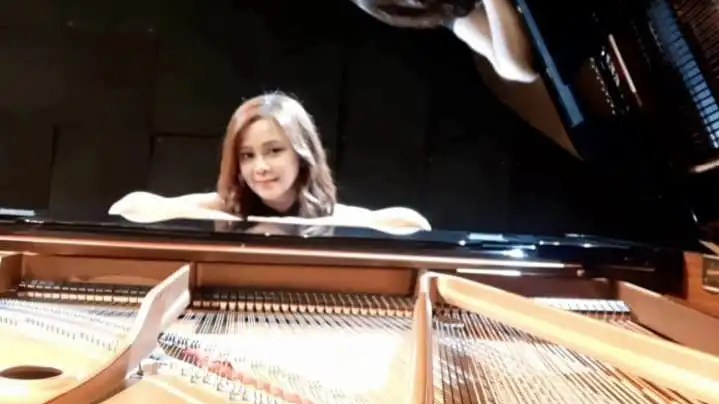
Andhika Patrick was born in Jakarta, Indonesia, and grew up in Australia. She began her music journey at 4 years old and after winning competitions in Asia & South-East Asia; in her final high school year was offered a place to study from a Juilliard piano professor at Monash University School of Music (Australia) where she graduated with a Bachelor and Masters degree in Music in piano performance (1st class honours). She has an extensive repertoire including the usual pedagogic works, she seeks to extend her technique with the virtuosic transcriptions of Schulz-Evler and Godowsky among others.
Discover more from MEET THE ARTIST
Subscribe to get the latest posts sent to your email.
 MEET THE ARTIST