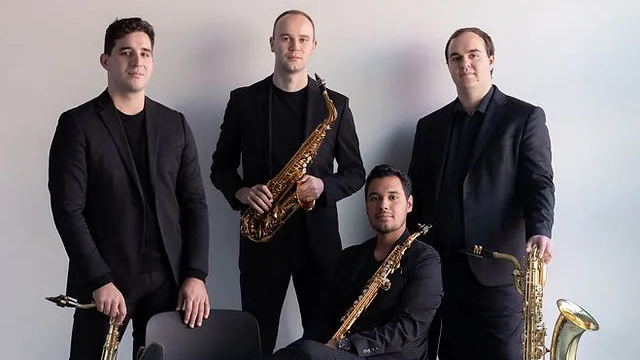
Aero Quartet are: Salvador Flores (soprano saxophone), Walt Puyear (alto saxophone), Matthew Koester (tenor saxophone), Brian Kachur (baritone saxophone)
Who or what inspired you to pursue a career in music and who or what have been the most important influences on your musical life and career?
We each had different life experiences leading to our individual decision to pursue music. However, in common, we all had fabulous support from our parents, friends, and mentors—paired with a deep love of the saxophone that fueled our dreams of making music for a living.
What have been the greatest challenges of your career so far?
We first played as an ensemble in early March 2020—just days before the COVID-19 lockdown. We were unable to resume playing together until the fall of that year, under restrictive conditions. Rehearsal time and space were severely limited, forcing us to work intensely when we were able. Ultimately, we benefited from the lessons learned during that year. Since this summer, all four of us now live in different states, but we do think the work flow and collaborative relationships we developed during our initial growth during the pandemic have allowed us to prosper as a group even though we live far apart. We cherish every opportunity we have to play music together.
Which performances/recordings are you most proud of?
Our recently released debut album, Aero Quartet, has to be our proudest achievement. It has long been a dream of ours to release a studio album on a prestigious label like Orchid Classics. We wanted to craft a record that would stand the test of time—capturing our quartet’s wide range musical interests and styles, and featuring some of our favourite works. We feel incredibly lucky to have had such a wonderful support team behind this project, and we are so excited to share this project with the world.
Which particular works/composers do you think you perform best?
We love to perform a variety of works in many different styles, though performing music in a crossover style that fuses classical and jazz is one of our favorite things to do. Off of our recently released debut album, works such as The Iberia Suite by Ed Calle, Dear Lord by John Coltrane, and Wapango by Paquito D’Rivera have become not only some of our most beloved pieces, but audience favorites as well. Another work we frequently play at our concerts is a transcription of jazz pianist Hiromi Uehara’s Cape Cod Chips. This tune has been on our live programs for years now, and is also named after one of our favorite snacks!
We all have extensive backgrounds as classically trained saxophonists, which is the foundational style of our chamber group. A bucket list piece we all really wanted to include in our debut album was Alexander Glazunov’s Saxophone Quartet. We think this is one of the most beautiful works in the repertoire—packed with beautifully twisting harmonies, and melodies that utilize just about every color the saxophone is capable of. The moment we wrapped up recording the theme and variations of the second movement, our recording engineer Jonathan Allen said “What a lovely set of variations that is”, and we hope you will agree if you take a listen!
What do you do off stage that provides inspiration on stage?
Among our members in the Aero Quartet, we each have slightly different individual pre-concert “rituals” that we have—but before we take the stage as a group, we take some personal time and love to have a bit of space to think and relax. We also talk and joke around a bit to create a light atmosphere for each other, and even play a little bit together, whether or not it is from the concert material. The atmosphere we create with each other in the green room is such an important factor in how we end up playing and interacting with each other on stage. Through this, we not only calm our nerves, but tend to feel much more natural when speaking and playing, and are able to “bounce” off of each other in a way that the audience can “feel”. It’s a difficult sensation to describe, but is easily recognizable based on comments from our audience members. On stage, we often play music memorized, which helps us communicate and emote on stage with one another. We find that the increased communication and eye contact with each other really makes the performing experience more united, relaxed, and enjoyable.
How do you make your repertoire choices from season to season?
As mentioned before, our quartet members live in four different states across the United States. Currently, we are each living in Washington D. C., Michigan, Wisconsin, and Illinois. Due to this, we have extremely limited rehearsal time which causes us to carefully and decisively select the repertoire we decide to play. We have a familiar list of repertoire we select from for each concert, and occasionally cycle in a brand new work that we all want to perform, especially when we have more rehearsal time than normal leading up to a concert. Based on what type of event we might be performing, we also might decide to throw in renditions of some more popular music that we think is appropriate for the occasion.
Do you have a favourite concert venue to perform in and why?
We would definitely say collectively that the Ebenezer Theater in Easton, Maryland is our favourite concert venue. We have had the pleasure of giving several performances in this historic space, both in a competition setting and through a Feature Guest Recital Invitation through the organization of Chesapeake Music. Recent renovations to the space have made it one of the most beautiful, intimate spaces for both chamber music concerts and solo recitals. The acoustics in the hall are wonderful and compliment the saxophone quartet beautifully—so much so that we decided to record our aforementioned debut album in that space.
What do you feel needs to be done to grow classical music’s audiences?
We think the idea of classical music should be allowed to overlap with other genres, which could help more audiences discover a love for it. Growing classical music audiences might be made possible by branching out beyond the term “classical music”.
We love to program a wide variety of works on our live concert programs, to ensure there will be something pleasant and enjoyable for everyone to listen to. The composers featured on our programs often range from Robert Schumann and Alexander Glazunov, all the way to John Coltrane and Hiromi. This is a formula we have found to be well-received by our audiences everywhere we perform. Including fusion or crossover works to our programs, along with our traditional classical pieces, has tremendously grown the scope of our audiences.
Orchestras around the world are branching out of the traditional classical realm through collaborations with artists such as Laufey and Jacob Collier, which has been successful in garnering the attention of young audiences toward classical music. We think building upon this idea of mixing genres with classical music is an excellent way to start bringing more attention to the overall genre of classical music.
What is your most memorable concert experience?
In autumn of 2021, we embarked on our Gold Medal Tour as a result of our top prize placement in the Fischoff Chamber Music Competition. This was the first time our ensemble had the chance to play for “normal” audiences, as concert attendance was finally ramping back up after the pandemic. We performed at a variety of venues and worked with countless students over the course of two weeks across the Midwest. The highlight concert for us was a concert held in Downtown Chicago’s Seventeenth Church of Christ Scientist. It was an absolutely beautiful venue, with the concert also being broadcast on Chicago’s WFMT 98.7 Classical Radio.
As musicians, what is your definition of success?
As a chamber group, we define our success as the ability to continue playing together, regardless of the distance. It is incredibly rare for an ensemble to not only play well together, but have the exact chemistry needed to create success together, which makes our time together incredibly special. I think we each realize what we have in this wonderful group, and would call it a great success just to continue performing together as much as we can.
What advice would you give to young/aspiring musicians?
One of the most important things for young musicians to think about is to never forget your “why”. Why did you decide to pursue music? Why did you fall in love with music? The answers to these sorts of questions can be easily forgotten or neglected through the stressors of the music business, the intimidating job search, competitions, academic work, amongst countless other things. An artist can only achieve their most heightened level of artistry when they are totally aware and in-touch with it. Truly making musical art requires an artistic self-awareness and an ability to see the bigger picture. Allowing yourself to find or rediscover that “why” will reward you with the artistic, intrinsic motivation to keep going in this field.
What’s the one thing in the music industry we’re not talking about which you think we should be?
That’s a big question! There are so many great advocates in our field, and we’re lucky to have had mentors who look toward the future. As musicians, we can always talk more about deepening connection through cross genre collaboration. Some of our most significant moments of growth as an ensemble have been in musical contexts outside of our comfort zone. It keeps our ears open and inspires the group to stay flexible. While each member of Aero is a professionally trained classical musician, performing music by and with artists outside of the contemporary classical world continues to broaden our identity.
What’s next? Where would you like to be in 10 years?
We each have different goals for our individual professional music careers, but we really are excited for the future of our group. The next few years will be very important for our development as a group—now living in four places, each of us with full-time positions or finishing school, our transition to a truly professional group is imminent. We hope to build on the connections and opportunities we are grateful to have had so far, and aim to perform for and engage with audiences as often as possible. We are so lucky to have released our first album, and I think in the coming years we would love to release another album that expands on our ensemble’s artistic identity and vision. All of us value our relationships as friends and chamber musicians very highly, and we intend to keep Aero Quartet as much of a major, active part of our professional lives as possible.
Aero Quartet’s debut recording is available now on the Orchid Classics label
https://www.youtube.com/@AeroQuartet
Discover more from MEET THE ARTIST
Subscribe to get the latest posts sent to your email.
 MEET THE ARTIST