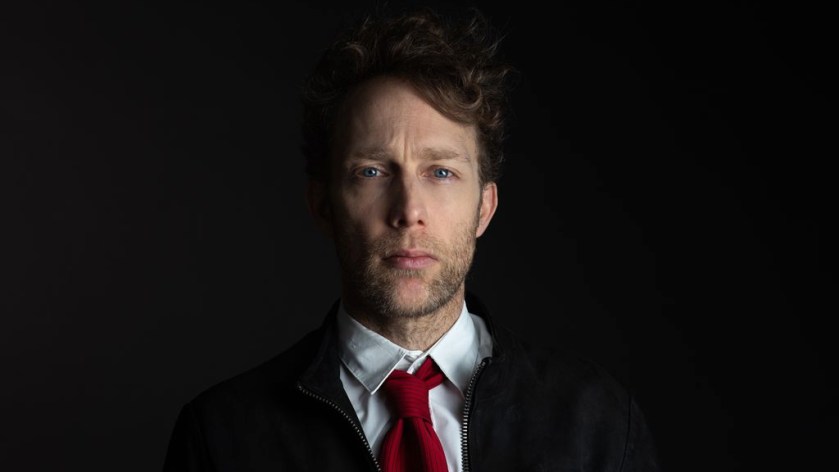
Who or what are the most significant influences on your musical life and career as a composer?
I am probably being unfair, because I am certainly underestimating some influences. But two of them are definite; Mozart and my former piano teacher. That teacher taught me a lot about music in general, not just about playing the piano. For example, that each player is an individual anyway and that therefore there is no point in focusing on one’s individuality. “If I have my students focus on their individuality the only effect is that they become egocentric.” Mozart had a great influence not so much on my sound but on my philosophy of writing, on my desire to combine a simple surface with a complex structure. On my preference to write as few notes as possible and for pieces that are not too long, for balance, etc. All typical attributes of the classical era.
What have been the greatest challenges of your career so far?
The greatest challenge has probably been to not be intimidated. Neither by the achievements of all predecessors, nor by the general indifference of the world. An enormous amount of impressive music has already been written and nobody has been waiting urgently for one to add to it. Also unless I’m on a project nobody cares whether I get up in the morning and work or not. Unlike a surgeon I could probably just lay in bed unnoticed for 6 months. So self-motivation can become a real challenge. To make things a little more interesting, music itself has undergone a massive devaluation in recent years, so making a living hasn’t become easier. These are all things that you have to learn to deal with and which, I admit, can be frustrating and/or discouraging from time to time.
What are the special challenges/pleasures of working on a commissioned piece?
For me, the most fun about commissioned works is the limitations. There are usually specifications regarding the cast, duration, time frame, etc. All of this helps when writing. Because basically you can do anything these days and that’s actually not helpful. To quote Stravinsky: ‘Anyone who robs me of an obstacle robs me of a force. ‘
What are the special challenges/pleasures of working with particular musicians, singers, ensembles or orchestras?
It is similar to the commissioned works: it limits the possibilities and creates a clearly defined framework within which to operate. In this case, these are the characteristics of the musicians, be it virtuosity, expression, a special instrument, a special performance venue with its own sound.
Of which works are you most proud?
A few years ago, I wrote variations on Radiohead’s ‘Everything in its right place’ for player-piano. The idea was to treat that kind of avantgarde-song like a classical theme and vary it accordingly. It was great fun and I still enjoy listening to it. Which is rather the exception.
How would you characterise your compositional language?
That’s a difficult question, because I actually believe it’s not a good strategy to consciously focus on one’s own language (see former piano teacher). Accordingly, I never did. But I can say what I like and like to use: I like memorable motifs, as few notes as possible, minimalism and economical work in general, music that is easy to understand but complexly written. I also like the possibilities of music production like in the Radiohead Variations there are structures that are not playable for a pianist. Hence the player-piano. So, when I talk about music production, I don’t mean additional effects, but planned, composed sounds that can’t be achieved in the traditional way.
How do you work?
That depends on what it’s about. I usually start by making a rough plan of what I want to happen musically. For traditional pieces, I work at the piano with pen and paper. If it’s electronic or experimental, I go straight to the computer after the conception phase.
As a musician, what is your definition of success?
In the artistic sense: writing music that flows as naturally as water.
In the practical sense: writing music that pays my bills.
What advice would you give to young/aspiring composers?
If you want to make writing music a job, I would recommend three things: firstly, realise that a love of music is a basic requirement and not an argument for a lack of craft. So, secondly, study thoroughly and as much as you can. Last but not least, realise that you will always write for an audience. Think about which audience that should be and learn how your business works.
What do you feel needs to be done to grow classical music’s audiences?
I don’t even know if it needs to grow. But if you want it to grow, one of the solutions is certainly access and bringing it to the people. For example, organising concerts in unusual venues. Here in Berlin, I once went to a chamber music concert in an old bunker, including a light performance. The concert was sold out and definitely not the kind of audience you see in a concert hall. Of course, money is also a factor. In the Paris Philharmonic, the best seats regularly cost around €50. Every time I’m there, about half of the audience seems to be made up of people under 30.
What’s the one thing in the music industry we’re not talking about but you think we should be?
Firstly, I have to say that I’ve primarily been involved with the music industry in Germany so far and I’m not sure how representative that is of the industry as a global whole! That being said, I think it’s worth talking about two things; culture and romanticism. About culture: a lot of music production (not so much in the world of classical music though) is based on software these days, because it’s easier and above all cheaper. But everything that is based on software can also be easily emulated by software. In short: relying on software for cost reasons is the shortest route to self-abolition; you can’t make it any easier for AI. On the subject of romanticism: a producer once said to me: ‘I always imagine you in a white silk scarf in a small room at a desk, writing music with a quill and ink.’ It’s okay that this romantic image of the artist still exists among large parts of the audience. But when you encounter it in a professional context (which happens to me quite often), it’s a problem. Because it obscures both the reality and possibilities and opportunities of the business.
What next – where would you like to be in 10 years?
In 10 years, the yellow emblem of Deutsche Grammophon can be found on my albums and I regularly work in different genres: film, concert music, dance, etc.
Sebastian Oswald’s EP ‘Grounded Bach Inventions’ is out now
Discover more from MEET THE ARTIST
Subscribe to get the latest posts sent to your email.

