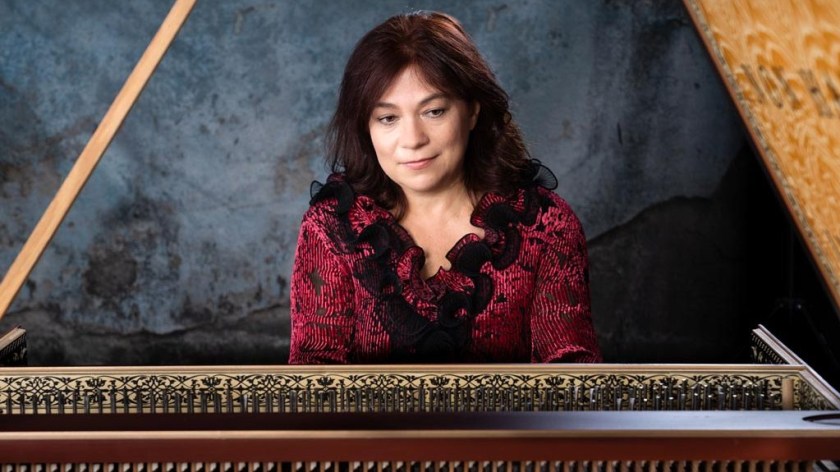
Who or what inspired you to pursue a career in music and who or what have been the most important influences on your musical life and career?
I grew up in Riga, capital of Latvia – a country where people love music and singing (every four years they prepare and celebrate a huge singing festival like the Olympic Games). Although it wasn’t directly related to my family – my parents were engineers, not musicians – my first musical input was this: when I was 6 years old, my father gave me a recording of Mozart’s Eine Kleine Nachtmusik. I was so fascinated by this music that I wished I could learn to play the piano… This first step towards music is thanks to my father, although my parents had nothing to do with music. Later, when I had listened a lot of baroque music, J.S.Bach, and the harpsichord recordings by Gustav Leonhardt, Trevor Pinnock and Pierre Hantai, who has particularly inspired me, I decided to become a harpsichordist. Later, my harpsichord studies in Oslo and Cologne with Leonhardt’s pupil Ketil Haugsand also played an important role. Since then my life has been passionately connected with harpsichord playing.
Which performances/recordings are you most proud of?
I am most proud of my solo harpsichord debut last year at the Utrecht Early Music Festival 2023 – I played in the same row as the most famous harpsichordists of our time.
My last solo harpsichord CDs “Johann Krieger – Sechs Musicalische Partien” (MDG 2021) and “Domenico Scarlatti… ma cantabile” (MDG 2022) have received a wonderful response internationally – many 5-star reviews (including Fanfare, Klassik heute, Crescendo, etc.) made me happy, of course! But also my first internationally acclaimed album “Cembalo cantabile” (Amati 2015). But also the success of my first CD made me proud to realize my musical concept for cantabile harpsichord playing – just as one would sing on harpsichord.
Earlier this year, I fulfilled my long-standing wish for a Bach album with my latest CD production “Johann Sebastian Bach… con passione” (MDG 2024)
Which particular works/composers do you think you perform best?
I like Johann Jakob Froberger very much because of the freedom that his music gives to the performer while at the same time opening up the expressiveness of the harpsichord. The works of Domenico Scarlatti, especially his more lyrical sonatas, also reflect something “romantic” in my soul, which I can accomplish, together with virtuosity, very vividly on the harpsichord. Johann Krieger is also close to my heart whom I had “discovered” for myself, and of course the works of J.S. Bach, such as the Chromatic Fantasy and Fugue BWV 903 or the last great harpsichord Partita No. 6 in E minor BWV 830.
What do you do off stage that provides inspiration on stage?
I’m always trying to discover something new for myself, be it through walks in nature, traveling where I haven’t been before, attending concerts with programmes that interest me, and meeting to exchange conversations with friends and other musicians. I really enjoy listening to recordings and interpretations by other musicians, including harpsichordists, to further develop my own ideas. It is always a pleasure to discover something new – be it in music or otherwise in life…. I always remain curious.
How do you make your repertoire choices from season to season?
If there are no guidelines on the part of the concert organisers, I choose those works that I would like to play with the greatest pleasure at that moment…
I always try to design the programmes in such a way that they never seem monotonous or boring to the audience (which can easily happen with harpsichord solo concerts…). I build the pieces together with a lot of variety and contrasts, so that the whole thing looks like a “musical story” on the stage.
Do you have a favourite concert venue to perform in and why?
My favourite concert halls for solo performances are always those where I feel embraced by the sound with good acoustics for the harpsichord, and where I can feel the reaction and the “breath” of the audience; these can be castle halls (e.g. the “Santa Clara Keller” in Cologne), or the churches such as the “Lutherse Kerk” in Utrecht, the “Marktkirche” in Detmold, and of course the bigger halls like “Konzerthaus Berlin” or “Cologne Philharmonic Hall” (where I enjoyed the atmosphere very much during various orchestral performances as a basso continuo player).
What do you feel needs to be done to grow classical music’s audiences?
First of all, I think it is important that the curricula of music lessons in schools should convey an appreciation for classical music and arouse interest in it – be it through exciting, interesting music stories, concert visits or making one’s own music.
I think every classical concert should have an energetic effect in such a way that it becomes a unique, exciting experience for the audience – that’s how I´m aiming to perform. To achieve this, I prefer to play with risk – like the famous quote of the great pioneer of baroque music Nikolaus Harnoncourt: “… Art is always on the brink of disaster…. and just before the crash it’s the most beautiful. That’s where you’ll find the miracle of music.”
What is your most memorable concert experience?
Two concerts I find the most important in my life so far: my very first solo recital in the Great Concert Hall of the Oslo Academy of Music, which inspired me for my entire harpsichord career, and my recent solo harpsichord debut at the Utrecht Early Music Festival 2023.
My harpsichord recital in March 2024 at the wonderful Old Church on the Market Square in Detmold was a great experience for me – also because of the broadcast of the concert by the Westdeutscher Rundfunk.
As a musician, what is your definition of success?
For me, success is when I get the feeling that I have achieved my most cherished musical goal, and the audience notices it too. Success is also when I have played a good concert, felt satisfied and have been able to inspire the audience with my music and my instrument.
What advice would you give to young/aspiring musicians?
I am reminded of a beautiful quote by J.W. von Goethe: “Whatever you can do, or what you dream of, start with it. Courage has genius, power and magic in it”.
What’s the one thing in the music industry we’re not talking about which you think we should be?
I think the support of classical music performers today is very important: sponsors, patrons – everything that helps them to develop their careers and thus keep the classical solo concerts alive.
What’s next? Where would you like to be in 10 years?
I hope I stay healthy and play concerts in different places in different countries where I’ve never been before…. and transport my energy and inspiration to the audience via the harpsichord.
What is your idea of perfect happiness?
I doubt if perfect happiness is even worth striving for, but to be in the here and now, to be able to do with love what you have always wished for as a musician, that is already a great happiness.
What is your most treasured possession?
My fantastic instrument: a two-manual harpsichord after Ruckers, built by Titus Crijnen, which can be heard on all my last solo CDs.
What is your present state of mind?
I am open and excited about everything that may come my way.
Discover more from MEET THE ARTIST
Subscribe to get the latest posts sent to your email.
 MEET THE ARTIST