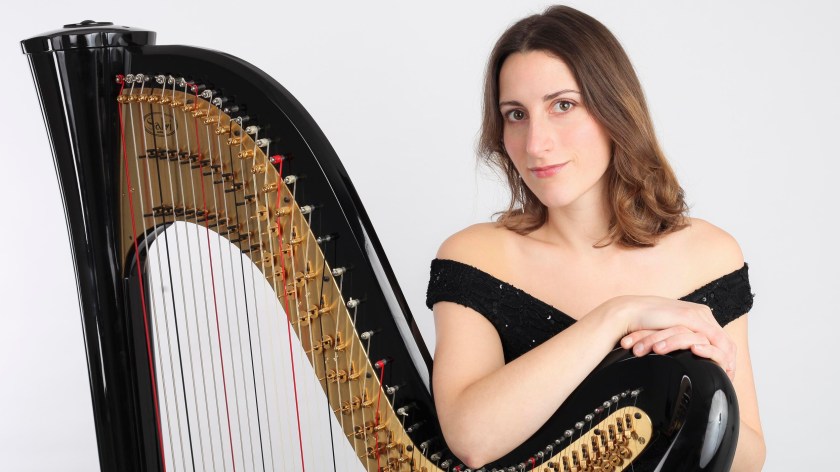
Who or what inspired you to pursue a career in music and who or what have been the most important influences on your musical life and career?
I was surrounded by music at a very young age. I’m the fourth of six children, and we were all encouraged to get involved with music. One brother was a chorister at Winchester Cathedral, another a chorister at St John’s Cambridge. There was an array of instruments in the house at all times: pianos, recorders, cellos, oboes and more. Music got under my skin from when I was practically still in the womb, and it’s stayed there ever since.
It was impossible not to pursue a career in music. I’ve dabbled in following other paths but it was never long before music took over my life again, and again.
My influences have been and still are my parents, my teachers, my friends, my husband. Every single person along the way who’s enjoyed listening to me play or sing and have encouraged me further are a part of the journey.
What have been the greatest challenges of your career so far?
My biggest challenge has been getting out of my own head. I’ve always struggled with confidence and believing in myself. Playing music is a deep personal experience where you are expressing not only the composer’s music and bringing it to life, but what feels like your deepest secrets. Learning how to share your soul with others through music can feel extremely vulnerable, but what I’ve learnt is the more I share, the more I get back.
Which performances/recordings are you most proud of?
A career highlight has been giving a recital in Kuwait city back in 2014 on behalf of the British Council of Kuwait and the British Embassy of Kuwait. Apparently in that year, Kuwaitis were the top Instagrammers in the world, and for a brief time, it was me that were instagramming about!
On the recording front, I’m extremely excited about my latest release with Thomas Hewitt-Jones, who has written three fabulous arrangements of well-known Christmas carols for harp solo and strings. Think traditional Christmas carols meets Downton Abbey Christmas special! They sparkle with fun and joy which is exactly what Christmas is for me. Working with Tommy has been a huge highlight of 2024. Watch out for this on the brand new Vivum Label.
I’m also very proud of a work called ‘Noel El El’ by composer Piers Kennedy which we worked on together during 2023. As a homage to Britten’s A Ceremony of Carols, this work is for lower voices and harp, as those poor tenors and basses can easily miss out on singing the Britten each year. Working with composers is extremely rewarding and this finished work speaks for itself. It’s about to be released on the Delphian Label with Ensemble Pro Victoria, directed by Toby Ward.
Which particular works/composers do you think you perform best?
Benjamin Britten’s A Ceremony of Carols is something I like to think I specialise in. At the very least it feels very special to me! I was one of the very first girl choristers at Ely Cathedral where I learnt the work as a singer, which then came in extremely useful when I learnt the work later on as a harpist as I feel I know it inside out. I’ve performed it countless times, with one winter season having a record number of 12 performances. The entire work is so cleverly written, but the solo harp ‘Interlude’ is my personal highlight due to Britten’s astonishing skill of putting so many ideas and so much intellect into something that still shines with perfect simplicity. Every year when I put it on my music stand I wonder to myself “what will I discover in here this year?” as there will be something new to learn all the time. It’s like Britten has left a treasure hunt of clues for you to pick up year after year, which has helped my own playing of the work continue to evolve as the magic of the music continues to surprise me. It is timeIess, it is genius, and I will fall in love with it again and again.
How do you make your repertoire choices from season to season?
More often than not, I am booked to play specific music for a concert or backgound music gig which makes life a lot easier in terms of decision making. But I do like to use ‘themes’ for recital programmes which could feed into the time of year, such as ‘Autumn’ or ‘Christmas’, or something that works all year round like “Magic of the Movies” or “Music of the British Isles”.
Do you have a favourite concert venue to perform in and why?
My concert venues vary from churches and cathedrals to national trust houses, pubs, and private living rooms. It’s very difficult to have a favourite as I love the contrasts of different spaces. However, I think cathedrals have the edge as the acoustics are so interesting and forces you to give a lot of space to the music you’re playing or it gets lost in the wash, as it were. St Paul’s Cathedral is pretty spectacular to perform in, and not just because the harp looks fabulous in there! I was expecting to work harder, given how large the space is, but the harp voicing works beautifully and has a very satisfying echo.
What do you do off stage that provides inspiration on stage?
Living in the countryside provides room to breathe and reset my mind. I love to walk my dog nearby to where I live and take in the clean air and beauty of the area. It’s possible to walk for miles without bumping into anyone which can give the most wonderful headspace and keep me centred. While walking I often like to listen through in my head any music I’m currently learning, which can help reframe the music’s context. This can often buoy me up so much that I jump straight on the harp on my return to the house to look at a certain passage as I’m eager to put my thoughts into practice.
What is your most memorable concert experience?
Not strictly a concert experience, but as a harpist, a lot of my work is playing at events and I’ve had some very interesting bookings! Weddings are very popular, as are corporate functions and private parties. There was one party I was booked to play at Goodwood House and Estate in Sussex. This is a very fine house, and the client was hosting just 12 guests from all over the world. I’d been given a strict schedule as there were an awful lot of artists involved, including many circus performers! When I arrived, I immediately spotted medieval tents with coned tops on the outside of the house. That was where the circus performers were going to do their trapeze tricks for the guests!
I was then dressed up in all gold which also incorporated gold eyelashes and makeup, and gold ribbons in my hair. I took the harp through to the ‘banqueting room’ which was made to look like the inside of a golden tent. I was to play on a golden stage overlooking the long table the guests were to feast at. Around the edges of the room were podiums where human statues were in place, wearing extremely little due to the fact they had been spray painted gold from head to foot! I played a selection of early baroque and medieval music, before having to get the harp out of the way for the contortion artists who was to take the stage after me (Of course!). However, they wanted the harp to leave in as special a way as possible, so two of the golden human statues popped the harp on their shoulders, and we walked out in ceremonial style!
As a musician, what is your definition of success?
I think ‘success’ is quite a loaded word. I try not to use it very often, or if I do it’s for specific concerts, or recordings etc. As musicians, we are prone to going up and down about how we feel about our own playing. I know that in the space of one week I could easily make a zigzagging graph of how ‘successful’ I feel. So, what’s more important for me is to escape giving myself a label to live up to and instead get lost in the music that I love to make. If the music makes me happy, I suppose that’s success!
What do you feel needs to be done to grow classical music’s audiences?
Unfortunately, we’re in danger of our classical music audiences becoming greatly depleted due to a huge lack of classical music education in the state school sector, and more people growing up thinking classical music is only for the ‘elite’. This is an exceptionally sad reality I struggle to fathom.
What can help in the meantime is accessibility! We’re living in a time where classical crossover is very popular with thanks to shows like ‘Bridgerton’. I think this gives us a huge opportunity to help bridge the gap with those who think classical music isn’t for them. Let them be drawn in by hearing their favourite music on a classical instrument, and hope they stay and spark a wider interest in classical music.
What’s the one thing in the music industry we’re not talking about which you think we should be?
How much Brexit has had an impact on international touring in Europe. British musicians are often not being chosen to perform due to the hassle of extra paperwork and general difficult bureaucracy.
What advice would you give to young or aspiring musicians?
Go to concerts, speak with other musicians, surround yourself with inspiring people. We all strive for perfection, but always focus on the bits that went right in a performance, and not the things that went wrong. Filming yourself playing is the most useful tool in fixing technical issues, as well as getting used to being in front of a camera which is acting as your audience. Playing background music for events is another good approach to help your confidence grow.
What’s next? Where would you like to be in 10 years?
I’m always excited about what the future will bring! My husband and I have an organ and harp duo called ‘Organics Music’, and we’re in the midst of planning some exciting tours of the Far East and America which should be wonderful highlights for 2025 and 2026! I hope in 10 years I’ll have many different and exciting projects and tours under my belt, and have worked with more fabulous musicians. However, I’m currently in a very good place, both mentally and physically, so I hope not too much will have changed!
What is your idea of perfect happiness?
Contentment is my happiness.
‘Carols of Harp’ with Cecily Beer and the Chamber Orchestra of London, conducted by Rupert Gough, is released on 10 November. The EP features arrangements of three well-known carols by award-winning composer Thomas Hewitt Jones
(Image credit: A P Wilding)
Discover more from MEET THE ARTIST
Subscribe to get the latest posts sent to your email.
 MEET THE ARTIST