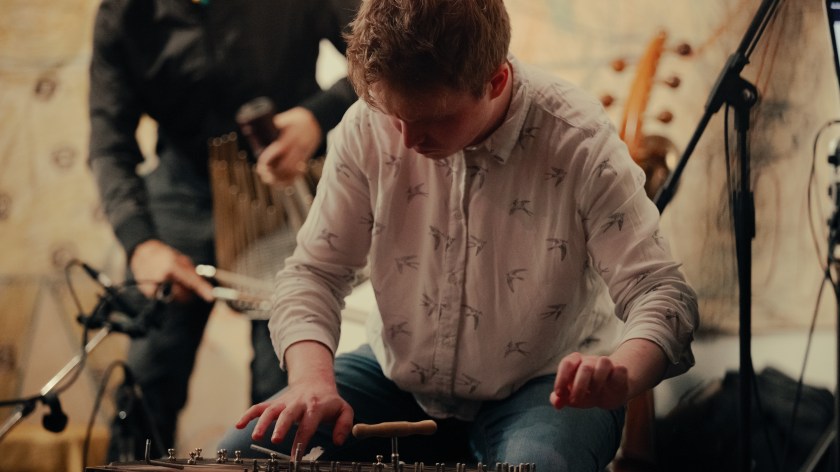
Who or what are the most significant influences on your musical life and career as a composer?
There are lots, and they all offer something slightly different. I grew up listening to show tunes, film soundtracks, big band arrangements, as well as quite a bit of Irish folk and of course classical music, along with mainstream pop, so my listening has always been quite broad. I’ve never really been a fan of symmetrical ideas of balance, perfection, or systematisation, so often I’ve been drawn to music which is stretched or extended, lopsided, dynamic, or which contains many different voices. Hildegard von Bingen and Guillaume de Machaut are early music heroes of mine and something about their use of line crops up in my mind often when I write. Erwin Schulhoff and Samuel Barber’s approaches to harmony were very important to me in my early years at conservatoire, as was the music of Igor Stravinsky, Charles Ives, and many of the composers in my cohort – including Nora Marazaitė and Juta Pranulytė, Lithuanian composer colleagues whose work I think of often. Andrew Norman’s The Companion Guide to Rome, and George Crumb’s Makrokosmos were important pieces for me in terms of opening my ears to new sounds. Japanese composers Tōru Takemitsu and Mamoru Fujieda have been more of an influence in recent years, especially their approaches to the placement of sounds, textures, and time, as well as Yoko Kanno for her soundtrack work – she can create in such a range of idioms, but something links it all together somehow.
But the composer whose work I return to, again and again, is Béla Bartók. Some people talk about Bach or Beethoven like this, but Bartók’s music has always made sense to me. I remember I first hear the Divertimento for Strings when I was about 11, on a CD I was given by a teacher. Something in its rhythm, its non-rectangular nature, its movement, its sitting between the cracks of harmonic traditions, I find speaks to me really clearly. In 2023 I had the privilege of going to a conference in Budapest and took some time to visit his grave. It was really moving. His music has been with me for a long time, and taught me so much. He’s a shadow behind everything, I think.
What have been the greatest challenges of your career so far?
Speaking as an early career composer, after my conservatoire training, I really felt quite lost. I had been exposed to so much new music, so many ways of working, so many different ideas, and had built a portfolio which was quite eclectic – including more conventional notated chamber works, through to graphic scores and experimental devised pieces. While inevitably some is good and some is less good, I have always felt that a diverse portfolio is a strength, but it has certainly made it harder sometimes to describe my practice or put it in a neat box (especially for funding applications or calls-for-scores). A staff member in the conservatoire, who I won’t name, made a comment that “you needed to reconcile this diverse practice, or you’ll find it hard to continue as a composer”. A few years later at a conference in Switzerland with my trio The Noisebringers, a similar comment was levied at us (“you have to choose, are you artists, composers, performers, film-makers, theatre people, what are you?”).
I view these comments as very closed-minded, and in a way quite targeted against early-career artists. It seems to me that in our culture, we value established artists/composers who have a diverse portfolio of work, who can turn their hand to anything, but ‘emerging’ artists are often asked to choose – to ‘hone’ a compositional voice, to perform a particular kind of linear coherence in their work. So this is something I think I wrestle with, culturally. When is the practice allowed to be diverse, and when does it have to be neatly describable? Of course, the flipside is true too – I’ve seen a lot of artists’ work described as ‘genre-defying’ or ‘groundbreaking’ just because it brings together several different strands of practice, which isn’t always justified in my view. Just putting new things together isn’t inherently interesting, and I’m wary when this is labelled as ‘innovative’ or ‘radical’ without further context. I suppose I’m more interested in how multi-genre or interdisciplinary work can help us understand each other better; build stronger community, give us different lenses to look at the world, through bringing things together. That’s the challenge – when we cross boundaries (which is a great thing to do), what is it for, and how can we make it meaningful?
The pandemic also came at a challenging time in my composing development. I was a couple of years out of my MA, and had been rebalancing life after a family caring responsibility took me out of composing for a little while. I’d just moved away from Scotland down to the north of England, to a new town, and suddenly bam – no more performance, hard to find community, challenging to make work, and no gigs, not to mention the psychological experience of that period (which we like to downplay in terms of its impact on our creativity). That was hard. I really found solace though in my housemates at the time, who were also composer-performers. We put on a house concert and livestreamed it, that was fun (even if no-one watched it). We made short films with each other, and did some virtual residencies. Through that time, though, I basically abandoned notated music and chamber music altogether, concentrating more on recording work. Years on, I find my portfolio from the last few years doesn’t quite fit into the usual calls-for-scores or composing opportunities. Much of it is unscored, for example, or is site-specific. Much of it isn’t professionally recorded, and premieres haven’t been documented. There are cultural questions, for me, about how we still need to provide aftercare and support to one another after the pandemic. My sense of a composing career pathway got quite derailed, and I feel I haven’t quite managed to rebalance. Community, and support, though, is what’s needed. We have to work together to uplift each other, support each other’s work, and these things take time.
What are the special challenges/pleasures of working on a commissioned piece?
I absolutely love working with other people. In a way, I feel I’m less interested in my own ideas than in what we can create when we come together. So being commissioned to do something where I get to work with other artists, or with a production team, is just an absolute joy. I remember in 2017, I was part of the Opera Sparks cohort commissioned by Scottish Opera to write three new chamber operas for the youth company. We had mentoring meetings and support from the directorial team, and that was really fantastic. They managed to bring out aspects of my ideas which I hadn’t seen myself, and in the end I was very happy with the piece as it came to be. The premieres were great, and they recommissioned my opera – Maud – in a new orchestration in 2023 for a run of new performances, which I was thrilled by. So having the opportunity to work with a team which can support you, nurture you, help develop your ideas is great – rather than just writing in isolation, like so much of the time. A challenge can be when the ideas I have take on a life of their own, and I have to wrestle them back into the form of the commission. In 2019 I was commissioned to write a piano piece explicitly with no preparations of any kind, but at the time all I was interested in was prepared piano (!). This was a psychological challenge, really just for me I suppose. How can I drop my prejudices against keys-only piano, and find new interests in it? Right now, I’m quite interested in the principles of organisations like CoMA (Contemporary Music for All) and the possibilities of open instrumentation, something I’ve been working with for a while. I think it’s joyous to be able to make something which could be feasible played by any kind of ensemble – it opens up a very creative space.
What are the special challenges/pleasures of working with particular musicians, singers, ensembles or orchestras?
In recent years I’ve found that the experimental and improvising communities (in music, and in dance) bring out something joyful and stimulating in my work in a way that many contemporary classical ensembles hadn’t, certainly in the past. There’s an easy-going-ness with improvisers which is paired with an absolute dedication and seriousness about the work, which I find so refreshing, and which really feels like home. The aesthetics are highly varied, as are the approaches, but there’s a mutual acceptance that what might emerge will be valued, in and of itself, without recourse to a fixed frame of reference – a canon, a closed way of doing things. In my lecturing work up in Scotland, with conservatoire students, I find that free improvisation really opens them to new terrain. It’s something that everyone (and I think especially classical performers) should have the opportunity to do, and to reflect on, to inform their wider practice. It can help to soften us out of pervasive paranoias in classical training – is this perfect enough? Is it virtuosic enough? Is my technique right? Am I demonstrating my skill? All this gets shifted in the improvising space.
More generally, I’ve always enjoyed working with percussionists because of the range of instruments and techniques they’re prepared to work with. It’s almost like walking into a workshop and being told “okay, we can do everything, what do you want to try?”. Such a diversity of sounds available, and a familiarity with so many different ways of sound-making. I find it really inspiring. I played recently with my friend Colin Frank in a set of recorded improvisations. Colin plays regularly on the ‘duck-call’ (for which he wrote a concerto), as well as on suspension coils from cars and a variety of little bells. Playing with him is good fun – something in our textural relationships just seems to match.
Working with my Swiss-UK trio The Noisebringers, which is Maria Sappho and Brice Catherin, and the various collaborators we’ve had over the years, is also brilliant. They’re both exceptional musicians, with a real exploratory attitude and a preparedness to just jump into any idea. We’ve been working together for nearly 6 years now (or 600, depending on whether you believe the chronology in our improvised book Mycorrhizal Noise) and in that time we’ve made exhibitions, installations, films, video games, a board game, and that can only come about because of a trust – that we’ll support each other, that we share workload, and also that we will almost unconditionally accept each other’s ideas and try to make them work.
Of which works are you most proud?
Right now, I’m really interested in composing with instruments and field recordings. I’m working on a series of pieces called Ecollages (eco-collages) which explore our relationship to the more-than-human world through sound, visuals, and movement. So the first piece in this series, Ecollage_01, I’m really proud of. It’s made for field recordings from Northumberland national park and prepared piano, and is about five minutes long.
Ecollages_01 (2024)
Another eco piece ‘Book of Trees’ (2015) is my most performed work, and has had the most love online (!). I remember I sent this for a competition once and the comments came back (in German) that it was “childish and backward looking”, which was just rude really, but for a piece about trees from my childhood village it was actually probably quite appropriate, when reframed slightly. Book of Trees is quite unabashedly modally/tonally centred. It’s a series of miniatures for learner pianists which came out of a really tricky couple of years for me, personally, as I struggled with mental health and an anxiety diagnosis. It was also my first exploration of illustrated notation, so I’m really proud of the piece, even if it’s developmental (we’re always developing, if we’re not developing, what are we doing?!).
Book of Trees (2015)
How would you characterise your compositional language?
I find this such a tricky question! I’ve always enjoyed working in multiple languages, from things which have a more modal/folky feel, through extended tonalities, right up to experimental improvisation and noise, which is where more of my recent work has been. In my composing work, I really value collaboration, from meeting other people and from listening to them, playing with them. So as a result of that, I’ve produced work which exists in a lot of different aesthetic spaces through dialogue with them. If I had to give characteristics, then, I’d probably say at its root my ‘language’ is quite flexible. At the same time, I’ve realised recently that much of my work has been either quite contemplative in nature – slow, placed, sensitive – or very dynamic – full of twists and turns, never sitting on one idea for too long. So something in between those two places.
Moss Gardens is a set of contemplative pieces based on cultural and aesthetic properties of mosses. No.1, for Harp and Tenor Recorder, shows this quietness quite well I think. By contrast, my album noise at the death of one beloved (2022) is more of a moving entity, changing, shifting, and mutating across a lot of different sonic environments within a free improvisational feel.
Moss Gardens No.1
Noise at the death of one beloved (2022)
As a composer-improviser, I experience all the time how unique sonic languages can emerge directly from the contexts we work in. If I’m playing with someone who comes more from a traditional background in bebop or trad. Jazz, for example, inevitably what we do takes on some of that feel. Similarly, if I’m working with players who have a practice in early music, some of that flavour comes through in what we create together. One of the joys of free improvisation, for me, in its broadest sense, is that it’s a space in which all kinds of genre/stylistic references can emerge and then dissolve; when there are no ‘rules’, what we make together becomes a collective negotiation which draws across our experiences, and quite magical things can happen. I played a gig earlier this year in Edinburgh, and my colleague Maria was using an FM radio hidden inside a wooden box. Half-way through, she tuned it into a channel which was playing Gaelic song, and at the same moment I had been exploring some pentatonic ornamentation on the recorder, just by chance. The two just synced up, and we played together for a couple of minutes, weaving some pentatonic melodies together, before we collapsed back into a more experimental and exploratory soundworld. That’s the kind of thing I love – the potential for things to coalesce, or come together just for a moment, and then fall away. Always changing. That’s what keeps it alive.
if i were a cat i would play feminist experimental avant noise (Waverley Bar, Edinburgh, 2024)
How do you work?
Practically, between the piano, my laptop, my art materials (paints, graphic score materials etc.) and DIY instruments. I often feel like my ideas move too quickly to be written down, which is probably why I spend more time now recording things and transcribing them (when they need transcribing), rather than working score-first. Also practically, I have a full-time research job at the moment, looking at improvisation in the context of wellbeing, health, and community. So often, I’m composing in evenings, at weekends, or in spare pockets of time. That means that things are moving more slowly, I’m taking more time to digest things than previously. This is a blessing and a curse – I feel like I can let things sit for longer, but sometimes my interests have moved on in a few months and I don’t want to go back to what I was doing! It’s an ongoing process of listening, learning, assessing, reevaluating, but I’m learning to put myself under less pressure. The emphasis should be on good work, not on churning something out because I don’t feel like I’ve made something in a while. It’s a hard thing to balance, but I’m trying. When I’m stuck, I go for a walk. I’m lucky to live in a place where I can be in the fields and the woods a few minutes from the house. They remind me what’s important.
As a musician, what is your definition of success?
I think many people want to create work which is seen/heard/loved/appreciated by audiences. That’s me too. I go back and forth with how big I wish those audiences were. Sometimes I wonder about whether I will ever write a piece to be performed in a high-profile venue in front of a massive crowd, but then I ask myself whether that matters to me or not. I think it’s more important that the work is meaningful, true to what I would like to create, and speaking to someone, than for it to be on the biggest world stage. I think success for me is about making a connection with someone through the work – emotionally, empathetically, even intellectually or conceptually (but that’s the least important, for me). Work which sticks with people, which shows them a way of thinking about something or feeling something, is work I’d like to write. I’d consider that successful. There’s a quote I love by novelist Ursula K. LeGuin in her introduction to The Left Hand of Darkness about what makes a good novel. She writes that after reading a novel, “when we’re done with it, we may find—if it’s a good novel—that we’re a bit different from what we were before we read it, that we have been changed a little, […] But it’s very hard to say just what we learned, how we were changed.” That’s what I’d love, if people felt a little changed by my work.
What advice would you give to young/aspiring composers?
I think for young composers, for students or for people who are coming to composition as adults, I’d say that there is so much out there which can enrich your practice beyond just creating works. Doing something other than just writing music doesn’t amount to ‘failure’, and a career as a composer will include a huge number of different things. All the composers I know do lots of things.
When I started undergraduate study in composition, there was a real mythology around what a composer was, who could be a composer (overwhelmingly white, cisgender, male, able-bodied, middle-class, European), and what composition did in the world. There was some idea that you could walk out of a composition degree and just magically acquire commissions, spend all your time writing music and attending premieres, and doing some composition teaching on the side. I don’t know anyone who lives that way, and I think that mythology really narrows and belittles the possibility for what composing can do. Since I left conservatory, I’ve worked in community facilitation contexts, running music sessions for disabled adults and young people; I’ve worked in schools, running theory classes, conducting, and co-composing with children; I’ve applied my compositional knowledge in curation and digital publishing; I’ve worked in research, and have thought compositionally about how to structure research activities, workshops, and lectures; and of course I’ve had works premiered, commissions etc. But it’s all part of the work. It’s all relevant, even when it doesn’t feel it, and it’s also all par for the course in today’s music economy.
I’d also say that even if you end up doing something else for a period of time, the composing is still there. It’s an old friend, it doesn’t go away, even if it changes shape completely. I’ve had to spend time really getting comfortable with the idea that things take time – there’s no rush, not really. Just make the work you want to make. Errollyn Wallen’s book Becoming a Composer is a great read, in terms of a composing journey written about explicitly in relation to social, economic, and cultural context.
What do you feel needs to be done to grow classical music’s audiences?
There are some really obvious things. For one, better representation of diverse populations within the industry, including questioning systemic racism, gender, and class biases within our tradition, and acting proactively to subvert them. This means people making space, giving up space, sharing ground, and thinking critically about perceptions of what sits within and outside the tradition. I attended some seminars in 2020 when a horrendous question was posed by an attendee – “if we expand classical music to include music from outside the Euro-Anglo-American tradition won’t that fundamentally change our music?” Aside from just being clearly underpinned by racism (“Our music”) and blinkered to the diversity of music we might describe as being within the tradition, I think it spoke to this sense of conservativism and conservationism within classical music’s culture. Ours needn’t be a fossilised tradition (and I don’t think it is, actually), but if we consistently narrate it that way, it will be. I think another emphasis should be music education. Everyone should have access to music education of a high quality across the course of learning from primary through to end of school. That means supporting and employing skilled musicians to deliver lessons, as well as breaking apart a culture in which music is considered ‘extracurricular’. Music is part of the curriculum because it’s part of our culture, of all cultures. While we know music enhances skill development in lots of areas (numeracy, social skills etc.), we should also emphasise music for the sake of pleasure, aesthetic enjoyment, meaning-making, creativity, and cultural heritage. It’s really that simple.
There are lots of other things, but something I’m quite passionate about, coming from a rural background, is performance outside of urban centres. In the UK, our musical economy is overwhelming urban-centric. Particularly for new music/contemporary music, opportunities and ensembles are city-based, and then very often concentrated in the south-east of England. I’d like to see more provision for the development of rural arts networks to support performance and access to performance for underserved communities outside of cities, in which there are similar issues of poverty, isolation, and deprivation, but which are often overlooked.
What’s the one thing in the music industry we’re not talking about but you think we should be?
Aside from how much unpaid labour there is (and how this keeps the industry afloat), I’ve really been thinking a lot about the challenges of social media platforms and the way that they force us to engage with time and attention in a particular way. We’re all encouraged to have a social media presence. It’s asked for and expected on calls for scores, funding applications, and I’ve even seen it on job applications. But while social media gives us huge possibilities for global reach, it’s not a meritocracy, it’s very hard to control, and it doesn’t let our work live in its fullest sense.
I spent some time earlier this year experimenting with Instagram to try and get my work heard by more people and to make some new online connections. I managed to find some new followers, and a couple of opportunities, but I found it absolutely exhausting. It wasn’t just the constant feeling of needing to check the platform to see how a post was performing, but also having to fit my artistic work into a very specific frame (short-form video content, a snappy caption, a set of hashtags) which doesn’t serve it in the best way. Longer durational music doesn’t suit platforms like Instagram, and vice-versa. The idea of having to promote yourself using very short 5-10 second snippets of music is so strange, especially if you’re writing drone music, or long-form music, or even music that’s just longer than 15 seconds. The expectation of wanting to grab people’s attention within mere seconds, within the context of information and sensory overload, is crazy and produces abrasive, aggressive media. There’s also the aspect, for me, that the majority of videos on social platforms have some kind of sound excerpt in them (a clip from a song or a meme). There’s so much sonic information that the sounds themselves almost disappear – they’re almost meaningless. And my favourite thing was being advised, by Instagram, to promote my own musical work by using trending audio – just so weird and inappropriate.
Without wanting to come across as technophobic (I’m not, and I still use these platforms) I worry about how the current emphasis on short-form video consumption is impacting our capacity to engage meaningfully with artworks, with each other, and with the world around us. Jenny Odell is an artist and writer who has written a fantastic book called How to do Nothing, where she unpicks some of our relationship with social media, from a professional and environmental stance. I highly recommend it for its well-researched, nuanced, and deeply personal approach.
What next – where would you like to be in 10 years?
At the moment, I’m in the early stages of setting up a project bringing together artists working with improvisation in a wellbeing and therapeutic spaces. Coming out of my research work, there’s a huge diversity of practitioners who are using improvisation (including ideas of instant composition) to benefit a wide range of groups, across dance, music, and theatre. So there’s something in that. I’d love if that could become something larger in 10 years time. I’d also love to spearhead some kind of rural musicians’ development network. So many opportunities are concentrated in urban centres, but that doesn’t mean that there isn’t a need or appetite for composition, contemporary or experimental music outside these spaces. So that’s on the wishlist as well. And I’d like to have a garden that I can grow vegetables in.
What do you enjoy doing most?
At the moment, I enjoy walking. I live on the borders of the Yorkshire dales, and I often try and get out of the house (especially after a day working at home) to just walk in the fields or up the hills. My partner, Harry, is a school teacher, and I try and get him out as well (even though he’s on his feet most of the day). Even in the city though, walking is good. Getting out of a building and into the world outside.
What is your present state of mind?
A collection of coffee cups accruing on the table, fog on the street outside, the gurgling of a radiator, and the beep of a washing machine ready to be emptied.
Discover more from MEET THE ARTIST
Subscribe to get the latest posts sent to your email.
 MEET THE ARTIST