Who or what are the most significant influences on your musical life and career as a composer?
My grandfather was a passionate amateur musician, singing bass solos in the church choir, my father is a renowned composer of popular und music publisher of production (Sonoton Music GmbH & Co.KG) and contemporary classical music (Proviva). So, I would assume that’s possibly the first deep rooted influence on my interest in music. From early age on I had piano lessons and somewhere around the age of 10 I started my first baby steps in writing music. With the guidance of my father the interest grew, and I started listening to classical music day and night.
At that time a classical music magazine offered a special series on classical music, every month about a different composer, with historic background and a companion CD. I bought all of them and absorbed their individual styles. Some touched me more than others, all where interesting. The Mozart Requiem was one that somehow struck me deeply, as well as a lot of the romantic music. It was also the style of music I would be exposed to on the piano, so I could practice and develop skills and instincts as a performer. But over time that was not enough anymore, and I wanted to create music myself, find a different way to express and experiment with music. Also, our teacher in school made us study Dvorak’s 9th Symphony. As I wanted to be able to create something like this, I hand copied the entire symphony. That was the foundation of my orchestrating skills that I learned at the age of 15. I was never learned orchestration from teachers, music scores of the masters thought me all I know now.
At the same time, I was already studying counterpoint, harmony in the music conservatory, so it somehow all come together. I had the tools to understand!
Ah, and there was film music. I was obsessed with the dramatic, romantic sound of classic Hollywood and the resurrection of the romantic orchestral tone by J. Williams.
These are really just a few anecdotes about influences, there are many more and they are still coming. It is all one, it is all music. The process of writing and performing, all is a part of music, of creation, feeling and communicating.
Sorry, that was a long answer…. In essence, it is music itself that is my sole and true inspiration.
What have been the greatest challenges of your career so far?
Somehow it feels that every new project is the one with the greatest so far, as it is not yet created. So, in short, the answer would be the next one. I could reuse old ideas and easily get away with it. But when I resist the instinct of applying known and approved solutions or to go down trampled paths it instantly becomes a challenge. I could walk down the easy way with light, expensive fancy shoes, but in order to grow I need to put on my hiking boots and take the unexcepted turns thru unknow terrain. It always pays off.
In the entertainment industry choosing the adventure path is not always possible as extreme schedule force us to rely on experience and known techniques. And there is nothing wrong with that. So, I guess the greatest challenge in those situations would be to find a balance of your own artistry, your own voice and ideas within the constraints of the project.
On the other side constrains, limitations are rules etc., which ever they might be, are necessary to create music, to develop form, harmony, structure…
Without rules the content becomes meaningless.
What are the special challenges/pleasures of working on a commissioned piece?
I guess I already touched a lot in my thoughts on the previous question. The pleasure of working on commissioned works comes in waves, first when you are chosen. Then you have to prove yourself and all the others that it was a good decision to hire you. You have to find out what the hell you are supposed to do, what you want to do and how. This is usually intensely frightening, a lonely and difficult part of the process. Once you have found a path to adventure thru, a voice for the project you want to communicate with the pleasures starts creeping up again. Upon finishing or presenting work in progress fear comes back, but that is normal. Once a project is completed, I usually do not listen to it for some time. Not that I don’t love it or stand behind it, I need the distance the find a new path.
But most importantly a commissioned piece forces me to go somewhere I have not been!
What are the special challenges/pleasures of working with particular musicians, singers, ensembles or orchestras?
When we play music together, we ideally become one newly formed musical organism.
The better we know each other, understand each other the healthier that group is, the better we listen and perform any given piece of music.
The challenge I talked about earlier, the pitfall of trusting the known more than exploring the unknown is equally present when performing. It is possibly the trust into each other and engagement of every one that is most valuable performing together, to explore interesting and new ways to feel, perform together as one any given piece of music.
It is fascinating how much a performers talent and individuality, even in small ensemble work, becomes a part of it all. They all melt together.
Of course, technique and craftsmanship are the basis for being able to freely play and experiment. With known musicians and orchestras, we understand each other, respect each other and be able to be in the same room and play music together.
Of which works are you most proud?
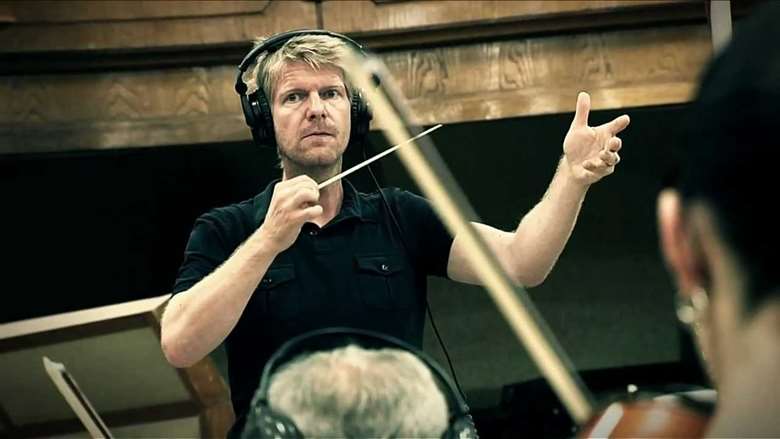
Currently I am very proud of my latest work as a conductor, recording Holst’s planets in Vienna.
It was the first time I recorded there, and it was a fantastic experience. Actually, it was the first time in my career I conducted such a big orchestra in a native German language country. I am used to conducting in English. In 1994 I moved from Austria to Los Angeles to study film music, English comes naturally but there was a certain understanding between the orchestra and me, one I had not felt in a long time. And we recorded, mixed and produced the entire album in Dolby Atmos, a fantastic new technology, especially for recreating the concert stage. It came from movie and TV and finally found its way into music only productions. That was a new one for me.
Of course, the score to the SpongeBob Movie was a fantastic experience too, and I still love how it turned out. Recording it in London was a dream come true, and the musician ship there is unparalleled.
Also, some concert music, chamber music I wrote I am still very fond of. Thinking of these still helps overcoming the fear to steer into unknown waters.
Overall, the Holst project ultimately combined my passion for classical music and modern film scoring. The composition is considered to be the original blueprint for Hollywood Sci-Fi music.
Many ideas and elements of the original Holst score can be heard in film scores like the first Star Wars movies and many others.
How would you characterise your compositional language?
I like to think in structure, in musical objects, colour could be one of them, rhythm or even the idea of contrast itself. So those staring points are relatively abstract. It’s possible not my choosing but was always that way for me. Developing ideas, solving musical problem or challenges guides the way.
Interestingly, maybe I am just a problem solver at heart. But is it the musical idea that is my main inspiration or the discovery and quest to solve the problems that come with it?
The language is constantly changing, the process not (yet ….) for me.
How do you work?
Well, some part of the answer I might have already touched on in the previous one. I love to have enough time to develop ideas, to find the most interesting path to explore. But often enough we don’t have that luxury of time. So tight schedules seam to actually help me to focus and to start, maybe like looking thru binoculars to peer for a specific detail, idea to work with. Stress lifts my rational mind onto a “neutral” flow that has no colour yet, something translucent, I cannot really describe but to something that creates. I do not think any more in a way I did before I started writing. I sometimes don’t remember how I got to a certain point, the experience, the rational and unexplained all become seemingly one.
As a musician, what is your definition of success?
Ah, that is one of the easier ones. If you succeed in making music part of your life, an equal and nourishing partner, if you manage to stay inspired and interested and open minded. If you manage to find joy, inspiration and balance in your work and life you have possibly accomplished more than most of us all. Financial success is easy to define, personal happiness is not. Music is a gift, if we invest our true passion, we receive more than we put in. We learn and hopefully be eternally inspired.
What advice would you give to young/aspiring composers?
Learn, be interested, open minded, engage, feel, be brave and listen! Music communicates with sound, not with a check book. If you are a composer, your language is music. Expand your vocabulary!
What do you feel needs to be done to grow classical music’s audiences?
Hard to say; audiences listen to and consume music. They want to be transported into different worlds, into past memories of their own or into something new. Music connects, not only composers with audiences but also each audience member with themselves and their memories, fears, hope, love and desire. Any of those thoughts could be used to develop new ideas to engage and communicate with our listeners.
What’s the one thing in the music industry we’re not talking about, but you think we should be?
With all the AI chatter going on, an important part is missed. Music has always been an expression of a moment by a single person or a related group that communicates with the tools and consolidated knowledge of each culture. AI uses the past to “create” (sorry to use that word here), we humans use the present.
What next – where would you like to be in 10 years?
Hopefully in a happy place with more questions and the energy to find solutions
What is your most treasured possession?
My heart, my mind, my interest and curiosity.
What do you enjoy doing most?
I do not have any specific favourites, the arise in the occasion.
What is your present state of mind?
Hopeful but worried.
HOLST conducted by Gregor Narholz is out now
Discover more from MEET THE ARTIST
Subscribe to get the latest posts sent to your email.
 MEET THE ARTIST