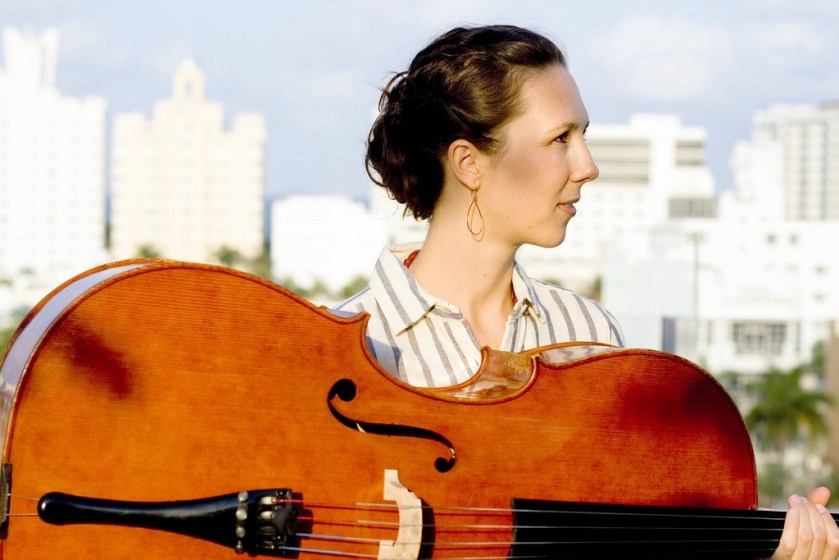
Who or what inspired you to pursue a career in music and who or what have been the most important influences on your musical life and career?
As a teenager, I attended a summer festival (the Bowdoin International Music Festival in Maine, USA) that really sealed the deal for me. There I realized, one, that a life in music was absolutely for me, and two, that I had a lot of work to do! I attended every recital and masterclass I could and relished the chance to meet other musicians from around the world. As the years went on, Iwas lucky to have cello teachers whose artistry and dedication to the craft were pretty awe-inspiring – Steven Doane and János Starker among them, and Scott Kluksdahl to start. It was never like, improve your technique for technique’s sake, but instead, that the building of technique is the means to authentic expression and freedom — and is something cellists have striven for generation after generation. So that was inspiring.
I also really value certain experiences I had during my early professional life. I got involved with early music during the tail end of my master’s program and ended up playing a season with the Apollo’s Fire Baroque Orchestra, which I learned a ton from. I don’t play baroque cello anymore but those sounds and gestures are always in my ear when I’m playing music from earlier eras! A few years later in New York I played in an upstart new music ensemble led by two composers. It was immensely valuable for me to have a role in this composer-performer continuum and experience the landscape for presenting new music.
What have been the greatest challenges of your career so far?
I feel like the challenges are ongoing and constantly evolving! In general, the need to balance creative pursuits — planning projects, collaborations — with weekly practice goals on the instrument, combined with the need to make a living and spend time with family and friends makes for a tricky equation. Because music is so all-consuming and intense work periods come in waves, I’m always trying to get better at time management! Several years ago, I had an injury that took me away from playing for a few months, and the uncertainty surrounding that was very challenging. The knowledge that I could not simply will a full recovery within a given timeframe was hard to accept.
Which performances/recordings are you most proud of?
I’m excited that my organization, Chiarina Chamber Players — which functions as a hybrid flexible ensemble and chamber music series — will release its debut recording in 2025, featuring chamber music by American composer Carlos Simon. The centerpiece of the album is a piece Carlos composed for us titled “The Best Cuisine.”
Which particular works/composers do you think you perform best?
I don’t think I’m an expert at any particular style, but I’ll say that I have a special affinity for the music of Latvian composer Pēteris Vasks, who was the topic of my doctoral dissertation. Delving into his harmonic language, influences, and historical context helped me to merge what I think he wanted to say with what I want to. I try to apply this model generally when I get a new piece of music!
How do you make your repertoire choices from season to season?
As co-artistic director of Chiarina Chamber Players, I aim to create the right mix for our particular audience community and group of performers. What standard “blockbuster” works have we been itching to play? Which new (or lesser known) composer voices do we want to introduce? How will the audience relate to a given composer or piece? Does the sequence of pieces throughout a concert provide a cohesive sound journey?
Do you have a favourite concert venue to perform in and why?
At Chiarina, we perform in the nave of a lovely historic church, St. Mark’s Capitol Hill, where the audience is seated “in the round,” with chairs encircling the center stage area. I love the up-closeness of this atmosphere where it feels like you’re playing directly to the audience, almost together with them, rather than at them from a distance.
What do you do off stage that provides inspiration on stage?
Getting an occasional break from the daily routine (sans instrument) is a good way to reset, so it’s important to schedule that in. Ideally that time can be spent somewhere in nature! For physical upkeep, I’m a big fan of lap swimming. Finally, I think we musicians sometimes overlook the value of experiencing a performance from the audience. When I’m lucky enough to catch an incredible chamber music performance, that inserts some new inspiration into my practice that week.
What is your most memorable concert experience?
Looking back to my student years, I will always remember experiencing some of the most existential chamber music works for the first time as an audience member — Quartet for the End of Time, Vox Balaenae — and then monumental string pieces like the Brahms sextets, and so on. As a performer some of my most memorable performances have been in outreach or educational settings — performing for patients at a hospital, or leading Honduran youth orchestra cellists in a final concert after days of hard work.
As a musician, what is your definition of success?
If someone walks away moved by your music, that’s success. Success also means you keep learning and continue raising the bar for yourself.
What do you feel needs to be done to grow classical music’s audiences?
Starting at a local, grassroots level makes it personal and relevant. At Chiarina, our audience is a mix of usual classical music fans who know the scene and then people who have never been to a classical concert, but it’s right in their neighborhood and they’re curious.
What’s the one thing in the music industry we’re not talking about which you think we should be?
With so much of our world on screens, people are looking for experiences and community. We can do a better job conveying that we provide that!
What advice would you give to young or aspiring musicians?
Remember what brought you to the art form. We all have a defining moment — perhaps that first taste of freedom of expression on the instrument or actually hearing the beautiful sound you want to create. This “love” will guide you at more challenging junctures! Also, be open for your career to take pathways you might not have expected.
Cellist Carrie Bean Stute is co-Artistic Director of Chiarina Chamber Players in Washington, D.C.
Image: Julisa Fuste
Discover more from MEET THE ARTIST
Subscribe to get the latest posts sent to your email.

