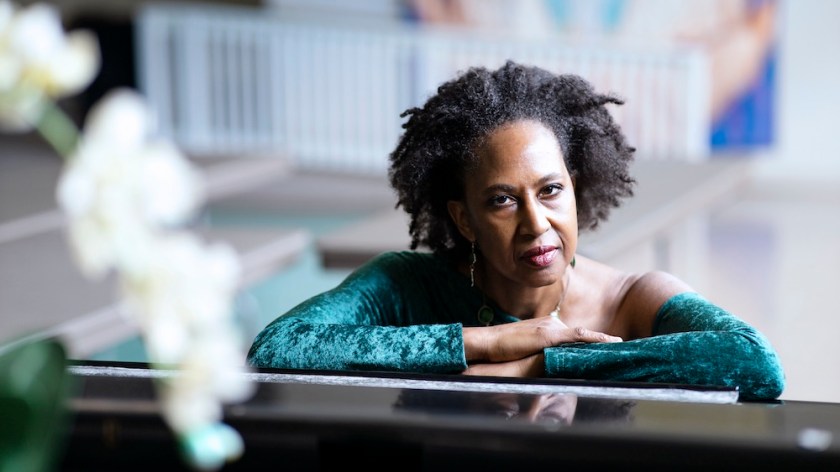
Who or what inspired you to pursue a career in music and who or what have been the most important influences on your musical life and career?
My mother, Eva Thompson (née Caisey) was my first piano teacher, passing down knowledge she received from my grandmother, Cecily Caisey, who earned a bachelor of music from the New England Conservatory in piano performance. At the time, Grandma was one of the few black students at the school. She attended a few years after Florence Price graduated, studying with some of the same professors (Frederick S. Converse, piano, and George Whitfield Chadwick, music theory). After listening to Mom instructing my late brother, Terry (who was four years older), I spent two years asking for piano lessons, starting when I was two years old. An aside: all four children in the Thompson household were fated to have piano lessons, whether we wanted them or not. Being the second oldest, I didn’t know that at the time.
I studied with Mom for four years, and then she sent me to Thelma J. O’Neill, a teacher at Alberta College in Edmonton, near where I grew up. Two years later, I began my studies with Alexandra Munn, a Juilliard graduate who was a professor at University of Alberta. I stayed with Miss Munn for ten years, from the age of 10 until I graduated magna cum laude.
My grandmother gave up practicing and performing when her third child was born. She asked me to promise not to follow in her footsteps. I wish I could have heard her play. She became a teacher to many children in her native Bermuda, but by the time I was born, her concertizing days were long gone.
My parents never pushed me to be a musician. In fact, I think they might have tried to talk me out of it if I had been a boy. They assumed that I could always marry someone with a more lucrative career (ironically, my ex-husband was a voice major when I met him at Juilliard). That said, I know my parents have always been proud of their children’smusical exploits. They were incredibly supportive, spending large amounts of time and money on lessons and chauffeuring us around (the latter job falling exclusively to my dad, Lloyd Thompson). They insisted that all of their children took education very seriously, because it was important for us to be able to support ourselves. In other words, though they hoped I’d marry someone who could provide me with financial stability, my parents were relieved when I got into the Juilliard doctoral program, which opened up opportunities in academia. (An aside: my ex got a Ph. D in ethnomusicology, so in theory, I was covered either way. If we’d stayed married, that is).
I’m not sure I’m answering the question! I’d say that my love of music inspired me, along with my mom, grandmother, dad, teachers (Miss Munn and Gyorgy Sandor were the main ones), and colleagues. As for the direction of my career, a lot of random encounters, my tendency to come up with crazy ideas, and the grace of God have pulled me along.
What have been the greatest challenges of your career so far?
Imposter syndrome has been a big one. On a logistical level, though, I’ll say that each performer who chooses to have children should carefully consider your ability to work as a team with your spouse. I have two children, and though only one is autistic, they both have special needs in that every child has them, even when their parents don’t divorce. My family lives far from me and my ex-husband, who is now in recovery, was actively battling alcoholism during our marriage. (Since he posts about this on Facebook, I’m not violating his anonymity). I’m grateful for the support of people in my community, particularly the congregation of my church, however, I still think that having the mental fortitude to manage my complicated life has been, and continues to be, my greatest challenge.
Which performances/recordings are you most proud of?
I’m proud of all of my recordings, however, if I have to choose I’ll say that I’m particularly proud that I recorded Soulscapes. It was a great honor to record the first twelve of Leslie Adams’ etudes, of which I world-premiered seven, however, Leslie’s reputation was quite well-established when I did so. I think that a recording focused on black female composers was less inevitable in the mid 2000’s. Soulscapes 2 is also very special to me because it includes composers from places outside of the United States. Also, it’s the first recording to include my piano music, some of which was written for the project. I followed it up a few months later with Soul Sanctuary, a recording of my spirituals that features Maria Clark, soprano, and Ismail Akbar, cello.
Regarding performances, it’s also hard to choose, but two stick out:
1. My Juilliard doctoral audition, in which I entered a rare zone of near infallibility and calm despite Mr. Sandor’s absence, an unexpected video camera and a program that included Liszt’s Mazeppa and Chopin’s Ballade in F Minor
and
2. My first recital after giving birth to my daughter. She was one when I performed the Schumann Fantasie, Debussy’s L’isle joyeuse, the Chopin Barcarolle and Ravel’s Gaspard de la Nuit at Morris Brown College in Atlanta. Only the two shorter pieces were new repertoire, however, that was a CRAZY program for a new mother with a child who didn’t sleep well at night and a university job. I wanted to prove something to myself, and I guess I did.
Which particular works/composers do you think you perform best?
I hope I do a good job with all of them? I’ve had a longstanding tendency not to program much Baroque music, at least, not as a soloist, but that doesn’t mean I don’t love the music itself. Just that if I have a choice, I tend to live and breathe elsewhere. I have extremely diverse tastes. I used to program a lot of Ravel, and I used to also say Beethoven was my favorite, but I also adore Chopin. Then I learned that there were black composers (slightly tongue in cheek, but not completely). I’m quite happy to focus primarily on this repertoire, at the moment.
That said, since I write my own music, I have to say I perform that the best!
What do you do off stage that provides inspiration on stage?
I don’t need inspiration other than the music itself. If I can change the question to “what helps me function on stage,” the answer is still the music, but I’ll add breathing. Whether it’s meditation for a few minutes or in the thick of the fray, I need to breathe.
The question strikes me as if offstage me is providing fuel for onstage me. I feel like they’re both me, and I’m just living my slightly weird life. That said, “all the world’s a stage.” So just experiencing emotions and thoughts gives me something to say onstage. Even if there are no tangible images or words involved, I feel like music should tell a story, or embody a mood or series of moods.
How do you make your repertoire choices from season to season?
Historically, there’s a piece I want to play and I’ll build a program around it. Or I may come up with a theme, like music by black women or pieces mentioned in my novel, Letting Go. These days, much more of my time goes towards composing, but I do still get whims that lead to concerts. My next plan is to take a suggestion from composer Andrea Clearfield and write a series of short pieces inspired by my son’s artwork (he has had international exhibitions and his work was shown at the Kennedy Center). I then plan to pair them with Mussorgsky. I haven’t played “Pictures” in ages. It’s always interesting to see how something I performed when I was young feels many years later.
Do you have a favourite concert venue to perform in and why?
The Liszt Academy was an incredible experience. The hall is a work of art and the acoustics are impeccable. That said, I love to perform for any audience that has open hearts and open minds.
What do you feel needs to be done to grow classical music’s audiences?
I think the ivory tower approach has served us poorly. Those who have spent a lot of energy trying to convince everyone that classical music is better than every other kind have turned some people off. Music is a method of communication. Is French better than Creole? No. Both can convey ideas, just differently. If classical music is seen as something you have to take a graduate course to enjoy, we’ve lost the war. A graduate course can deepen your understanding, but it works that way for other kinds of music, too. For example, a pop song may seem very simple, but if you examine the production, you’ll see that there’s a lot of sophistication involved. Or rather, if it’s so easy to write a great song, then everybody could do it. Disrespect for the music that doesn’t originate in Europe breeds mutual disrespect.
Another strategy is to humanize the performers and the experience as much as possible. I think a great example of this is the Tiny Desk concerts on YouTube. Any and all music is represented in a casual setting, including classical. Not all of it appeals to everyone, but the idea that all music is valid, with no heirarchy, invites people to feel welcome to explore. Classical music shouldn’t feel like an elite club; its practicioners are no “loftier” than anybody else.
I gave a talk at a community center in Lancaster, PA, where I live. I would title it differently now, but at the time “Classical Music for Urban Kids” didn’t raise any eyebrows. When I walked in, someone asked if I was going to rap. “Nope,” I told the maybe 10 year-old boy, “but I wish I could, because it takes a lot of skill.” I presented a wide range of music to a black and brown audience of children and teens (note: this was before I was playing a lot of music by black composers). The place wasn’t air conditioned which gave them a good excuse for falling asleep, however, for the most part, they stayed attentive, even when I played Traumerei (which was tempting fate, I realize). I told them not to let someone put them in a box by telling them what they’re supposed to like. I made sure to convey that I love all kinds of music. To me, knee-jerk rejection of musical genres and styles it’s like saying that you shouldn’t want to understand a language other than the one you grew up with. I said that “I love you” means the same thing in every language. Similarly, Bach had the same emotions that the people they listen to do. He just expressed them differently.
I’m paying my bills by creating experiences that touch people, based on the feedback I’ve gotten over the years. I make music in a way that I respect, sharing from the depths of my heart and soul. Along the way, people like Rebeca Omordia have found me inspirational. So I’m very successful, in my book.
By the way, after the presentation, three or four kids came to me and said (very quietly) that they liked Beethoven’s Moonlight Sonata and Für Elise. they weren’t ready to say it to the room, but I’m glad I opened the door for them to take classical music out of the realm of a guilty pleasure. And really, if something gives us pleasure without hurting anyone else, why feel guilty?
Before I move on, I’d like to mention that I’m a fan of casual settings for classical music, but there’s also nothing like the experience of getting all dressed up to perform in a beautiful concert hall. In my experience, it’s the interaction with the audience on a human level that matters more than the location of the concert in creating a welcoming atmosphere.
What is your most memorable concert experience?
When I was a doctoral candidate, Juilliard sent me to do a tour of Central America as part of an annual cultural exchange sponsored by an American agency whose name escapes me. I performed in El Salvador during a war. There was a curfew, so I flew in from Costa Rica at the crack of dawn (literally had to get up at 4 a.m.). I was met by my hosts in a car with bullet-proof glass, driven by a man with a machine gun on the seat beside him. I slept for a few hours, then went to try out the piano in a beautiful but slightly rundown hall. Soldiers were standing outside, with guns in hand and ammunition draped over their shoulders. Once I got inside, I did my best to ignore the bats flying overhead. It was difficult. The concert went well, other than the moment in the Bartok Sonata where my exhaustion got the better of me and I ended up improvising a couple of measures during the last movement before bringing it to a close.
During the trip, I also performed in Guatemala, where there were rolling blackouts due to mismanagement of the money designated for maintaining the infrastructure. In Costa Rica, I performed in an extremely resonant church because an earthquake had recently damaged the concert hall. My one regret is that I declined to perform in Honduras because there was no grand piano. I was young and foolish. At this stage of my life, I would have gladly shared the music with them.
As a musician, what is your definition of success?
What advice would you give to young/aspiring musicians?
Make music because you love it, but only make it a career if you’re addicted. Addiction isn’t healthy, I know! But seriously, if there’s anything else you can do as a career, do that. But continue to love music, to make music, to listen to music.
Returning to the theme of love, your relationship with music will be like a marriage. You may grow apart and find that your passion has waned to friendship. Music may break your heart, turning out to be a lot different than you thought it was. Or it may be a lifelong companion and a constant friend. Or you may find that the fire never dies, despite the hard work the relationship demands. To quote Shakespeare again, “Tis better to have loved and lost than never to have loved at all.” (Or maybe I’m just paraphrasing…)
Regardless, if you feel like you need to pursue music as a career, don’t hesitate. It’s hard when you’re young, but easier than when you’re older.
What’s the one thing in the music industry we’re not talking about which you think we should be?
So much of my time is spent on other things, I’m sure I’m missing some of the conversations. I’m not sure I have anything new to add. I think the impact of streaming has been covered, and I think we’re still talking about opening up the “canon” to include a wider array of voices.
As a composer, I am gratified to see new publishing models that give a greater share to the creators. I would love for that to be the norm.
What’s next? Where would you like to be in 10 years?
I’d like to be living in a world with clean air, clean water, livable temperatures, international co-operation, and mutual respect within and among nations. Unfortunately, I doubt that’s what’s next.
On a perhaps more feasible note, I’d love for my works to continue to gain traction. I feel blessed by the trajectory, especially since most of my music has been composed during and since the pandemic.
On Saturday 19 July at London’s Wigmore Hall Maria Thompson Corley performs a programme of music by women composers of African descent. Part of the African Concert Series. Find out more
Discover more from MEET THE ARTIST
Subscribe to get the latest posts sent to your email.
 MEET THE ARTIST