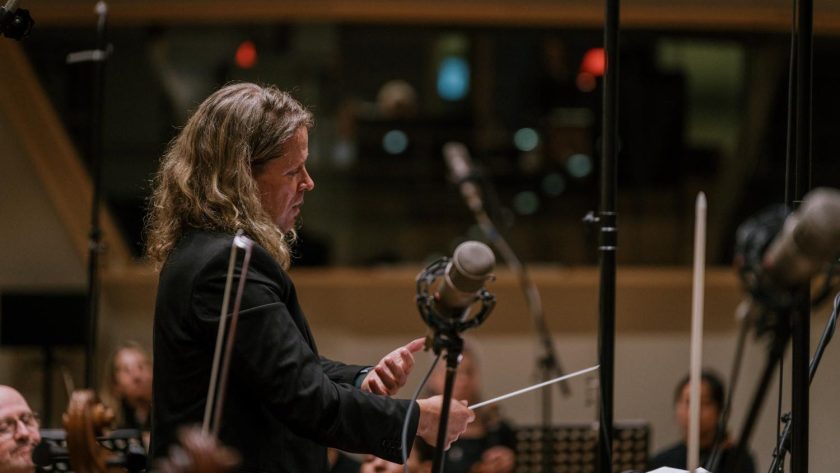
Who or what are the most significant influences on your musical life and career as a composer?
I would say the music of John Williams, Prokofiev, Puccini, Grieg and Debussy have had the greatest impact. I would also mention Gershwin, early on I was fascinated by how orchestral players smile reflexively when they play his music. Porgy and Bess is a masterpiece, the great American opera.
What have been the greatest challenges of your career so far?
Deciding where to record, finding your team, best practices, all of this has been an ongoing learning experience the last 3 years. Fortunately I have found help along the way, good mentors who have supported me and provided insights and advice. Keeping an open mind regarding your own music and collaborating at every stage of the process is natural and important.
What are the special challenges/pleasures of working on a commissioned piece?
I have yet to apply for a commission! My pieces so far have been from my own initiative and deep love for music.
What are the special challenges/pleasures of working with particular musicians, singers, ensembles or orchestras?
This is an area I adore. I love the idea of recurring collaborations, similar to repertory theatre, where we see the same actors in different plays and contexts. I hope to do the same with musicians I meet along the way! When we recorded Five Scenes for Orchestra at Teldex in Berlin, I became friends with not only the production team, but also many of the musicians, and we have remained in touch. For me this is thrilling, as they are from among the best orchestras in the world. Also very down to earth, musical and generous in their performances. I recently finished recording my latest concert piece, Romanza, in Budapest and became friends with the pianist, Marouan during rehearsals. When I turn to chamber music or solo work, I immediately think of specific players I have worked with before. Making music can be a bit of a family or community thing!
Of which works are you most proud?
I am very happy with my new piece, Romanza, which I feel has a more delicate and romantic style. For me limiting the forces to a large string orchestra, percussion section and piano soloist, gave me an opportunity to explore those colors and more directly express a lyrical and accessible style. Kind of a blend of Mahler 5 Adagietto with Puccini, Debussy and Gershwin.
But I do believe Five Scenes for Orchestra is overall the work of which I am most proud.
How would you characterise your compositional language?
Neo-romantic and Impressionist.
How do you work?
As a pianist I tend to improvise at the piano, I use music memos app on my phone and record these improvisations. Often I will find harmonic, melodic or rhythmic sequences or ideas and start from there freshly at the score paper. I use Dorico Pro for notation software.
As a musician, what is your definition of success?
To always make music that you love, that if you were in the audience you would be happy to receive, and hopefully that is direct and speaks to what is most personal or intimate, familiar, to what you may need. I think music has a real power to heal and to allow us to name in our hearts things we do not want to forget, that somehow we need to remember.
What advice would you give to young/aspiring composers?
Keep learning! Attend workshops, seek out mentors and good teachers. Music is a lifelong adventure of learning and growing. And start making music and do it regularly. Doing is a great teacher!
What do you feel needs to be done to grow classical music’s audiences?
I think the growth of films in concert the last 15 years or so has really helped a lot. We need to keep encouraging creative programming of audio-visual experiences that can draw in new audiences. The more influencers such as Gustavo Dudamel, Antonio Pappano or Kirill Petrenko and other charismatic classical stars can reinvigorate our cultural discussions of why classical music is relevant, a growing living thing with inspired programming.
Focusing on the orchestra, the voice of the orchestra, the players themselves, we can encourage a romance between audiences and the orchestra itself. Art institutions can profile and bring the lives of musicians to their audiences and bridge any sense of distance, and audiences can come to see their favorite players. The more we feel we know our orchestras, the greater engagement. Like when we follow a favoirte sports team or our favorite stars, can only help.
When we see art institutions really trying to infuse their programming with their imagination and care, people can sense this and flock to that energy full of curiosity.
What’s the one thing in the music industry we’re not talking about but you think we should be?
I think we should be talking more about the role of music in our lives, why classical music is relevant and essential, and how we can do more to bring music to young people.
What next – where would you like to be in 10 years?
This summer I am composing some chamber music and piano solo to record this fall as companion pieces to go with Romanza for my next album, which I am aiming to release at Valentine’s Day 2026. In 10 years I hope to have good health and be making music.
What is your idea of perfect happiness?
Doing what I love, spending time with my cat Lua, going for a hike in nature, exploring a city, conducting an orchestra and hearing my music for the first time by a group of brilliant musicians, what a profound joy.
What is your most treasured possession?
Well, I don’t think I have a most treasured possession. My most treasured anything is my cat, Lua, which means “moon” in Portuguese. I adopted Lua after my beloved cat Heidi, who was my mother’s cat, passed suddenly in September 2023. I met Lua at the local national park, Monte Brasil. For many weeks I would bring him food on my hikes there, and we would say hello most days. So after many weeks, one day he crawled into my shirt tied around my waist, and I could tell it was meant to be. I decided to bring him home.
What do you enjoy doing most?
Writing music, conducting
What is your present state of mind?
Good! Focused this week on the release of Five Scenes for Orchestra. This is my orchestral album debut. But also getting to work on the companion pieces for Romanza, I want them to feel “part of the family” with it, as if related melodically or texturally, as if the story continues. I’m excited!
Five Scenes for Orchestra is released on 11 August
Discover more from MEET THE ARTIST
Subscribe to get the latest posts sent to your email.
 MEET THE ARTIST