Who or what inspired you to pursue a career in music and who or what have been the most important influences on your musical life and career?
I always loved to sing, right from being a small child – though as I was growing up I didn’t imagine that it could be a career. I’ve been very lucky to have had some fantastic teachers at school and University, as well as colleagues throughout my career who have encouraged and supported me. But it’s the joy of singing and my love of music that continues to motivate me to perform.
What have been the greatest challenges of your career so far?
I struggled with audition nerves early in my career, which presented a real challenge. I now have a one-year-old daughter, and singing through the pregnancy and managing my return to work was also a challenge – but a lovely one!
Which performances/recordings are you most proud of?
I’m most proud of a performance I gave last year of Mozart’s Exsultate Jubilate with Sir John Rutter and the Oxford Philharmonic Orchestra in Bath Abbey. It was the hottest day of the year and I was 37 weeks pregnant and exhausted. I had a fantastic time even though on paper it should have been really hard work! Since having our daughter it’s been very liberating to have had to let go of worrying about being on top physical form and having had enough sleep before a big performance. I can now trust that my technique and preparation does the heavy lifting for me, and this takes away a lot of the stress of performing.
Which particular works/composers do you think you perform best?
I love singing Mozart and Haydn – in particular Mozart’s Great Mass in C minor and Haydn’s Creation.
How do you make your repertoire choices from season to season?
The repertoire I perform is usually determined by the invitations I receive. I love this about my job, as it means I’m introduced to music I wouldn’t otherwise encounter. However, when I am involved in programming I really enjoy it. I try to include composers from a diverse range of backgrounds, and to create connections with current events or universal themes that I think will speak to the audience.
Do you have a favourite concert venue to perform in and why?
I don’t think I can name just one! The variety of venues is one of the fun things about this career, from churches and cathedrals to concert halls, museums, country houses, courtyards and even boats.
What do you do off stage that provides inspiration on stage?
I go to a Pilates class every week. I find that connecting movement to breath and the focus on my awareness of my body is very helpful on stage.
What is your most memorable concert experience?
I recently took part in a performance of Purcell’s Dido and Aeneas, in which Helen Charlston as Dido gave such a convincing performance at the moment of Dido’s death that the backstage staff radioed for first aid.
As a musician, what is your definition of success?
A diary full of projects that I’m excited about – which for me means the opportunity to connect with audiences, perform great music, and keep pushing myself to learn and develop.
What do you feel needs to be done to grow classical music’s audiences?
High quality music education in schools. Access to classical music for people from all backgrounds. Funding for professional performance as well as education. And greater visibility and celebration of classical music on mainstream media.
What’s the one thing in the music industry we’re not talking about which you think we should be?
I recently gave evidence to the government’s Women and Equalities Committee as part of their enquiry into misogyny in music. This process made me realise that there are all sorts of things we need to talk about, but to pick one – why are there so few women in leadership positions in classical music, and how can we change this?
What advice would you give to young or aspiring musicians?
I’d advise them to diversify their musical skills. Conduct, teach, compose, or even learn another instrument. It’s incredibly empowering to have all-round musicianship, and if it creates another income stream then so much the better. I’d also advise them to find something completely different to do as a hobby or side gig. Classical music is a small and often strange world so it can be very helpful to have a change of perspective.
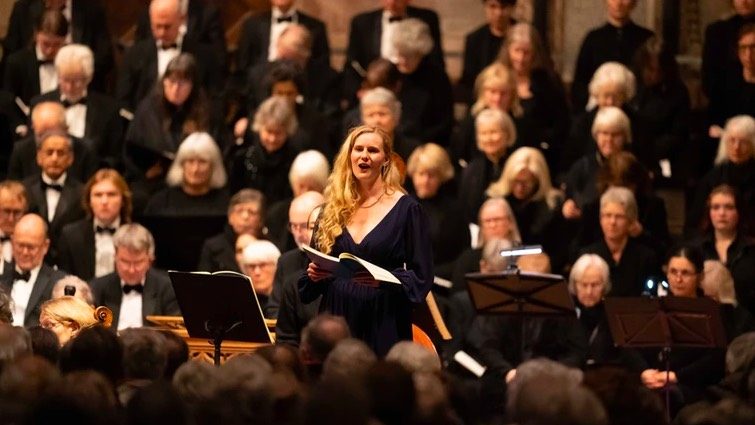
Lucy Cox appears on ‘The Spirit of Love’, a new recording of chamber music and songs by Ailsa Dixon, released on 22 August on the Resonus Classics label
(Artist photo: Michael Whitefoot)
Discover more from MEET THE ARTIST
Subscribe to get the latest posts sent to your email.
 MEET THE ARTIST