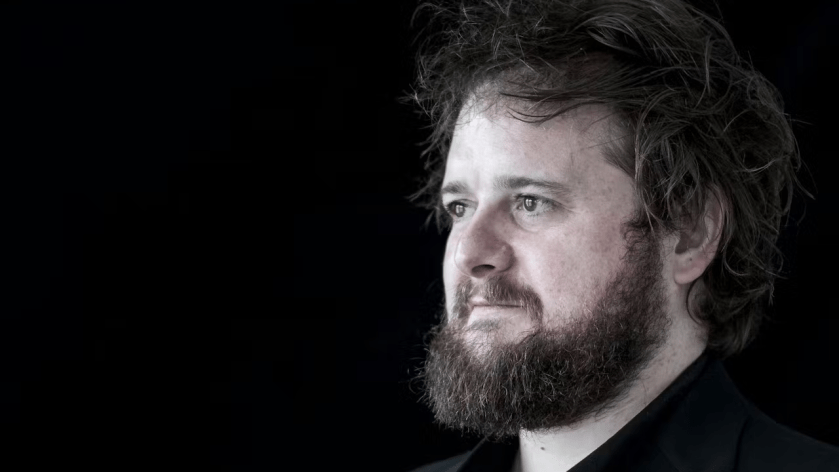
Who or what inspired you to pursue a career in music, and who or what have been the most important influences on your musical life and career?
My family moved to Cambridgeshire when I was eight, and because two of my football-playing friends were in a boys’ choir, I went along with them on the nights they couldn’t play footy. It was run by a wonderfully mad Swede called Nicholas Bergström-Allen, who gave each kid a weekly singing lesson (for free) and made us all take Grade 5 singing and music theory exams.
I was exposed to all kinds of music – opera, choral, folk, pop – and we did at least one concert a month. Forty of us in matching jumpers, and all from memory (there were two junior choirs below us as well – it’s unthinkable now, sadly). It was also when I first sang solos of Britten’s music in his A Ceremony of Carols. I had no idea then how important and formative it was.
What have been the greatest challenges of your career so far?
Musically, there hasn’t been anything as all-consuming as Brett Dean’s Hamlet. It’s a staggering piece of music drama, and it’s bloody hard. More personally/practically, I struggle with the lifestyle of a self-employed musician – I’m not a great traveller, and would generally rather be at home than abroad for nine months of the year.
There was also a difficult period when I left music college and singing became my job – there’s a different kind of pressure and mindset needed when a small, fragile part of the body is paying the rent (for the avoidance of doubt, I’m talking about my vocal cords here…).
Which performances/recordings are you most proud of?
As I said, Hamlet was a very special event, with a wonderful group of people to make it happen (on/off/below-stage), and to have been able to perform it around the world has been a privilege.
More recently, Deborah Warner’s production of Peter Grimes has been everything that I could’ve hoped for, again with wonderful colleagues across the board. And I’m fresh off the back of performances of Mark-Anthony Turnage’s spectacular new opera Festen. The stars really aligned for that one, and I think it’s one of the most important and exciting operas of the last 50 years.
Which particular works/composers do you think you perform best?
Britten’s music just makes sense to me.
– And anyone who doesn’t write semiquavers.
What do you do off-stage that provides inspiration on-stage?
I don’t know if it provides inspiration, but I do spend a lot of time with the music trying to work out how the character is feeling and how he might respond to the music at any given moment. Not just in opera, but in concert and song performances too. I hope it means I have more options when I’m in the moment on stage. I don’t know if that really answers the question.
How do you make your repertoire choices from season to season?
It’s a tricky combination of ignoring my long- suffering agent’s emails and finding things that excite me. I spent a long-ish time waiting for the right moment to sing Grimes, and there are other roles that I’ve been offered, but which I don’t think are right for me; whether they will be in the future I have no idea. The problem with that approach is that opera schedules are planned a long time in advance – I might be ready to give my Brünnhilde next year, but I’ll have to wait until 2035…
It’s also important to me to have a mix of opera, orchestral and chamber work throughout the season. We’re so lucky as singers to be able to move between these worlds, and I think the best performers take elements of all three with them on stage no matter what they’re performing.
There are also people who I love to work with, so if they ask it’s generally a ‘yes’!
Do you have a favourite concert venue to perform in and why?
That’s like asking who’s my favourite niece! Snape for its soul, Wigmore Hall for song, Covent Garden for opera, the Philharmonie in Paris for the backstage – they actually have windows and more than two dressing rooms.
What do you feel needs to be done to grow classical music’s audiences?
Give kids the chance to hear and make music of all sorts at school. There are so many professional organisations in this country working tirelessly to bring music education to kids, but unless music-making – and exposure to top-level performance – is normalised in the classroom, it feels like a losing battle.
What is your most memorable concert experience?
Performing the round Ah! Poor bird in a Greek Orthodox Church outside Nablus with some locals and some close friends.
As a musician, what is your definition of success?
Making it on stage and performing the music as honestly as possible. Not being too annoyed with myself afterwards.
What advice would you give to young/ aspiring musicians?
Perform as much as you can: whether it be at your school, the local pub, the village hall, busking outside Argos. You learn so much from these different circumstances, and your interaction with the audience (if there is one!) will help you develop different ways of approaching the music you’re making.
What’s the one thing in the music industry we’re not talking about which you think we should be?
I think the most important subjects probably are being addressed at the moment. Inequality and a lack of representation is being tackled, but of course there’s a lot more to be done. And I hope a change in government might mean that music education in schools is taken more seriously (though I’m sceptical it will) – without that, there won’t be a classical music industry to talk about at all.
On a lighter note, the sooner we can all agree that wearing white tie for concerts is utterly ludicrous, the better.
What is your most treasured possession?
A Liverpool FC shirt, signed by Stevie Gerrard.
This interview first appeared in the brochure for the 2025 Aldeburgh Festival
Discover more from MEET THE ARTIST
Subscribe to get the latest posts sent to your email.
 MEET THE ARTIST