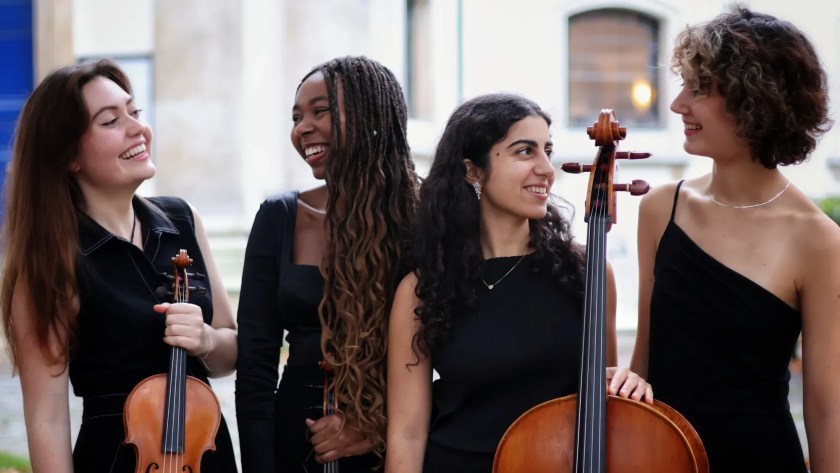
Woolf Quartet are: violinists Zosia Herlihy-O’Brien and Emily Harrison, violist Beatrice Slocumbe and cellist Hoda Jahanpour
Who or what inspired you to pursue a career in music?
Zosia: My parents aren’t professional musicians, but for as long as I can remember, there’s always been music in our home! When she was pregnant with me, my Mum would listen to all different genres of music pretty much nonstop, and bizarrely I actually remember much of it. I saw someone playing violin on a kids’ TV show when I was about three years old, and begged my Mum for an instrument of my own. At the time in Auckland (New Zealand) no one would teach such a little child, and so it was just after my fourth birthday that a young Suzuki teacher agreed to take me on – thus the journey commenced!
Hoda: My mum tells me that from when I was little, I kept asking to learn to play an instrument as I saw my older sisters play violin and piano. After trying the violin, recorder and piano, I finally found the cello when I was six and fell in love with its deep sound. I haven’t stopped since!
What motivated me to pursue a career in music was the realisation that the arts can be a powerful tool for communicating messages in a way that touches the heart. We live at a time where we have more access to information than ever before, but I think we are still learning how to process it in constructive ways. I want to use music to help people understand and feel connected to themselves and to each other.
Emily: I began my musical journey with Music Masters charity. I had such frequent, exhilarating opportunities to perform, meaning I gained a very early confidence on stage. This was also because of the chance we had to play with Music Masters’ amazing artists – professional musicians who act as inspirational role models. Playing with the acclaimed violinist Benjamin Beilman in my final year at primary was unforgettable. I remember listening to him in rehearsals and being astonished that I was actually going to be playing with him! He wasn’t just at a distance on the stage or on the radio, he was a real inspiration right there in front of me, playing with me. ‘I want to be able to do that’ was my thought each time I heard Benjamin and other Music Masters Artists, like Jennifer Pike or Midori!
Beatrice: Music has always been something that has connected with me and given me a voice to express myself when I’ve found it difficult to do so in other formats and I think from a young age I knew that I wanted to pursue this as a career. My mum has always encouraged me to go for a career that makes me happy and so took me to music lessons from age 4, researched an industry that we didn’t have much knowledge of and has supported my musical journey as she knew this was something I wanted to do. I feel so much joy when I am creating and I hope to continue learning, playing and sharing music for many years to come.
Who or what have been the most important influences on your professional life?
Zosia: I’ve always loved performing and connecting with audiences through my music, so for me it wasn’t a particularly large decision to study my three great loves – violin, organ, and conducting – after completing high-school. I think it was probably my collaborative experiences, especially in my teen years, that developed my passion to pursue a career in music long-term, as I began to realise I had something to say, musically, and that there were people to listen. My teachers have always been immensely inspiring to me, and importantly they challenged me when I really needed it! My family have always been my greatest supporters and enabled my younger brother (a cellist!) to pursue our dreams.
Hoda: My first cello teacher Jozef Luptak really influenced how I see my role in society as a musician. He is a soloist, festival director and has always used his platform for activism. Maybe it’s because he is part of the generation that protested to end socialism in Czechoslovakia in 1989, and many young people used the arts (especially theatre) to protest peacefully. As a result, it felt part of my calling as a musician and member of the artistic community to use my skills and platform to say something meaningful. Growing up, he encouraged me to play in events advocating social justice such as ones that celebrated whistleblowers and advocated for open borders. Today, I am curious to discover more ways to use our art and platform to spark curiosity and advocate for positive change.
Beatrice: I will forever be grateful to my family and family friends who at a very young age introduced me to a plethora of music; whether it be exciting, contemplative; enriched in significant historic or political messaging; past, present or international. To this day I love to alternate between the styles of music that I listen to with favourites being soul, r&b, soft rock, bossanova and soca music. Specifically, soca music has been instilled within me from before I can remember. Having grown up in my mum’s Carnival Mas band that attended Notting Hill Carnival and others including Hackney, Luton and Isle of Wight, simply hearing a soca tune brings me instant joy and feelings of belonging. Music has always felt like home to me as it is not only what I have chosen to pursue as a career but it is full of memories, lessons and instant connection to the ones that I love most.
Emily: Growing up, my dad has always made playlists for whenever we go on holiday as a family. They are an eclectic mix of reggae, pop, rock, classical, folk, raï, and everything in between. I think early experiences of listening to all of these different sound worlds has led me to want to mirror this eclecticism within what I create as a musician.
Do you have a favourite concert venue to perform in and why?
It feels predictable, but Wigmore Hall. It is such a beautiful acoustic for strings and quite overwhelming to play there, after watching so many amazing concerts and feeling such awe for the incredible talents that performed on that iconic stage. We are so excited, as the Royal Academy of Music/ Wigmore Hall Learning and Participation Fellows, for our upcoming lunchtime concert at Wigmore Hall on 2nd May!
What is your most memorable concert experience?
We feel so lucky to already have so many memorable concert experiences together in our early career but one that really stands out was our ‘For Crying Out Loud’ concert at Wigmore Hall in December last year. We had the pleasure of working alongside the wonderful Rosie Bergonzi to perform to an audience of parents and their babies, a new experience for our quartet and one we all enjoyed. The unique format gave us opportunity to be imaginative with storytelling, different staging and repertoire, shaping the narrative of a voyage on the sea with some Danish String Quartet, Haydn, Beethoven, Price and pieces by our cellist Hoda and violist Beatrice.
What have been the greatest challenges of your career so far?
One aspect that we understand will always be present (which most ensembles experience) is balancing individual work commitments/ schedules with quartet rehearsal time. As we are all in the early stages of our professional careers we want to navigate this the best that we can so that we can prioritize the quartet amongst adapting to working in the industry.
Which performances are you most proud of?
We first performed together as the Woolf Quartet back in early November 2024, performing a programme of Debussy, Caroline Shaw and ‘Remembering’, composed by our cellist Hoda Jahanpour. This concert will always be a significant part of our journey as a quartet. We knew this was quite an ambitious programme for a new quartet while also preparing for an audition on the same day as this concert, but we remained dedicated to achieving the best that we could. It was exhilarating to complete the performance, have friends and family there to support us and have a successful audition too.
Another highlight was Beatrice’s showcase ‘Senses’ held at Map Studio Cafe in late November last year. This concert was inspired by the artwork of Aubrey Williams combining styles of classical, jazz, r&b, soul and poetry, centred on merging community, artistic expression and connection between audience and performer. The quartet opened the evening with the fiery last movement of Shostakovich’s 7th String Quartet, before playing Beatrice’s piece ‘Assemblance’ and improvising underneath the poetry of writer Mya Onwugbonu.
Which particular works/composers do you think you perform best?
As a newer quartet we are still navigating our quartet sound and adopting the amazing insights to good ensemble from our coaches which means our list of repertoire is still growing. Being an ensemble of four women, each passionate about amalgamating our eclectic musical tastes with the canonised repertoire we know and love, the majority of our concerts feature music by living women composers or even works we have written ourselves. We very much look forward to working with young composers, exploring vast ranges of styles and periods and deepening our knowledge of canonised repertoire.
How do you make your repertoire choices from season to season?
As avid listeners of chamber music, we try to incorporate our personal favourites when discussing programmes – performing works you love makes the audience’s experience more enjoyable and is often something that people comment on after our concerts – programming music we love enhances how we communicate with one another and the audience! We also have to combine this with choosing our repertoire in relation to competitions, auditions, scheduled concerts and the length of time we have for a concert.
Another aspect that has become familiar with our programming each season is including pieces we have written ourselves or performing lesser-known music that have captivated us in our search for new repertoire to play.
What do you do off stage that provides inspiration on stage?
Outside of the rehearsal room we value checking in with each other and just chatting as friends about life! Getting to know each other in this deeper way develops the connection we have on stage. Audiences often comment on our physical interactions, specifically our strong use of eye contact and overall just looking like we are having a great time together. We feel that these moments really settle us and remind us that we are in this together!
As a quartet we aim to use our individual pursuits in exploring a variety of genres, collaboration, improvisation and other instruments to enrich the music we make together.
As musicians, what is your definition of success?
Success varies! Whether it’s accomplishing the goals you once dreamed of, playing in a cool venue or completing an intense teaching day. It can be hard to truly praise yourself for your accomplishments, especially with a constant aim to learn more and improve in personal practice or performance. But it’s important to congratulate yourself not just for the bigger goals but the smaller ones too.
What do you feel needs to be done to grow classical music’s audiences?
In the professional classical music world, we think further change needs to happen to make music more accessible in order to grow its audience. Most concert venues and orchestras now have a strand of work promoting accessibility but, somehow, classical music still feels ‘elitist’ to many people. We think the more that music education becomes accessible for children, the more long-term change we will see, as new generations of musicians and audiences emerge.
Through workshops with young people we have each seen that sharing classical repertoire through engaging activities, creating music together or selecting pieces with different textures can bring instant connection to something children may not listen to themselves.
What advice would you give to young or aspiring musicians?
It’s very easy to be hard on yourself when it comes to navigating your path as a musician and sometimes it takes longer to reach specific goals that we have for ourselves and that’s ok. Accept where you are at with your musical journey and be patient with yourself.
What’s next? Where would you like to be in 10 years?
Recently we have become members of Nederlandse StrijkKwartet Academie, Chamber Studios and Dimore del Quartetto and are thrilled for these opportunities to not only learn from leading chamber musicians pivotal in the success of the ‘string quartet’ but build a network of connections outside of London. We look forward to taking part in prestigious competitions including ROSL, Premio Paolo Borciani and in the longer term, Osaka International Chamber Music Competition. At the quartet’s core is a passion for improvisation, cross-genre collaboration, new compositions and performing canonical repertoire we love. We hope this will culminate in the release of our own albums and the creation of new projects where we can continue to combine these in the concert hall. There is already some new music from the quartet in the works, so definitely look out for that in the next year!
Woolf Quartet perform music by Debussy, Anna Meredith, Shostakovich and the world premiere of a new work by Zosia Herlihy O’Brien at London’s Wigmore Hall on Saturday 2 May. Find out more
Discover more from MEET THE ARTIST
Subscribe to get the latest posts sent to your email.

