Who or what inspired you to pursue a career in music and who or what have been the most important influences on your musical life and career?
That’s a tricky opening question. In my experience inspiration and influence has been (and is) cumulative; there are too many people I could name, and if I tried I would inevitably, and regrettably, accidentally miss someone out.
I have been incredibly fortunate to have had dedicated and encouraging instrumental teachers from the very beginning, but, no less importantly, I have benefited beyond measure from conversations with others who have communicated their enthusiasms, and in different ways inspired my own musical curiosity.
What have been the greatest challenges of your career so far?
I think the challenge that is the most persistent for me is “simply” juggling my time. I have a full-time job with the BBC Symphony Orchestra and have to work around that schedule as best I can when planning solo and chamber concerts.
But it’s not just about finding dates… I love exploring, searching for, and researching repertoire which deserves to be better known, and when so many concert societies and clubs are (rightly) anxious to sell tickets to keep their accounts viable, a lot of time needs to be spent working out how to persuade them to take a risk on the unknown. But that challenge is definitely part of the fun!!
Which performances/recordings are you most proud of?
If you insisted on making me choose then I would say my first disc of music for two solo violas (with Matthias Wiesner), which was also my first solo recording. We had found something that not many people knew about, it was music that took people by surprise and could hold its own next to the mainstream ensembles and repertoire, audiences were asking how they could follow it up, and there wasn’t an easy answer. Meridian Records understood what we were about and took a chance on us, being incredibly generous and supportive along the way. It was definitely a turning point.
But the truth is I can’t really choose… all of the various solo and chamber projects I have done since then have been immensely fulfilling, they all shed a light on either pieces, genres, composers or ensembles that deserve to be better known. I think of these recordings as starting points, not as the last word (and this is true of the performances too). They really just capture a single moment in time. We often find that when we play some of this repertoire now, we see it differently from how we saw it then, but we like to think that the pieces themselves bring pleasure, inspire interest, or somehow pass on a musical parcel to the next listener or performer.
Which particular works/composers do you think you perform best?
I don’t think there is any particular work or composer. There’s a reason why mainstream compositions are mainstream and I enjoy learning and performing them, but I’ve always enjoyed the great variety of music I’ve played, from the modern back to the Renaissance. And this sort of variety is one of the many reasons (from an orchestral perspective) why I love working with the BBC Symphony Orchestra. Interpretation is inevitably subjective, but my priority as a performer is to make sense of what I am playing, and to communicate its expressiveness to an audience. This is particularly satisfying with works which, for whatever reason, don’t have an extensive performance history or tradition. I have worked a lot with contemporary composers, and it is always stimulating to hear their reaction to our reactions to their music. This interaction, collaboration, is one of the real pleasures of music for a performer.
How do you make your repertoire choices from season to season?
This is less a question of season to season and more on a rolling basis. I’m always planning (or at least thinking) several projects ahead of where I am, seeing what has mileage, what works well together. Sometimes these plans and thoughts materialise, sometimes you realise there’s a reason why something isn’t better known and it falls by the wayside. Each time we discover a piece or composer that’s new to us a lot of reading and exploring takes place which inevitably leads to more discoveries. We then choose how to balance these with more familiar names and works. I don’t really choose repertoire as much as undertake a never-ending search for new material.
One of my longest-standing projects has been repertoire for two violas, and this has involved unearthing works which may have been unpublished, or rarely performed; or commissioning new pieces from contemporary composers. Mainstream or canonical repertoire is clearly popular and a joy to play – who doesn’t love Bach’s Brandenburg Concerto No.6? But there is a lot of music at various levels beneath the surface of the mainstream which is not familiar now, and which deserves to be better known.
Do you have a favourite concert venue to perform in and why?
The first time I performed at London’s Royal Albert Hall…breathtaking. Performing in Berlin Philharmonie, Suntory Hall Tokyo, or Auditorio de Zaragoza…unforgettable. There is something magical about performing in these big venues, but my favourite venues are actually the smaller, more intimate ones. The chance to really feel close to the audience, to be able to break down the barriers, to be able to really interact with them on a personal level, particularly if there’s chance to talk to them afterwards. The term may have developed in the 18th century, but these small venues, often people opening up their homes, literal Hausmusik, is often the most genuine and enjoyable sort of venue.
It’s been a particular pleasure working on my latest recording project with Shirley Turner, Lynn Arnold, and Meridian Records; it’s called A Musical Soirée, and it celebrates exactly this sort of venue and repertoire.
What do you do off stage that provides inspiration on stage?
I’ve got two answers to this. Because a lot of what I perform is outside of the mainstream I spend a lot of time finding out what I can about the composers and the context of the pieces. At one level or another, all music is a form of personal expression, and I find it both inspiring and stimulating to bring this kind of background to a performance. But also, on a purely practical level, the best way to help myself on stage is to have peace off stage – I’ll be the person in the corner doing gentle research and/or quietly building my energy for the coming performance.
What is your most memorable concert experience?
I can think of lots of memorable concerts, and they’re not all memorable for musical reasons (!!), but the one I’m going to tell you about has to be a concert I did at university. It featured Bridge’s Lament for two violas, and Beethoven’s Storm Quintet, Op.29. It happened at a period in my life when I wasn’t sure what direction to go in. Did I really want to do the music route, performance or otherwise? Was I good enough? Did I enjoy it enough? What can I say, this concert just got me so excited, I can still feel the buzz now when I think about it, and that was the moment I knew I had to give the music profession and performance a go. I just had to know if it was something I was capable of or I would always be wondering. Those feelings can’t be ignored.
As a musician, what is your definition of success?
In one sense success can be something going well that has been really difficult, either technically, ensemble wise, or something else similar. But what success really comes down to for me as a musician is the audience impact and reaction in that moment. Music has the power to transport people, to say things that words can’t, to inspire, to comfort, to encourage. It may not happen to a whole room or hall, maybe it’s just one person in a particular concert, but there’s a definite sense of success and accomplishment when I learn that someone has been moved emotionally, or transported back to a particular moment in time or memory, or been given a spark of interest, or realised how much more can be gained from seeing and hearing music live.
What do you feel needs to be done to grow classical music’s audiences?
There are three obvious, bordering on clichéd buzz words, but they’re buzz words for a reason. Education, exposure, and accessibility. It must start with the very young. My violin duo partner, Shirley Turner, and I do a lot of outreach work, both with the BBCSO and outside of it, and we constantly find that children of primary age are naturally, instinctively, drawn to the pleasures of music, even if it is just repeating a rhythm. The more that can be done to increase this exposure and show how to actively listen, the better.
What’s the one thing in the music industry we’re not talking about which you think we should be?
It’s curious how some countries really value the arts and respect the artists, while in others it seems to be viewed more like a hobby which can be cut with supposedly no repercussions. There are so many studies on the benefits of music (and I don’t just mean classical) and on how it can help improve other areas and subjects too. Perhaps, going back to the education topic and classical audiences, syllabuses can try to break down divisions between classical and more popular, and focus on different ways music, all music, is a natural, powerful way of bringing individuals and communities together. There’s also concern around shows which are replacing live musicians with recordings, but these are all things that are already being talked about and fought.
What advice would you give to young or aspiring musicians?
There are so many different avenues that can be followed in music. If music gets you excited, if you love what it’s capable of, then follow it. It can be very difficult, there’s no escaping that, but the rewards far outweigh the challenges. See people perform live, listen to music, talk to teachers and people who can guide you and help expand your learning. And if a specific instrument and performance is the avenue you really wish to pursue then nothing replaces regular practice.
What is your present state of mind?
I can’t deny that there’s a hint of tiredness – it was a short night after travelling back from a concert and am just getting ready for another one – but basically my mind is whirring. I’ve just come across an interesting composer, new to me, and it appears they’ve written some viola music. (No, I’m not going to tell you who it is here in case it goes nowhere). I’ve sorted out some programmes and am ready to email them off when I get home. I’ve ruled out several ways of arguing the case for what makes a group of pieces work well together and am starting on the next attempt (Thomas Edison saying something like “I have not failed, I’ve just worked out 1,000 ways that won’t work” springs to mind), and I’m clutching a lovely, much needed cup of coffee.
A Musical Soirée is released on 27 April on the Meridian label
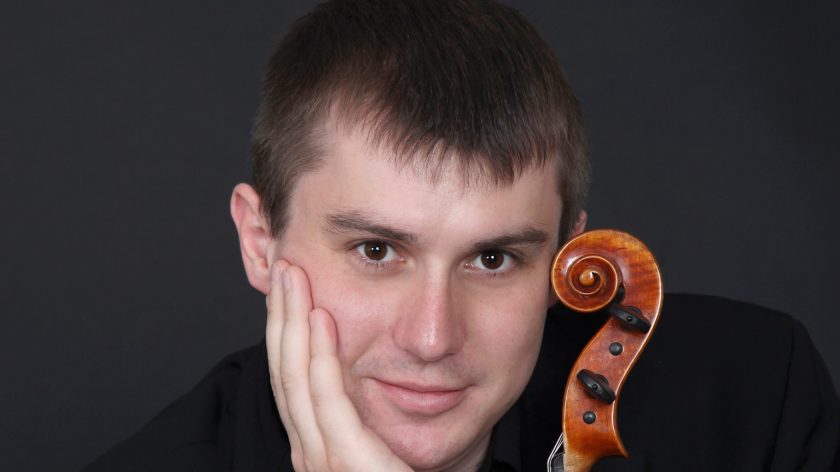
(Artist image: Melanie Strover)
Discover more from MEET THE ARTIST
Subscribe to get the latest posts sent to your email.
 MEET THE ARTIST